
Catalogue Search | MBRL


Are you sure you want to remove the book from the shelf?

{{itemTitle}}
66
result(s) for
"Women in popular culture -- Japan"
Sort by:

The monstrous-feminine in contemporary Japanese popular culture
\"This book explores the monstrous-feminine in Japanese popular culture, produced from the late years of the 1980s through to the new millennium. Raechel Dumas examines the role of female monsters in selected works of fiction, manga, film, and video games, offering a trans-genre, trans-media analysis of this enduring trope. The book focuses on several iterations of the monstrous-feminine in contemporary Japan: the self-replicating shهojo in horror, monstrous mothers in science fiction, female ghosts and suburban hauntings in cinema, female monsters and public violence in survival horror games, and the rebellious female body in mytho-fiction. Situating the titles examined here amid discourses of crisis that have materialized in contemporary Japan, Dumas illuminates the ambivalent pleasure of the monstrous-feminine as a trope that both articulates anxieties centered on shifting configurations of subjectivity and nationhood, and elaborates novel possibilities for identity negotiation and social formation in a period marked by dramatic change.\"-- Provided by publisher.
Book

Beautiful fighting girl
From Cutie Honey and Sailor Moon to Nausica? of the Valley of the Wind, the worlds of Japanese anime and manga teem with prepubescent girls toting deadly weapons. Sometimes overtly sexual, always intensely cute, the beautiful fighting girl has been both hailed as a feminist icon and condemned as a symptom of the objectification of young women in Japanese society. In Beautiful Fighting Girl, Sait? Tamaki offers a far more sophisticated and convincing interpretation of this alluring and capable figure. For Sait?, the beautiful fighting girl is a complex sexual fantasy that paradoxically lends reality to the fictional spaces she inhabits. As an object of desire for male otaku (obsessive fans of anime and manga), she saturates these worlds with meaning even as her fictional status demands her ceaseless proliferation and reproduction. Rejecting simplistic moralizing, Sait? understands the otaku's ability to eroticize and even fall in love with the beautiful fighting girl not as a sign of immaturity or maladaptation but as a result of a heightened sensitivity to the multiple layers of mediation and fictional context that constitute life in our hypermediated worldùa logical outcome of the media they consume. Featuring extensive interviews with Japanese and American otaku, a comprehensive genealogy of the beautiful fighting girl, and an analysis of the American outsider artist Henry Darger, whose baroque imagination Sait? sees as an important antecedent of otaku culture, Beautiful Fighting Girl was hugely influential when first published in Japan, and it remains a key text in the study of manga, anime, and otaku culture. Now available in English for the first time, this book will spark new debates about the role played by desire in the production and consumption of popular culture.
eBook

Poison Woman
Based on the lives and crimes of no less than twenty real women, dokufu (poison women) narratives emerged as a powerful presence in Japan during the 1870s. In Poison Woman, Christine L. Marran investigates this powerful icon, its shifting meanings, and its influence on defining women's sexuality and place in Japan.
eBook

Beauty Up
This engaging introduction to Japan's burgeoning beauty culture investigates a wide range of phenomenon—aesthetic salons, dieting products, male beauty activities, and beauty language—to find out why Japanese women and men are paying so much attention to their bodies. Laura Miller uses social science and popular culture sources to connect breast enhancements, eyelid surgery, body hair removal, nipple bleaching, and other beauty work to larger issues of gender ideology, the culturally-constructed nature of beauty ideals, and the globalization of beauty technologies and standards. Her sophisticated treatment of this timely topic suggests that new body aesthetics are not forms of \"deracializiation\" but rather innovative experimentation with identity management. While recognizing that these beauty activities are potentially a form of resistance, Miller also considers the commodification of beauty, exploring how new ideals and technologies are tying consumers even more firmly to an ever-expanding beauty industry. By considering beauty in a Japanese context, Miller challenges widespread assumptions about the universality and naturalness of beauty standards.
eBook
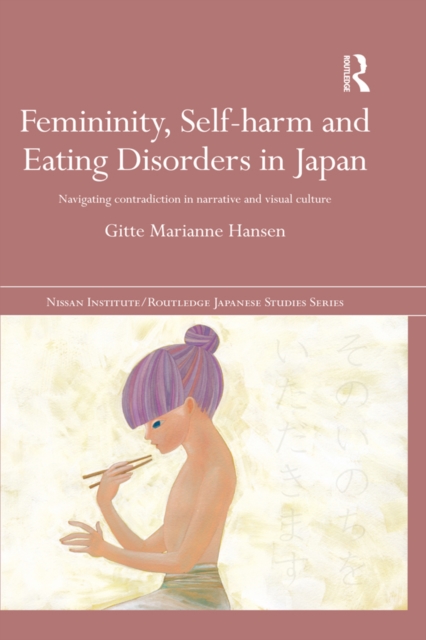
Femininity, Self-harm and Eating Disorders in Japan
From the 1980s onwards, the incidence of eating disorders and self-harm has increased among Japanese women, who report receiving mixed messages about how to be women. Mirroring this, women's self-directed violence has increasingly been thematised in diverse Japanese narrative and visual culture.
This book examines the relationship between normative femininity and women's self-directed violence in contemporary Japanese culture. To theoretically define the complexities that constitute normativity, the book develops the concept of 'contradictive femininity' and shows how in Japanese culture, women's paradoxical roles are thematised through three character construction techniques, broadly derived from the doppelgänger motif. It then demonstrates how eating disorders and self-harm are included in normative femininity and suggests that such self-directed violence can be interpreted as coping strategies to overcome feelings of fragmentation related to contradictive femininity. Looking at novels, artwork, manga, anime, TV dramas and news stories, the book analyses both globally well known Japanese culture such as Murakami Haruki's literary works and Miyazaki Hayao's animation, as well as culture unavailable to non-Japanese readers. The aim of juxtaposing such diverse narrative and visual culture is to map common storylines and thematisation techniques about normative femininity, self-harm and eating disorders. Furthermore, it shows how women's private struggles with their own bodies have become public discourse available for consumption as entertainment and lifestyle products.
Highly interdisciplinary, it will be of huge interest to students and scholars of Japanese studies, Japanese culture and society and gender and women's studies, as well as to academics and consumers of Japanese literature, manga and animation.
eBook

Uneasy warriors
Following World War II, Japan's postwar constitution forbade the country to wage war or create an army. However, with the emergence of the cold war in the 1950s, Japan was urged to establish the Self-Defense Forces as a way to bolster Western defenses against the tide of Asian communism. Although the SDF's role is supposedly limited to self-defense, Japan's armed forces are equipped with advanced weapons technology and the world's third-largest military budget. Sabine Frühstück draws on interviews, historical research, and analysis to describe the unusual case of a non-war-making military. As the first scholar permitted to participate in basic SDF training, she offers a firsthand look at an army trained for combat that nevertheless serves nontraditional military needs.
eBook

Boys Love Manga and Beyond
Boys Love Manga and Beyondlooks at a range of literary, artistic and other cultural products that celebrate the beauty of adolescent boys and young men. In Japan, depiction of the \"beautiful boy\" has long been a romantic and sexualized trope for both sexes and commands a high degree of cultural visibility today across a range of genres from pop music to animation.
In recent decades, \"Boys Love\" (or simply BL) has emerged as a mainstream genre in manga, anime, and games for girls and young women. This genre was first developed in Japan in the early 1970s by a group of female artists who went on to establish themselves as major figures in Japan's manga industry. By the late 1970s many amateur women fans were getting involved in the BL phenomenon by creating and self-publishing homoerotic parodies of established male manga characters and popular media figures. The popularity of these fan-made products, sold and circulated at huge conventions, has led to an increase in the number of commercial titles available. Today, a wide range of products produced both by professionals and amateurs are brought together under the general rubric of \"boys love,\" and are rapidly gaining an audience throughout Asia and globally.
This collection provides the first comprehensive overview in English of the BL phenomenon in Japan, its history and various subgenres and introduces translations of some key Japanese scholarship not otherwise available. Some chapters detail the historical and cultural contexts that helped BL emerge as a significant part of girls' culture in Japan. Others offer important case studies of BL production, consumption, and circulation and explain why BL has become a controversial topic in contemporary Japan.
eBook
IN-DEPTH INTERVIEW-BASED STUDY ON THE FEATURES OF KOREAN CULTURE THAT ATTRACT AND REPEL JAPANESE YOUTH
The aim of the study is to analyze the changing attitude of the Japanese youthtowards Korean culture. This study conducted in-depth interviews with 18 menand women in their 20s living in the Tohoku region of Japan to examine aspectsof Korean culture that attracted and repelled them. The analysis results indi-cated that the interview respondents were attracted to the Korean cultural facetsof ‘emotional intimacy,’ ‘practical convenience,’ and ‘fast pace,’ and were put offby the ‘insincere service,’ ‘unease with traffic-related safety,’ and ‘dirty restrooms.’These perceptions were strongly influenced by expectation-related differences:unexpected positive experiences resulted in high levels of satisfaction and nega-tive experiences caused acute disappointment. Thus, interactions with Koreanculture are both appealing and displeasing to Japanese youth. Rather than per-ceiving this contrary response as a problem, the interview respondents indepen-dently accepted it as a characteristic of Korean culture. Future research initiativesshould explore the generalizability of these findings by expanding the span oftheir surveys.
Journal Article


Disasters and gender in Japanese anime films: Makoto Shinkai’s Your Name and Weathering with You
PurposeThis article focuses on the representations of natural hazards, disasters, gender roles and norms in Makoto Shinkai’s disaster-themed anime films Your Name (2016) and Weathering with You (2019).Design/methodology/approachThis article commences with a literature review on disasters, disaster films, gender in disasters and gender in disaster films; then, this article thoroughly investigates the portrayal of disasters and gender in the two films, drawing data from their narratives and plots.FindingsThis article finds that the two films’ depictions of disasters and gender adhere to the traditional patterns observed in Hollywood and Japanese disaster films. The natural hazards and disasters in the two films reflect real-world disasters that occurred in Japan’s recent decades, especially the 3.11 Tohoku earthquake in 2011. Traditional gender figures and prevalent heterosexual expectations in Japanese culture and society deeply influence the two films’ portrayal of gender roles and norms.Originality/valueNumerous academic works explored Hollywood disaster films, their representations of gender roles and norms in disaster themes. However, few focus on recent Japanese anime films such as Your Name and Weathering with You. This article aims to fill this gap.
Journal Article