
Catalogue Search | MBRL


Are you sure you want to remove the book from the shelf?

{{itemTitle}}
15
result(s) for
"Women revolutionaries Fiction."
Sort by:

Blood run
\"Biochemist Emma Caldridge joins Jackson Rand, pharmaceutical CEO, on a humanitarian mission to deliver vaccines to remote villages in Africa. But after narrowly escaping a crew of trained assassins, Emma realizes that there is more to this mission than she anticipated. Rand is keeping secrets from her, information that could cost both of them their lives...not to mention millions more. After its eradication nearly forty years ago, the smallpox virus is once again threatening the world. With no known cure and limited stores of vaccine, the highly contagious, deadly and disfiguring disease has the power to wipe out entire cities. Rand's company was hired to secure the last known vials, but some have gone missing in Africa and a ruthless government now hunts them for use as a biochemical weapon. Emma must locate these vials before the killer plague is unleashed on the innocent, ravaging a world that never expected to see it again. She runs to the border, finding and freeing hostages as she does. But an insurgency is rising around them, blocking their every attempt to escape. Surrounded and with no choice but to head to the desert, Emma must stop the virus and lead her ragtag team to freedom...if the Sahara doesn't kill them first.\"--Back cover.
Book

Haiti Fights Back
Haiti Fights Back: The Life and Legacy of Charlemagne Péralte is the first US scholarly examination of the politician and caco leader (guerrilla fighter) who fought against the US military occupation of Haiti. The occupation lasted close to two decades, from 1915-1934. Alexis argues for the importance of documenting resistance while exploring the occupation’s mechanics and its imperialism. She takes us to Haiti, exploring the sites of what she labels as resistance zones, including Péralte’s hometown of Hinche and the nation’s large port areas--Port-au-Prince and Cap-Haïtien. Alexis offers a new reading of US military archival sources that record Haitian protests as banditry. Haiti Fights Back illuminates how Péralte launched a political movement, and meticulously captures how Haitian women and men resisted occupation through silence, military battles, and writings. She locates and assembles rare, multilingual primary sources from traditional repositories, living archives (oral stories), and artistic representations in Haiti and the United States. The interdisciplinary work draws on legislation, cacos’ letters, newspapers, and murals, offering a unique examination of Péralte’s life (1885-1919) and the significance of his legacy through the 21st century. Haiti Fights Back offers a new approach to the study of the US invasion of the Americas by chronicling how Caribbean people fought back.
eBook


Changing Women, Changing Nation
Changing Women, Changing Nation explores the literary representations of women in Salvadoran and US-Salvadoran narratives during the span of the last thirty years. This exploration covers Salvadoran texts produced during El Salvador's civil war (1980–1992) and the current postwar period, as well as US-Salvadoran works of the last two decades that engage the topic of migration and second-generation ethnic incorporation into the United States. Rather than think of these two sets of texts as constituting separate literatures, Yajaira M. Padilla conceives of them as part of the same corpus, what she calls \"trans-Salvadoran narratives\"—works that dialogue with each other and draw attention to El Salvador's burgeoning transnational reality. Through depictions of women in trans-Salvadoran narratives, Padilla elucidates a \"story\" of female agency and nationhood that extends beyond El Salvador's national borders and imaginings.
eBook


Redefining Resistance: Revolutionary Women in Audre Lorde's \Who Said It Was Simple\
Audre Lorde's poetry, especially \"Who Said It Was Simple\", vividly illustrates her lived experiences as an African American lesbian woman navigating intersecting prejudices of racism, sexism, and homophobia. This study aims to analyze how Lorde's poem reflects and critiques societal norms that perpetuate inequality, particularly for Black women, and explores the poem's role in feminist discourse. The research employs a qualitative descriptive analysis with a focus on textual analysis. Using a qualitative content analysis approach, the study interprets the thematic elements of Lorde’s poem, examining how linguistic elements and symbols convey Lorde's experiences and societal critiques. The analysis reveals that Lorde’s poem addresses the systemic barriers faced by Black women, emphasizing how these barriers stem from the interplay of race, gender, and sexuality. The poem illustrates the isolation and marginalization Lorde experiences, both within her own community and in broader society. It concludes by highlighting the persistent divide in societal acceptance of diverse identities. This study contributes to the understanding of intersectional feminism by illustrating how Lorde’s poetry encapsulates the complexities of identity and resistance. It enhances the discourse on Black feminism by highlighting the unique struggles faced by Black lesbian women and how these struggles are articulated through poetic expression.
Journal Article
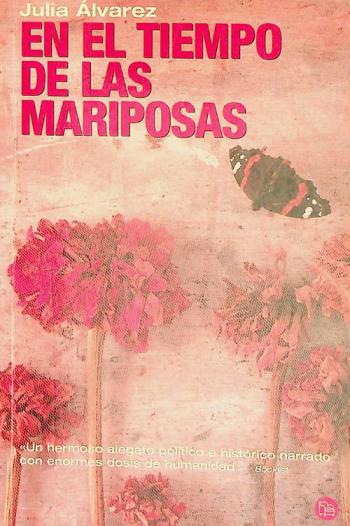
En el tiempo de las mariposas
On a deserted mountain road in the Dominican Republic in 1960, three young women from a pious Catholic family were assassinated after visiting their husbands who had been jailed as suspected rebel leaders. The Mirabal sisters, thus martyred, became mythical figures in their country, where they are known as Las Mariposas (the butterflies). Three decades later, Julia Alvarez, daughter of the Dominican Republic and author of the acclaimed How the Garcia Girls Lost Their Accents, brings the Mirabal sisters back to life in this extraordinary novel. Each of the sisters speaks in her own voice, beginning as young girls in the 1940s, their stories vary from hair ribbons to gun-running to prison torture. Their story is framed by their surviving sister who tells her own tale of suffering and dedication to the memory of Las Mariposas. This inspired portrait of four women is a haunting statement about the human cost of political oppression, and is destined to take its place alongside Garcia Marquez's One Hundred Years of Solitude and Allende's The House of the Spirits as one of the great 20th-century Latin American novels.
Book

Mukwahepo
In 1963 Mukwahepo left her home in Namibia and followed her fiance across the border into Angola. They survived hunger and war and eventually made their way to Tanzania. There, Mukwahepo became the first woman to undergo military training with SWAPO. For nine years she was the only woman in SWAPO's Kongwa camp. She was then thrust into a more traditional women's role - taking care of children in the SWAPO camps in Zambia and Angola. At Independence, Mukwahepo returned to Namibia with five children. One by one their parents came to reclaim them, until she was left alone. Already in her fifties, and with little education, Mukwahepo could not get employment. She survived on handouts until the Government introduced a pension and other benefits for veterans. Through a series of interviews, Ellen Ndeshi Namhila recorded and translated Mukwahepo's remarkable story. This book preserves the oral history of not only the 'dominant male voice' among the colonised people of Namibia, but brings to light the hidden voice, the untold and forgotten story of an ordinary woman and the outstanding role she played during the struggle.
eBook

In the city of silver and gold : the story of Begum Hazrat Mahal
When the British decide to subdue Lucknow, the beautiful \"city of gold and silver\" in Oudh, India, Hazrat Mahal, the fourth wife of the ruler, becomes a leader in the resistance.
Book

Unsex'd Revolutionaries
Using historical and feminist psycho-linguistic studies as a base, Ty explores some of the complexities encountered in the writings of Mary Wollstonecraft, Mary Hays, Helen Maria Williams, Elizabeth Inchbald, and Charlotte Smith
eBook