
Catalogue Search | MBRL


Are you sure you want to remove the book from the shelf?

{{itemTitle}}
6,693
result(s) for
"Word order"
Sort by:


Dependency locality as an explanatory principle for word order
This work focuses on explaining both grammatical universals of word order and quantitative word-order preferences in usage by means of a simple efficiency principle: dependency locality. In its simplest form, dependency locality holds that words linked in a syntactic dependency (any head–dependent relationship) should be close in linear order. We give large-scale corpus evidence that dependency locality predicts word order in both grammar and usage, beyond what would be expected from independently motivated principles, and demonstrate a means for dissociating grammar and usage in corpus studies. Finally, we discuss previously undocumented variation in dependency length and how it correlates with other linguistic features such as head direction, providing a rich set of explananda for future linguistic theories.
Journal Article

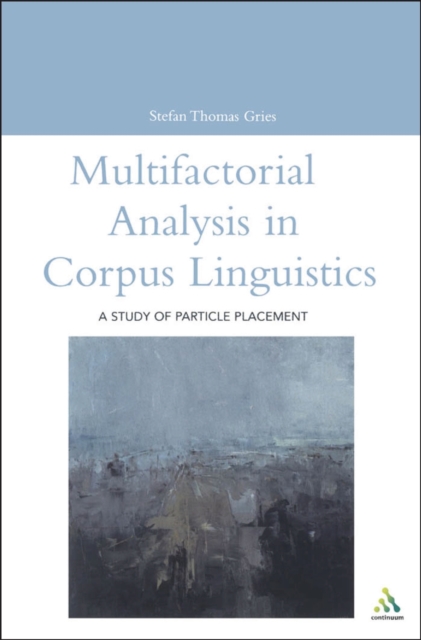
Multifactorial analysis in corpus linguistics : a study of particle placement
This book presents a new analysis of the word-order alternation of English transitive phrasal verbs (aka Particle Movement) from a cognitive-functional and psycholinguistic perspective. Its main objective, however, is a methodological one, namely to demonstrate the superiority of corpus-based, multifactorial and probabilistic approaches towards grammatical phenomena over traditional analyses based on acceptability judgements and minimal pair tests.
eBook


Word-order information in the Lexicon
We propose that crosslinguistic word-order variation (Greenberg 1963; Cinque 2005; Abels 2016) reflects information stored in the lexicon in the format of Lexical Items, and that the operations yielding word-order are the same that guide lexicalisation more generally in Nanosyntax (Starke 2009). We show that this lexicalisation-based approach shares the empirical coverage of current analyses (Cinque 2005; Abels & Neeleman 2012; Cinque 2023) without making reference to traditional syntactic movement. This spares the system from stipulating semantically vacuous structural dependencies triggering movement, and correctly separates subtypes of movements subject to different constraints. The proposal also favours a novel perspective on how the relevant Lexical Items are acquired and activated during processing, shedding new light on the different typological frequency of word-order patterns and structural priming.
Journal Article


Word order change in acquisition and language contact : essays in honour of Ans van Kemenade
The case studies in this volume offer new insights into word order change. As is now becoming increasingly clear, word order variation rarely attracts social values in the way that phonological variants do.
eBook

Heritage language development and processing: Non-canonical word orders in Mandarin–English child heritage speakers
Previous research suggests that child HSs’ performance in offline linguistic tasks is typically worse than their age-matched monolingual peers and is modulated by linguistic and child-level factors. This study examined the comprehension and production of three Mandarin non-canonical structures in 5- to 9-year-old Mandarin–English heritage children and Mandarin-speaking monolingual children, including an online processing task. Results showed that heritage children had different performance in production and offline comprehension across structures compared to monolinguals. In online processing, they showed sensitivity to different cues similarly to monolinguals but took longer to revise initial misinterpretations. Within heritage children, we found that presence of morphosyntactic cues facilitated performance across tasks while cross-linguistic influence was only identified in production and offline comprehension but not in online processing. Additionally, input quantity predicted their production and offline comprehension accuracy of non-canonical structures, whereas age modulated their production. Lastly, online processing was not modulated by age nor input.
Journal Article

Children’s acquisition of word order variation: A study of subject placement in embedded clauses in Norwegian
Norwegian embedded clauses give children two options for subject placement: preceding or following negation (S-Neg/Neg-S). In the adult language, S-Neg is the ‘default’ and highly frequent option, and Neg-S is infrequent in children’s input. However, Neg-S may be argued to be the structurally less complex. We investigate whether children are aware of the existence of both subject positions, and if they prefer the more frequent or the less complex position. Through an elicited production task with monolingual Norwegian children (N=33, age 3;1-6;1) we find that children in general overuse the Neg-S option, and we suggest that children have an inherent preference for the less complex position, due to a principle of structural economy. We also find that a group of children display U-shaped development, first using only S-Neg, then only Neg-S and finally S-Neg again, and we relate this to structure building and economy of movement.
Journal Article