
Catalogue Search | MBRL


Are you sure you want to remove the book from the shelf?

{{itemTitle}}
885
result(s) for
"Work-Social aspects"
Sort by:

The mythology of work : how capitalism persists despite itself
There was once a time when 'work' was inextricably linked to survival. But what was once an integral part of life has slowly morphed into a painful and meaningless routine, colonising almost every part of our lives. As our society is transformed into a factory that never sleeps, work becomes a universal reference point for everything else, devoid of moral or social worth. Blending theory with accounts of job-related suicides, office-induced paranoia, fear of relaxation, managerial sadism and cynical corporate social responsibility campaigns, Fleming provides a damning report on the way work consumes our lives in modern capitalist society. -- from back cover.
Book

Demanding Work
Since the early 1980s, a vast number of jobs have been created in the affluent economies of the industrialized world. Many workers are doing more skilled and fulfilling jobs, and getting paid more for their trouble. Yet it is often alleged that the quality of work life has deteriorated, with a substantial and rising proportion of jobs providing low wages and little security, or requiring unusually hard and stressful effort. In this unique and authoritative formal account of changing job quality, economist Francis Green highlights contrasting trends, using quantitative indicators drawn from public opinion surveys and administrative data. In most affluent countries average pay levels have risen along with economic growth, a major exception being the United States. Skill requirements have increased, potentially meaning a more fulfilling time at work. Set against these beneficial trends, however, are increases in inequality, a strong intensification of work effort, diminished job satisfaction, and less employee influence over daily work tasks. Using an interdisciplinary approach, Demanding Work shows how aspects of job quality are related, and how changes in the quality of work life stem from technological change and transformations in the politico-economic environment. The book concludes by discussing what individuals, firms, unions, and governments can do to counter declining job quality.
eBook


Undoing Work, Rethinking Community
This revolutionary book presents a new conception of community and the struggle against capitalism. In Undoing Work, Rethinking Community, James A. Chamberlain argues that paid work and the civic duty to perform it substantially undermines freedom and justice. Chamberlain believes that to seize back our time and transform our society, we must abandon the deep-seated view that community is constructed by work, whether paid or not. Chamberlain focuses on the regimes of flexibility and the unconditional basic income, arguing that while both offer prospects for greater freedom and justice, they also incur the risk of shoring up the work society rather than challenging it. To transform the work society, he shows that we must also reconfigure the place of paid work in our lives and rethink the meaning of community at a deeper level. Throughout, he speaks to a broad readership, and his focus on freedom and social justice will interest scholars and activists alike. Chamberlain offers a range of strategies that will allow us to uncouple our deepest human values from the notion that worth is generated only through labor.
eBook


The new sociology of economic behaviour
The New Sociology of Economic Behaviour seeks to revitalize the classical approach and introduces students to the essential ideas in the field. It also shows researchers and graduate students how to make use of concepts like demoralization, cheap labour, dignity at work and a fair day′s pay, to develop critiques of current economic arrangements.
eBook

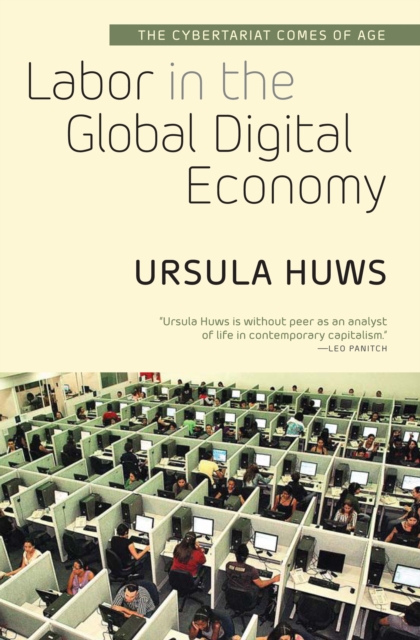
Labor in the Global Digital Economy
\"Following on her brilliant The Making of a Cybertariat, a modern classic in the analysis of class and gender, work and consumption, Huws turns her sharp eye to the present crisis into which the cybertariat 'has come of age.' Rich in theoretical and methodological insights, Labor in the Global Digital Economy carefully guides us through the world of transnational business, value chains, creative, precarious and knowledge labor, self-service consumers, and consumption workers. Challenging accepted thinking and providing enough wisdom to fill several volumes, Huws has once again demonstrated her preeminence among analysts of work and inequality in digital capitalism.\"-Vincent Mosco, author, To the Cloud: Big Data in a Turbulent World.
eBook


Work in a Modern Society
Whereas the history of workers and labor movements has been widely researched, the history of work has been rather neglected by comparison. This volume offers original contributions that deal with cultural, social and theoretical aspects of the history of work in modern Europe, including the relations between gender and work, working and soldiering, work and trust, constructions and practices. The volume focuses on Germany but also places the case studies in a broader European context. It thus offers an insight into social and cultural history as practiced by German-speaking scholars today but also introduces the reader to ongoing research in this field.
eBook