
Catalogue Search | MBRL


Are you sure you want to remove the book from the shelf?

{{itemTitle}}
33,600
result(s) for
"Working mothers"
Sort by:

Making motherhood work : how women manage careers and caregiving /
A cross-national account of working mothers' daily lives--and the revolution in public policy and culture needed to improve them.
Book

Academic Motherhood
Academic Motherhoodtells the story of over one hundred women who are both professors and mothers and examines how they navigated their professional lives at different career stages. Kelly Ward and Lisa Wolf-Wendel base their findings on a longitudinal study that asks how women faculty on the tenure track manage work and family in their early careers (pre-tenure) when their children are young (under the age of five), and then again in mid-career (post-tenure) when their children are older. The women studied work in a range of institutional settings-research universities, comprehensive universities, liberal arts colleges, and community colleges-and in a variety of disciplines, including the sciences, the humanities, and the social sciences.Much of the existing literature on balancing work and family presents a pessimistic view and offers cautionary tales of what to avoid and how to avoid it. In contrast, the goal ofAcademic Motherhoodis to help tenure track faculty and the institutions at which they are employed \"make it work.\" Writing for administrators, prospective and current faculty as well as scholars, Ward and Wolf-Wendel bring an element of hope and optimism to the topic of work and family in academe. They provide insight and policy recommendations that support faculty with children and offer mechanisms for problem-solving at personal, departmental, institutional, and national levels.
eBook

The mother of all jobs : how to have children and a career and stay sane(ish)
When Christine Armstrong became a mother, it never occurred to her that she would want to stop work or even work part-time. But the truth is, combining work and small kids is hard. From the broken breast pumps on business trips, to hiding chickenpox from the nursery, to the heartbreak when you come home and realise your baby smells of the childminder. When Christine Armstrong tried it, she found herself desolate with misery. Determined to make it work, she looked for answers by interviewing other working mums and found that she wasn't alone. These are the stories of the women who shared everything (and we mean, everything) and what they want you to know.

Emotional Support Makes the Difference: Work-Family Conflict and Employment Related Guilt Among Employed Mothers
In the present study we aimed to investigate the role of social support, particularly emotional support, on work-family conflict (WFC) and employment-related guilt among employed mothers. Achieving an optimal work-family balance is difficult, especially for employed mothers with young children. Previous research has found support to be a key factor in helping to alleviate conflict. However, determining which types of support are most beneficial is an important issue to be investigated. Using path analysis, we examined the effect of three sources of social support—emotional spousal support, emotional supervisory support, and instrumental spousal support—on WFC and employment-related guilt. Voluntary domestic support, paid domestic support, and number of children were control variables. Data were collected from 201 employed Turkish mothers who have at least one child below the age of 10. Participants were between 25 and 47 years-old (M = 33.6, SD = 4.4). Spousal and supervisory emotional support were significant predictors of WFC for employed mothers. Moreover, supervisory support was a significant predictor of employment-related guilt. Implications of the results are discussed with reference to cultural context, and recommendations are provided for professionals in the field.
Journal Article


Women Who Opt Out
pIn a much-publicized and much-maligned 2003 New York Times article, “The Opt-Out Revolution,” the journalist Lisa Belkin made the controversial argument that highly educated women who enter the workplace tend to leave upon marrying and having children. Women Who Opt Out is a collection of original essays by the leading scholars in the field of work and family research, which takes a multi-disciplinary approach in questioning the basic thesis of “the opt-out revolution.” The contributors illustrate that the desire to balance both work and family demands continues to be a point of unresolved concern for families and employers alike and women’s equity within the workforce still falls behind. Ultimately, they persuasively make the case that most women who leave the workplace are being pushed out by a work environment that is hostile to women, hostile to children, and hostile to the demands of family caregiving, and that small changes in outdated workplace policies regarding scheduling, flexibility, telecommuting and mandatory overtime can lead to important benefits for workers and employers alike. strongContributors:/strong Kerstin Aumann, Jamie Dolkas, Ellen Galinsky, Lisa Ackerly Hernandez, Susan J. Lambert, Joya Misra, Maureen Perry-Jenkins, Peggie R. Smith, Pamela Stone, and Joan C. Williams. Listen to Bernie D. Jones on WPYR Radio: Mothers and the delicate work-family balance/p
eBook
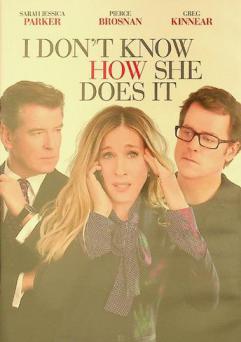
I don't know how she does it
\"A working mother strives to balance her demanding career with the stress of raising two young children and maintaining a healthy marriage in this comedy adapted from the best-selling novel by Allison Pearson. By day, Kate Reddy (Sarah Jessica Parker) works for a Boston-based financial management firm; by night, she's a devoted mother to two adoring children and the happily married wife of out-of-work architect Richard (Greg Kinnear). Though balancing those two worlds has its fair share of challenges, Kate generally manages to come out on top thanks to the support of her best friend, Allison (Christina Hendricks), who's had plenty of experience balancing kids and a career. Meanwhile, on the other end of the spectrum, Kate's sharp-as-a-tack junior associate assistant, Momo (Olivia Munn), possesses a fear of children and a strong work ethic. Just when Kate lands a lucrative new account that will see her traveling across the country on a regular basis, however, her new business associate Jack (Pierce Brosnan) reveals his flirtatious side and Richard receives a job offer he can't turn down. Though it looks as if Kate and Richard couldn't possibly take on any more responsibility, the demands of modern living ensure they'll never have a dull moment, even if they try\"--Allmovie.com, September 28, 2018.
DVD
Mothers on the fast track : how a new generation can balance family and careers
In the past few decades the number of women entering graduate and professional schools has been going up and up, while the number of women reaching the top rung of the corporate and academic worlds has remained relatively stagnant. Why are so many women falling off the fast track? This book traces the career paths of the first generation of ambitious women who started careers in academia, law, medicine, business, and the media in large numbers in the 1970s and '80s. Many women who had started families but continued working had ended up veering off the path to upper management at a point the author calls “the second glass ceiling.” Rather than sticking to their original career goals, they allowed themselves to slide into a second tier of management that offers fewer hours, less pay, lower prestige, and limited upward mobility. Men who did likewise—entered the career world with high aspirations and then started families while working—not only did not show the same trend, they reached even higher levels of professional success than men who had no families at all. Along with her daughter, an aspiring journalist, the author has written a guide for young women who are facing the tough decision of when—and if—to start a family. It is also a guide for older women seeking a second chance to break through to the next level, as the author herself did in academia.
eBook

Mothers work : confronting the Mommy Wars, raising children, and working for social change
Through a series of focus group interviews and an analysis of the media and popular culture, Mothers Work explores the institution of motherhood and the arenas in which mothering occurs while analyzing how mothers feel about themselves, each other, and the culture that situates them against one another.
Book

Families Apart
In a developing nation like the Philippines, many mothers provide for their families by traveling to a foreign country to care for someone else’s. Families Apart focuses on Filipino overseas workers in Canada to reveal what such arrangements mean for families, documenting the difficulties of family separation and the problems that children have when reuniting with their mothers in Vancouver.
eBook