
Catalogue Search | MBRL


Are you sure you want to remove the book from the shelf?

{{itemTitle}}
373
result(s) for
"World War, 1914-1918 Campaigns"
Sort by:

World War I, 1914-1916 : a terrible new warfare begins
This book follows the events of the first few years of World War I. After the assassination of Austro-Hungarian Archduke Franz Ferdinand, war was declared by Europe's five great powers. Readers will learn that, althoughit was a European war, the fighting spread outward to the colonies of the countries involved.
BOOK

Year of the locust
Year of the Locust captures in page-turning detail the end of the Ottoman world and a pivotal moment in Palestinian history. In the diaries of Ihsan Hasan al-Turjman (1893–1917), the first ordinary recruit to describe World War I from the Arab side, we follow the misadventures of an Ottoman soldier stationed in Jerusalem. There he occupied himself by dreaming about his future and using family connections to avoid being sent to the Suez. His diaries draw a unique picture of daily life in the besieged city, bringing into sharp focus its communitarian alleys and obliterated neighborhoods, the ongoing political debates, and, most vividly, the voices from its streets—soldiers, peddlers, prostitutes, and vagabonds. Salim Tamari's indispensable introduction places the diary in its local, regional, and imperial contexts while deftly revising conventional wisdom on the disintegration of the Ottoman Empire.
eBook

The First World War in the Middle East
\"The First World War in the Middle East is an accessibly written military and social history of the clash of world empires in the Dardanelles, Egypt and Palestine, Mesopotamia, Persia and the Caucasus. Coates Ulrichsen demonstrates how wartime exigencies shaped the parameters of the modern Middle East, and describes and assesses the major campaigns against the Ottoman Empire and Germany involving British and imperial troops from the French and Russian empires, as well as their Arab and Armenian allies. Also documented are the enormous logistical demands placed on host societies by the Great Powers' conduct of industrialised warfare in hostile terrain. The resulting deepening of imperial penetration, and the extension of state controls across a heterogeneous sprawl of territories, generated a powerful backlash both during and immediately after the war, which played a pivotal role in shaping national identities as the Ottoman Empire was dismembered. This is a multidimensional account of the many seemingly discrete yet interlinked campaigns that resulted in one to one and half million casualties. It details not just their military outcome but relates them to intelligence-gathering, industrial organisation, authoritarianism and the political economy of empires at war.\"--Book jacket.
Book

Grand Duke Nikolai Nikolaevich
Grand Duke Nikolai Nikolaevich Romanov (1856-1929) was a key
figure in late Imperial Russia, and one of its foremost soldiers.
At the outbreak of World War I, his cousin, Tsar Nicholas II,
appointed him Supreme Commander of the Russian Army. From 1914 to
1915, and then again briefly in 1917, he was commander of the
largest army in the world in the greatest war the world had ever
seen. His appointment reflected the fact that he was perhaps the
man the last Emperor of Russia trusted the most. At six foot six,
the Grand Duke towered over those around him. His fierce temper was
a matter of legend. However, as Robinson's vivid account shows, he
had a more complex personality than either his supporters or
detractors believed. In a career spanning fifty years, the Grand
Duke played a vital role in transforming Russia's political system.
In 1905, the Tsar assigned him the duty of coordinating defense and
security planning for the entire Russian empire. When the Tsar
asked him to assume the mantle of military dictator, the Grand
Duke, instead of accepting, persuaded the Tsar to sign a manifesto
promising political reforms. Less opportunely, he also had a role
in introducing the Tsar and Tsarina to the infamous Rasputin. A few
years after the revolution in 1917, the Grand Duke became de facto
leader of the Russian émigré community. Despite his importance, the
only other biography of the Grand Duke was written by one of his
former generals in 1930, a year after his death, and it is only
available in Russian. The result of research in the archives of
seven countries, this groundbreaking biography-the first to appear
in English-covers the Grand Duke's entire life, examining both his
private life and his professional career. Paul Robinson's engaging
account will be of great value to those interested in World War I
and military history, Russian history, and biographies of notable
figures.
eBook


From Empire To Empire
The history of Jerusalem as traditionally depicted is the quintessential history of conflict and strife, of ethnic tension, and of incompatible national narratives and visions. It is also a history of dramatic changes and moments, one of the most radical ones being the replacement of the Ottoman regime with British rule in December 1917. From Empire to Empire challenges these two major dichotomies, ethnic and temporal, which shaped the history of Jerusalem and its inhabitants. It links the experiences of two ethnic communities living in Palestine, Jews and Arabs, as well as bridging two historical periods, the Ottoman and British administrations. Drawing upon a variety of sources, Jacobson demonstrates how political and social alliances are dynamic, context-dependent, and purpose-driven. She also highlights the critical role of foreign intervention, governmental and nongovernmental, in forming local political alliances and in shaping the political reality of Palestine during the crisis of World War I and the transition between regimes.
eBook

The Russian Origins of the First World War
In a major reinterpretation, Sean McMeekin rejects the standard notion of the war’s beginning as either a Germano-Austrian pre-emptive strike or a miscalculation. The key to the outbreak of violence, he argues, lies in St. Petersburg. Russian statesmen unleashed the war through policy decisions based on imperial ambitions in the Near East.
eBook
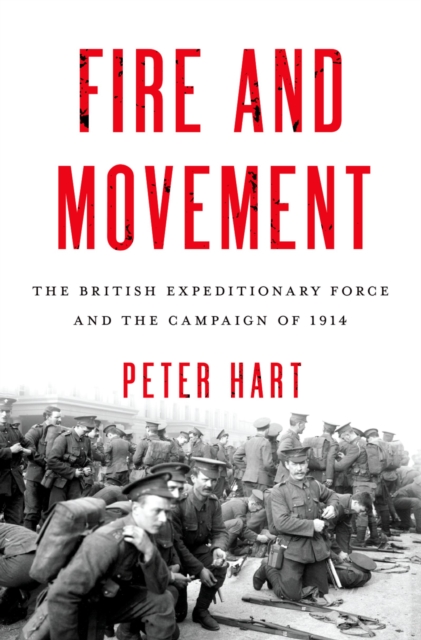
Fire and Movement
Fire and Movement offers a fresh look at the first months of the Great War. Considering each of the major offenses of 1914, from the Battle of the Frontiers to the Battle of Ypres and the genesis of trench warfare, renowned military historian Peter Hart argues that the real story of the opening campaigns of World War I is far different from the mythology that has come to surround it.
eBook