
Catalogue Search | MBRL


Are you sure you want to remove the book from the shelf?

{{itemTitle}}
18
result(s) for
"World War, 1914-1918 Political aspects United States."
Sort by:


Embattled home fronts : domestic politics and the American novel of World War I
Embattled Home Fronts is an inquiry into the highly conflicted US American experience of World War I as it plays itself out in the diverse body of novelistic works to which it has given rise and by which it has been, in turn, shaped and commemorated. As such, this book naturally concerns itself with the formal aspects of artistic war representation. But rather than merely endeavoring to illustrate how American writers from various backgrounds chose to depict World War I, the present work seeks to uncover the particular ideologies and political practices that inform these representational choices. To this end, Embattled Home Fronts examines both canonized and marginalized US American World War I novels within the context of contemporaneous debates over shifting class, gender, and race relations. The book contends that American literary representations of the Great War are shaped less by universal insights into modern society's self-destructiveness than by concerted efforts to fashion class-, gender-, and race-specific experiences of warfare in ways that stabilize and heighten political group identities. In moving beyond the customary focus on ironic war representations, Embattled Home Fronts illustrates that the representational and ideological battles fought within American World War I literature not only shed light on the emergence of powerful identity-political concepts such as the New Woman and the New Negro, but also speak to the reappearance of utopian, communitarian, and social protest fictions in the early 1930s. This study Embattled Home Fronts provides a new understanding of the relationship between war literature and home front politics that should be of interest to students and scholars working from a variety of disciplines and perspectives.
eBook

War, the American state, and politics since 1898
\"This book examines major foreign conflicts from the Spanish-American War through Vietnam, arguing that international conflicts have strong effects on American political parties, elections, state development, and policymaking. First, major wars expose and highlight problems requiring governmental solutions or necessitating emergency action. Second, despite well-known curtailments of civil liberties, wars often enhance democracy by drawing attention to the contributions of previously marginalized groups and facilitating the extension of fuller citizenship rights to them. Finally, wars affect the party system. Foreign conflicts create crises - many of which are unanticipated - that require immediate attention, supplant prior issues on the policy agenda, and engender shifts in party ideology. These new issues and redefinitions of party ideology frequently influence elections by shaping both elite and mass behavior\"-- Provided by publisher.
Book

Bodies of War
The United States lost thousands of troops during World War I, and the government gave next-of-kin a choice about what to do with their fallen loved ones: ship them home for burial or leave them permanently in Europe, in makeshift graves that would be eventually transformed into cemeteries in France, Belgium, and England. World War I marked the first war in which the United States government and military took full responsibility for the identification, burial, and memorialization of those killed in battle, and as a result, the process of burying and remembering the dead became intensely political. The government and military attempted to create a patriotic consensus on the historical memory of World War I in which war dead were not only honored but used as a symbol to legitimize America's participation in a war not fully supported by all citizens.The saga of American soldiers killed in World War I and the efforts of the living to honor them is a neglected component of United States military history, and in this fascinating yet often macabre account, Lisa M. Budreau unpacks the politics and processes of the competing interest groups involved in the three core components of commemoration: repatriation, remembrance, and return. She also describes how relatives of the fallen made pilgrimages to French battlefields, attended largely by American Legionnaires and the Gold Star Mothers, a group formed by mothers of sons killed in World War I, which exists to this day. Throughout, and with sensitivity to issues of race and gender, Bodies of War emphasizes the inherent tensions in the politics of memorialization and explores how those interests often conflicted with the needs of veterans and relatives.
eBook

World War I and urban order : the local class politics of national mobilization
\"This book uses Portland, Oregon to bring to life the transformation of U.S. cities during the first truly national war mobilization effort. World War I had an enormous impact on urban life and the relationship between cities and the federal government that has been almost entirely unexplored until now\"--Provided by publisher.
Book

Private Politics and Public Voices
This political history of middle-class African American women during World War I focuses on their patriotic activity and social work. Nearly 200,000 African American men joined the Allied forces in France. At home, black clubwomen raised more than $125 million in wartime donations and assembled \"comfort kits\" for black soldiers, with chocolate, cigarettes, socks, a bible, and writing materials. Given the hostile racial climate of the day, why did black women make considerable financial contributions to the American and Allied war effort? Brown argues that black women approached the war from the nexus of the private sphere of home and family and the public sphere of community and labor activism. Their activism supported their communities and was fueled by a personal attachment to black soldiers and black families. Private Politics and Public Voices follows their lives after the war, when they carried their debates about race relations into public political activism.
eBook

Torchbearers of Democracy
On April 2, 1917, Woodrow Wilson thrust the United States into World War I by declaring, \"The world must be made safe for democracy.\" For the 380,000 African American soldiers who fought and labored in the global conflict, these words carried life or death meaning. Relating stories bridging the war and postwar years, spanning the streets of Chicago and the streets of Harlem, from the battlefields of the American South to the battlefields of the Western Front, Chad L. Williams reveals the central role of African American soldiers in World War I and how they, along with race activists and ordinary citizens alike, committed to fighting for democracy at home and beyond.Using a diverse range of sources, Williams connects the history of African American soldiers and veterans to issues such as the obligations of citizenship, combat and labor, diaspora and internationalism, homecoming and racial violence, \"New Negro\" militancy, and African American historical memories of the war. Democracy may have been distant from the everyday lives of African Americans at the dawn of the war, but it nevertheless remained a powerful ideal that sparked the hopes of black people throughout the country for societal change.Torchbearers of Democracyreclaims the legacy of black soldiers and establishes the World War I era as a defining moment in the history of African Americans and peoples of African descent more broadly.
eBook
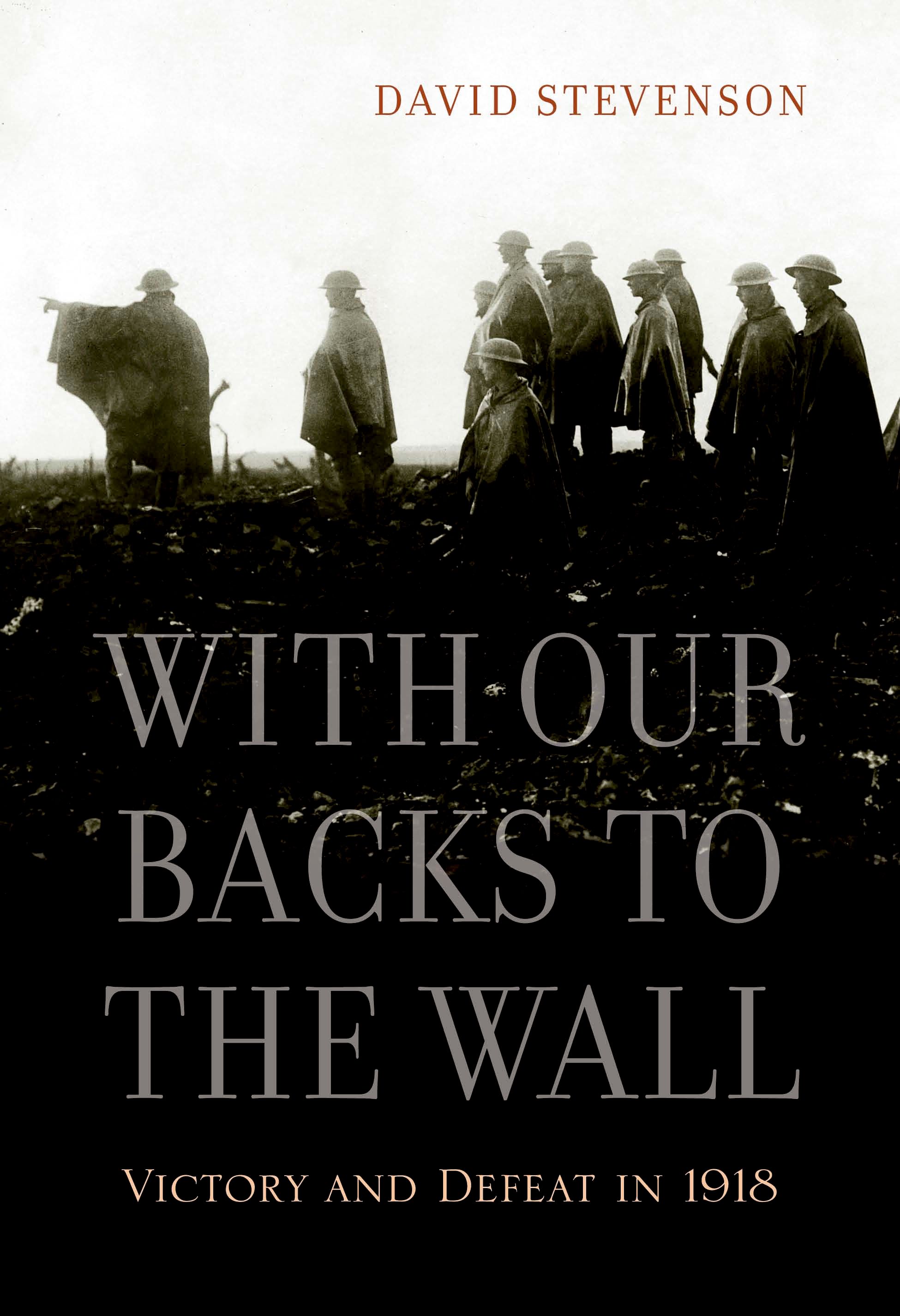
With our backs to the wall : victory and defeat in 1918
With so much at stake and so much already lost, why did World War I end with a whimper-an arrangement between two weary opponents to suspend hostilities? After more than four years of desperate fighting, with victories sometimes measured in feet and inches, why did the Allies reject the option of advancing into Germany in 1918 and taking Berlin? Most histories of the Great War focus on the avoidability of its beginning. This book brings a laser-like focus to its ominous end-the Allies' incomplete victory, and the tragic ramifications for world peace just two decades later. In the most comprehensive account to date of the conflict's endgame, David Stevenson approaches the events of 1918 from a truly international perspective, examining the positions and perspectives of combatants on both sides, as well as the impact of the Russian Revolution. Stevenson pays close attention to America's effort in its first twentieth-century war, including its naval and military contribution, army recruitment, industrial mobilization, and home-front politics. Alongside military and political developments, he adds new information about the crucial role of economics and logistics. The Allies' eventual success, Stevenson shows, was due to new organizational methods of managing men and materiel and to increased combat effectiveness resulting partly from technological innovation. These factors, combined with Germany's disastrous military offensive in spring 1918, ensured an Allied victory-but not a conclusive German defeat.
eBook

The Shadows of Total War
The period between the two world wars of the twentieth century was one of the most challenging in the history of war. In anticipation of another conflict, military planners and civilian thinkers struggled after 1918 with the painful implications of World War I. Given its scope, the wholesale mobilisation of civilian populations and the targets of civilians via blockades and strategic bombing, many observers regarded this titanic conflict as a 'total war'. They also concluded that any future conflict would bear the same hallmarks; and they planned accordingly. The essays in this collection, the fourth in a series on the problem of total war, examine the inter-war period. They explore the consequences of World War I, the intellectual efforts to analyse this conflict's military significance, the attempts to plan for another general war and several episodes in the 1930s that portended the war that erupted in 1939.
eBook

The great interwar crisis and the collapse of globalization
Challenging the standard narrative of Interwar International History, this account establishes the causal relationship between the global political and economic crises of the period, and offers a radically new look at the role of ideology, racism and the leading liberal powers in the events between the First and Second World Wars.
eBook