Catalogue Search | MBRL


Are you sure you want to remove the book from the shelf?

{{itemTitle}}
49
result(s) for
"World War, 1914-1918 Social aspects United States."
Sort by:


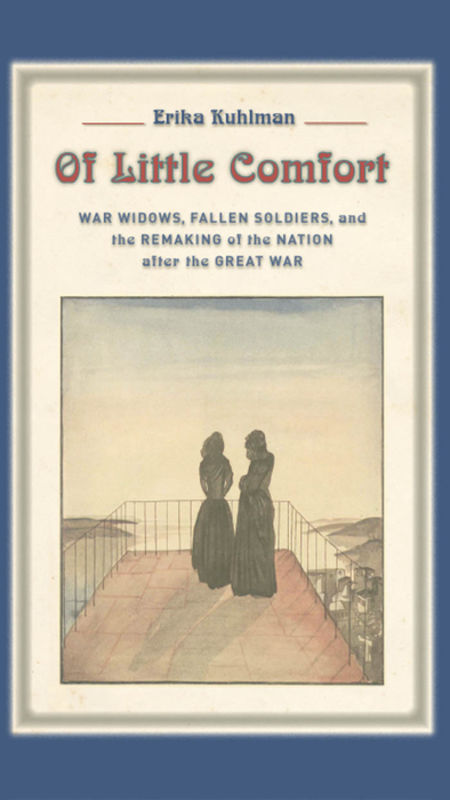
Of Little Comfort
During and especially after World War I, the millions of black-clad widows on the streets of Europe’s cities were a constant reminder that war caused carnage on a vast scale. But widows were far more than just a reminder of the war’s fallen soldiers; they were literal and figurative actresses in how nations crafted their identities in the interwar era. In this extremely original study, Erika Kuhlman compares the ways in which German and American widows experienced their postwar status, and how that played into the cultures of mourning in their two nations: one defeated, the other victorious. Each nation used widows and war dead as symbols to either uphold their victory or disengage from their defeat, but Kuhlman, parsing both German and U.S. primary sources, compares widows’ lived experiences to public memory. For some widows, government compensation in the form of military-style awards sufficed. For others, their own deprivations, combined with those suffered by widows living in other nations, became the touchstone of a transnational awareness of the absurdity of war and the need to prevent it.
eBook


Bodies of War
The United States lost thousands of troops during World War I, and the government gave next-of-kin a choice about what to do with their fallen loved ones: ship them home for burial or leave them permanently in Europe, in makeshift graves that would be eventually transformed into cemeteries in France, Belgium, and England. World War I marked the first war in which the United States government and military took full responsibility for the identification, burial, and memorialization of those killed in battle, and as a result, the process of burying and remembering the dead became intensely political. The government and military attempted to create a patriotic consensus on the historical memory of World War I in which war dead were not only honored but used as a symbol to legitimize America's participation in a war not fully supported by all citizens.The saga of American soldiers killed in World War I and the efforts of the living to honor them is a neglected component of United States military history, and in this fascinating yet often macabre account, Lisa M. Budreau unpacks the politics and processes of the competing interest groups involved in the three core components of commemoration: repatriation, remembrance, and return. She also describes how relatives of the fallen made pilgrimages to French battlefields, attended largely by American Legionnaires and the Gold Star Mothers, a group formed by mothers of sons killed in World War I, which exists to this day. Throughout, and with sensitivity to issues of race and gender, Bodies of War emphasizes the inherent tensions in the politics of memorialization and explores how those interests often conflicted with the needs of veterans and relatives.
eBook


On the Battlefield of Memory
This work is a detailed study of how Americans in the 1920s and 1930s interpreted and remembered the First World War. Steven Trout asserts that from the beginning American memory of the war was fractured and unsettled, more a matter of competing sets of collective memories—each set with its own spokespeople— than a unified body of myth. The members of the American Legion remembered the war as a time of assimilation and national harmony. However, African Americans and radicalized whites recalled a very different war. And so did many of the nation’s writers, filmmakers, and painters. Trout studies a wide range of cultural products for their implications concerning the legacy of the war: John Dos Passos’s novels Three Soldiers and 1919 , Willa Cather’s One of Ours , William March’s Company K , and Laurence Stallings’s Plumes ; paintings by Harvey Dunn, Horace Pippin, and John Steuart Curry; portrayals of the war in The American Legion Weekly and The American Legion Monthly; war memorials and public monuments like the Tomb of the Unknown Soldier; and commemorative products such as the twelve-inch tall Spirit of the American Doughboy statue. Trout argues that American memory of World War I was not only confused and contradictory during the ‘20s and ‘30s, but confused and contradictory in ways that accommodated affirmative interpretations of modern warfare and military service. Somewhat in the face of conventional wisdom, Trout shows that World War I did not destroy the glamour of war for all, or even most, Americans and enhanced it for many.
eBook


The Great War and America : civil-military relations during World War I
The First World War marked a key turning point in America's involvement on the global stage. Isolationism fell, and America joined the ranks of the Great Powers. Civil-Military relations faced new challenges as a result. Ford examines the multitude of changes that stemmed from America's first major overseas coalition war, including the new selective service process; mass mobilization of public opinion; training diverse soldiers; civil liberties, anti-war sentiment and conscientious objectors; segregation and warfare; Americans under British or French command. Post war issues of significance, such as the Red Scare and retraining during demobilization are also covered. Both the federal government and the military were expanding rapidly both in terms of size and in terms of power during this time. The new group of citizen-soldiers, diverse in terms of class, religion, ethnicity, regional identity, education, and ideology, would provide training challenges. New government-military-business relationships would experience failures and successes. Delicate relationships with allies would translate into diplomatic considerations and battlefield command concerns.
eBook

Lest we forget : the Great War : World War I prints from the Pritzker Military Museum & Library
\"Lest We Forget: The Great War is a fitting tribute to the memory of those who served during World War I. Each print in the book is a story within itself and the narrative and accompanying photos are extraordinarily informative. Within the chronology and 'traditional' recitation of the war's progress are outstanding discussions of the campaigns outside the Western Front (a true world war), conscription, the impact of the influenza epidemic, and many other special topics.\" Review by General David Bramlett, US Army (Retired)
Book