
Catalogue Search | MBRL


Are you sure you want to remove the book from the shelf?

{{itemTitle}}
34
result(s) for
"World War, 1939-1945 -- Secret service -- United States"
Sort by:

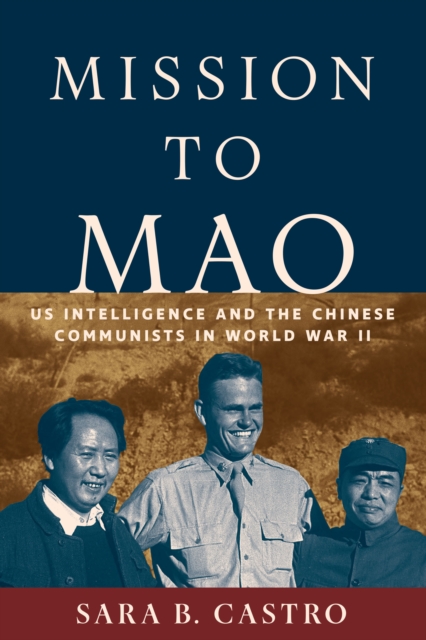
Mission to Mao : US intelligence and the Chinese Communists during World War II
An innovative history of US intelligence officers on the ground and the first official contacts between the United States and the Chinese Communist PartyFrom 1944 to 1947, the United States planted a liaison mission in the headquarters of Chinese Communist forces behind the lines. Nicknamed the \"Dixie Mission,\" for its location in \"rebel\" territory, it was an interagency delegation that included intelligence officers from the Office of Strategic Services (OSS), the US Army, and the State Department.Mission to Mao is a social history of the OSS officers in the field that reveals the weakness of US intelligence diplomacy in the 1940s. Drawing on over 14,000 unpublished records from five archives as well as white papers and memoirs from the participants, Sara B. Castro demonstrates how the US intelligence officers in China clashed with political appointees and Washington over the direction of the US relationship with the Chinese Communists. Interagency and political conflicts erupted over assessments of Communist capabilities and whether or not the mission would later involve operations with the Communists. Castro shows how potential benefits for the war effort were thwarted by politicization, rivalries, and the biases of US intelligence officials. Mission to Mao is a fresh look at US intelligence in WW II China and takes readers beyond the history of \"China Hands\" versus American anticommunists, introducing more nuance.
eBook

Monopoly X : how a top-secret World War II operation used the game of Monopoly to help Allied POWs escape, conceal spies, and send secret codes
\"The incredible true story of how Monopoly games were used to smuggle escape aids to Allied servicemen in German P.O.W. camps...and more\"-- Provided by publisher.
BOOK
The elusive enemy: U.S. naval intelligence and the Imperial Japanese Fleet
In this exploration of U.S. naval operations and intelligence-gathering efforts, Douglas Ford introduces a new perspective on the clash between the United States and Japan in the Pacific. At the outset of the war, the U.S. Navy could not accurately determine the fighting efficiency of Japans Imperial Navy and land-based fighting forces. As the capabilities designed to improve intelligence gathering evolved, technology, ingenuity, and sheer luck often combined to produce useful, but incomplete, information. Only through combat over an extended period of time, Ford demonstrates, did the U.S. Navy actually identify the capabilities of its adversary. The intense combat produced a trove of information obtained from prisoners, captured weapons, and documents, and firsthand accounts of American naval personnel often provided some the most actionable intelligence of the war.In recent years, a large number of documents related to intelligence activities during World War II has been declassified and made available in U.S. and British archives. As a result, a steady flow of work on the subject has emerged. However, much of the work on intelligence has focused on signals decrypts and clandestine operations. The subject of qualitative intelligence about the performance and fighting capabilities of the Imperial Japanese Navy has remained largely unexplored. The Elusive Enemy fills that void. As a historical case study, it demonstrates how intelligence plays a critical role in influencing the conduct of warfare and the manner in which threat perceptions influence international relations. It also serves as an explanation of cultural factors and their subsequent influence on U.S. and Japanese military practices. Finally, it is an innovative explanation of American perceptions regarding the Japanese during a critical period of history. Such a comprehensive examination of the impact of intelligence on the conduct of various campaigns is without parallel.
eBook

Insidious foes : the Axis Fifth Column and the American home front
Nazi Germany's efforts to weaken the United States by subversion failed miserably. Bungling spies were captured and half-hearted efforts at sabotage came to nothing. Yet anyone who lived through WWII remembers the chilling posters warning Americans that \"Enemy Agents Have Big Ears\" and \"Loose Lips Sink Ships.\" Even Superman joined the struggle against these insidious foes. In 1940, polls showed that 71% of Americans believed a Nazi Fifth Column had penetrated the country. Almost half were convinced that spies, saboteurs, dupes, and rumor-mongers lurked in their own neighborhoods and work-places. These fears extended to the White House and Congress. In this book, Francis MacDonnell explains the origins and consequences of America's Fifth Column panic, arguing that conviction and expedience encouraged President Roosevelt, the FBI, Congressmen, Churchill's government, and Hollywood to legitimate and exacerbate American's fears. Gravely weakening the isolationists, fostering Congress's role in rooting out Un-American activities, and instigating the creation of the modern intelligence establishment, the Fifth Column scare did far more than sell movie tickets, comic books, and pulp fiction. Insidious Foes traces the panic from its origins in the minds of reasonable Americans who saw the vulnerability of their open society in an age of encroaching totalitarianism.
eBook

Agents of influence : a British campaign, a Canadian spy, and the secret plot to bring America into World War II
\"As World War II raged into its second year, Britain sought a powerful ally to join its cause-but the American public was sharply divided on the subject. Canadian-born MI6 officer William Stephenson, with his knowledge and influence in North America, was chosen to change their minds by any means necessary. In this extraordinary tale of foreign influence on American shores, Henry Hemming shows how Stephenson came to New York--hiring Canadian staffers to keep his operations secret--and flooded the American market with propaganda supporting Franklin Roosevelt and decrying Nazism. His chief opponent was Charles Lindbergh, an insurgent populist who campaigned under the slogan \"America First\" and had no interest in the war. This set up a shadow duel between Lindbergh and Stephenson, each trying to turn public opinion his way, with the lives of millions potentially on the line.\"-- Provided by publisher.
Book
Mission to Mao
An innovative history of US intelligence officers on the
ground and the first official contacts between the United States
and the Chinese Communist Party
From 1944 to 1947, the United States planted a liaison mission
in the headquarters of Chinese Communist forces behind the lines.
Nicknamed the \"Dixie Mission,\" for its location in \"rebel\"
territory, it was an interagency delegation that included
intelligence officers from the Office of Strategic Services (OSS),
the US Army, and the State Department.
Mission to Mao is a social history of the OSS officers
in the field that reveals the weakness of US intelligence diplomacy
in the 1940s. Drawing on over 14,000 unpublished records from five
archives as well as white papers and memoirs from the participants,
Sara B. Castro demonstrates how the US intelligence officers in
China clashed with political appointees and Washington over the
direction of the US relationship with the Chinese Communists.
Interagency and political conflicts erupted over assessments of
Communist capabilities and whether or not the mission would later
involve operations with the Communists. Castro shows how potential
benefits for the war effort were thwarted by politicization,
rivalries, and the biases of US intelligence officials.
Mission to Mao is a fresh look at US intelligence in WW
II China and takes readers beyond the history of \"China Hands\"
versus American anticommunists, introducing more nuance.
eBook

The lady is a spy : Virginia Hall, World War II hero of the French resistance
\"When Hitler invaded Poland on September 1, 1939, Virginia Hall was traveling in Europe. Which was dangerous enough, but as fighting erupted across the continent, instead of returning home, she headed to France. In a country divided between freedom and fascism, Virginia was determined to do her part for the Allies. An ordinary woman from Baltimore, Maryland, she dove into the action, first joining a French ambulance unit and later becoming an undercover agent for both the British Special Operations Executive and the US Office of Strategic Services. Working as a spy in the intelligence network, she made her way to Vichy, coordinating Resistance movements, assisting in the sabotage of Nazis, and rescuing downed Allied soldiers. She passed in plain sight of the enemy, and soon found herself being hunted by the Gestapo. But Virginia cleverly evaded discovery and death, often through bold feats and daring escapes. Her covert operations, efforts with the Resistance, and risky work as a wireless telegraph operator greatly contributed to the Allies' eventual win\"-- Provided by publisher.
Book

Murder and Martial Justice
A remarkable story of how the U.S. military tortured German POWs into confessing their guilt
“An expert dissection of the crime, its witnesses, and Washington’s shifting goals. Murder and Martial Justice is a good murder mystery, based on a solid examination of the various contradictions and irritating bureaucratic villains.” —Arnold Krammer, author of Nazi Prisoners of War in America and Undue Process: The Untold Story of America’s German Alien Internees
During World War II, the United States maintained two secret interrogation camps in violation of the Geneva Convention—one just south of Washington, D.C., and the other near San Francisco. German POWs who passed through these camps briefed their fellow prisoners, warning them of turncoats who were helping the enemy—the United States—pry secrets from them. One of these turncoats, Werner Drechsler, was betrayed and murdered by those he spied on.
U.S. military authorities reacted harshly to Drechsler’s death, even though he was not the first captive to be assassinated by his fellow POWs. How had military intelligence been compromised? Were fanatical Nazis terrorizing their countrymen on American soil? Would Hitler take reprisals against the GIs he held if the United States did not protect the German POWs from violence and death while confined at the interrogation camps? At one of the secret camps, U.S. officials forced Drechsler’s seven murderers to confess. The next problem faced by authorities was how to court-martial them when their confessions were legally invalid. Their secret trial was stage-managed to deliver death sentences while apparently complying with U.S. and international law.
This presented U.S. authorities with further problems. The Geneva Convention entitled the prisoners’ governments to the full facts about their crimes, trials, and sentencing. Despite escalating German complaints, the War Department adopted a policy of giving as little information as possible about any of the several POW murder trials in order to avoid releasing inconvenient facts about the Drechsler case. Unsurprisingly, the Reich began sentencing GIs to death. Gambling with American lives, the War Department stalled every German attempt to trade these men for the convicted German murderers until the war ended. Every American was saved; every German but one was hanged.
The Drechsler case foreshadows current controversies: creative circumvention of the Geneva Convention, secret interrogation centers, torture, and the consequent problem of how to provide a fair trial to prisoners coerced into self-incrimination. Author Meredith Lentz Adams sees a familiar pattern of cover-ups, leading to difficulties with public and international relations. In contrast to recent policies, she points out how leaders during World War II felt constrained by their respect for Geneva and by fear of retribution against their own soldiers.
Murder and Martial Justice is a fascinating and provocative book that will appeal to those with an interest in World War II, POWs, international law, foreign policy, and true crime history.
eBook