
Catalogue Search | MBRL


Are you sure you want to remove the book from the shelf?

{{itemTitle}}
16
result(s) for
"World War, 1939-1945 Prisoners and prisons, Soviet."
Sort by:


Stalin's Gulag at war : forced labour, mass death, and Soviet victory in the Second World War
Stalin's Gulag at Warplaces the Gulag within the story of the regional wartime mobilization of Western Siberia during the Second World War. The author explores a diverse array of issues, including mass death, informal practices, and the responses of prisoners and personnel to the war.
eBook

Stalin's Gulag at war : forced labour, mass death, and Soviet victory in the Second World War
\"Stalin's Gulag at War places the Gulag within the story of the regional wartime mobilization of Western Siberia during the Second World War. Far from Moscow, Western Siberia was a key area for evacuated factories and for production in support of the war effort. Wilson T. Bell explores a diverse array of issues, including mass death, informal practices such as black markets, and the responses of prisoners and personnel to the war. The region's camps were never prioritized, and faced a constant struggle to mobilize for the war. Prisoners in these camps, however, engaged in such activities as sewing Red Army uniforms, manufacturing artillery shells, and constructing and working in major defense factories. The myriad responses of prisoners and personnel to the war reveal the Gulag as a complex system, but one that was closely tied to the local, regional, and national war effort, to the point where prisoners and non-prisoners frequently interacted. At non-priority camps, moreover, the area's many forced labour camps and colonies saw catastrophic death rates, often far exceeding official Gulag averages. Ultimately, prisoners played a tangible role in Soviet victory, but the cost was incredibly high, both in terms of the health and lives of the prisoners themselves, and in terms of Stalin's commitment to total, often violent, mobilization to achieve the goals of the Soviet state.\"-- Provided by publisher.
Book
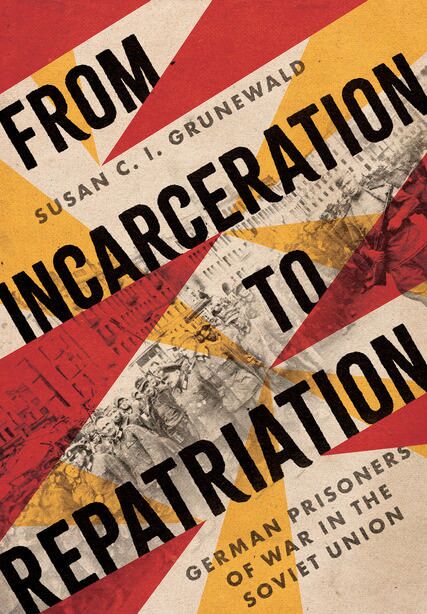
From Incarceration to Repatriation
From Incarceration to Repatriation
explores the lives and memories of the nearly 1.5 million
German POWs who were held by the Soviet Union during and after
World War II and released in phases through 1956, seven years
longer than the prisoners of any other Allied nation.
Susan C. I. Grunewald argues that Soviet leadership deliberately
kept able-bodied German POWs to supplement their labor force after
the end of the war. The Soviet Union lost 27 million citizens and a
quarter of its physical assets during the war, motivating Soviet
leadership to harness the labor of German POWs for as long as
possible.
Engaging with recently declassified documents in former Soviet
archives, archival material from multiple German governments, as
well as innovative use of digital humanities methods and geographic
information system (GIS) mapping, Grunewald demonstrates that
Soviet authorities detained German POWs primarily for economic
rather than punitive reasons. In fact, the GIS mapping of the
historical materials makes it clear that most of the four thousand
POW camps across the USSR were strategically located near
industrial, infrastructure, and natural resource sites that were
critical to postwar economic reconstruction.
From Incarceration to Repatriation is the first book to
draw together the distinct fields of Soviet and German history to
provide a more nuanced and comprehensive understanding of German
POW captivity in the USSR during and after World War II. Attending
to the ways that the memory of German POWs remains in circulation
in both the former Soviet Union and Germany, Grunewald tracks the
political repercussions of war commemoration.
eBook

Stalin's double-edged game : Soviet bureaucracy and the Raoul Wallenberg Case, 1945-1952
\"Drawing on previously classified Soviet archival sources, this study challenges prevailing hypotheses on Stalin's motives behind the arrest of the Swedish diplomat Raoul Wallenberg and the Soviet apparatus' handling of his case.\"-- Provided by publisher.
Book

Suppressed terror
At the end of World War II, the Soviet secret police installed ten special camps in the Soviet occupation zone, later to become the German Democratic Republik. Between 1945 and 1950, roughly 154,000 Germans were held incommunicado in these camps. Whether those accused of being Nazis, spies, or terrorists were indeed guilty as charged, they were indiscriminately imprisoned as security threats and denied due process of the law. One third of the captives did not survive. To this day, most Germans have no knowledge of this postwar Stalinist persecution, even though it exemplifies in a unique way the entangled history of Germans as perpetrators and victims. How can one write the history of victims in a “society of perpetrators?” This is only one of the questions Displaced Terror: History and Perception of Soviet Special Camps in Germany raises in exploring issues in memory culture in contemporary Germany. The study begins with a detailed description of the camp system against the backdrop of Stalinist security policies in a territory undergoing a transition from war zone to occupation zone to Cold War hot spot. The interpretation of the camps as an instrument of pacification rather than of denacification does not ignore the fact that, while actual perpetrators were a minority, the majority of the special camp inmates had at least been supporters of Nazi rule and were now imprisoned under life-threatening conditions together with victims and opponents of the defeated regime. Based on their detention memoirs, the second part of the book offers a closer look at life and death in the camps, focusing on the prisoners' self-organization and the frictions within these coerced communities. The memoirs also play an important role in the third and last part of the study. Read as attempts to establish public acknowledgment of violence suffered by Germans, they mirror German memory culture since the end of World War II.
eBook

Illness and inhumanity in Stalin's Gulag
A new and chilling study of lethal human exploitation in the Soviet forced labor camps, one of the pillars of Stalinist terror In a shocking new study of life and death in Stalin's Gulag, historian Golfo Alexopoulos suggests that Soviet forced labor camps were driven by brutal exploitation and often administered as death camps. The first study to examine the Gulag penal system through the lens of health, medicine, and human exploitation, this extraordinary work draws from previously inaccessible archives to offer a chilling new view of one of the pillars of Stalinist terror.
Book

\We Were Slaves\
This essay discusses the memoir Knekht zenen mir geven (Buenos Aires, 1956), by Avrom Zak (1891–1980), a Polish-Yiddish journalist, poet, and prose writer who survived WWII in the Soviet Union. While in the USSR, he was deported in summer 1940 to a forced labor camp in the Republic of Komi, where he spent more than a year. The essay focuses on the reconstruction of the existential experience that Zak's memoirs contain against the backdrop of the memoirs of Polish Gulag prisoners who, unlike the Jewish prisoners, have already become the subject of extensive research by literary historians. Moreover, the essay addresses the uniqueness of the Jewish experience. Yiddish memoirs of Polish Jews who were prisoners of Soviet forced labor camps during WWII, heretofore absent from studies of so-called Gulag literature and/or Soviet exile literature and, in a broader sense, from Holocaust studies, are still waiting to become incorporated into that discussion. It is only by collecting the greatest possible corpus of testimonies that we shall be able to reconstruct a wider image of the Soviet aspect of the Jewish experience of WWII.
Journal Article

The Stalingrad Cauldron
The encirclement of the German 6th Army at Stalingrad in mid-November 1942 and its final collapse in February 1943 was a signature defeat for Hitler, as more than 100,000 of his soldiers were marched off into captivity. Frank Ellis tackles this oft-told tale from the unique perspective of the German officers and men trapped inside the Red Army's ever-closing ring of forces. This approach makes palpable the growing desperation of an army that began its campaign confident of victory but that long before the end could see how hopeless their situation had become. Highlighting these pages are three previously unpublished German army division accounts, translated here for the first time by Ellis. Each of these translations follows the combat experiences of a specific division-the 76th Infantry, the 94th Infantry, and the 16th Panzer-and take readers into the cauldron (or Kessel) that was Stalingrad. Together they provide a ground-level view of the horrific fighting and yield insights into everything from tactics and weapons to internal disputes, the debilitating effects of extreme cold and hunger, and the Germans' astonishing sense of duty and the abilities of their junior leaders. Along with these first-hand accounts, Ellis himself takes a new and closer look at a number of fascinating but somewhat neglected or misunderstood aspects of the Stalingrad cauldron including sniping, desertion, spying, and the fate of German prisoners. His coverage of sniping is especially notable for new insights concerning the duel that allegedly took place between Soviet sniper Vasilii Zaitsev and a German sniper, Major Konings, a story told in the film Enemy at the Gates (2001). Ellis also includes an incisive reading of Oberst Arthur Boje's published account of his capture, interrogation, and conviction for war crimes, and explores the theme of reconciliation in the works of two Stalingrad veterans, Kurt Reuber and Vasilii Grossman. Rich in anecdotal detail and revealing moments, Ellis's historical mosaic showcases an army that managed to display a vital resilience and professionalism in the face of inevitable defeat brought on by its leaders. It makes for compelling reading for anyone interested in one of the Eastern Front's monumental battles.
eBook

The Labyrinth of Dangerous Hours
Lilka Trzcinska was fourteen years old when the Nazis invaded Poland in 1939. The daughter of an architect, Lilka was a high school student at the time. When schools were closed by the occupier, she, along with her siblings, continued their education in secret classes, and joined the Polish Home Army– the secret resistance force.
Lilka and her family were arrested by the Gestapo in 1943 and sent to the political prison Pawiak, then to Auschwitz. There, Lilka's mother died and her younger sister was sent off to another camp. The rest of the family was put to work in the camp building offices. After being transported to a number of other camps (in one instance by a way of a three-day march), the three sisters were reunited in 1945, and shortly thereafter liberated by the British. Lilka later went to Italy to continue her education, moving to Canada in 1948.
The Labyrinth of Dangerous Hoursis the memoir of a survivor. Lilka Trzcinska-Croydon narrates her adolescence and that of her sisters and brother in a way that binds poetry and history together seamlessly. It describes the strength of the family ties and solidarity that help them emerge from their horrific ordeal with their dignity intact.
As many as 150,000 Polish political prisoners were taken during the war, half of whom died in the camps. This memoir is a testament to their struggle.
eBook