
Catalogue Search | MBRL


Are you sure you want to remove the book from the shelf?

{{itemTitle}}
396
result(s) for
"World War, 1939-1945 Women."
Sort by:

Women heroes of World War II. The Pacific Theater : 15 stories of resistance, rescue, sabotage, and survival
Discusses several of the \"women and girls who risked their lives through their involvement in the Pacific Theater of Operations during World War II. Fifteen ... stories unfold across China, Japan, Malaya, Singapore, the Dutch East Indies, and the Philippines, providing [a] ... reminder of womens' and girls' refusal to sit on the sidelines around the world and throughout history\"--Amazon.com.
Book

Nine Wartime Lives
This book provides a fascinating re-evaluation of the social history of the Second World War and the 20th century making of the modern self. Using the wartime diaries of nine individuals, the book illuminates the impact of war on attitudes to citizenship, the changing relationships between men and women, and the search for meaning in a wartime context of limitless violence. The diaries from which this book is derived were written by some of the unusually self-reflective and public-spirited people who agreed to write intimate journals about their daily activity for the social research organisation, Mass Observation. Each in their way is vivid, interesting and surprising. One of the nine diarists discussed is Nella Last, whose published diaries have been a source of delight and fascination for thousands of readers. A central insight underpins the book: in seeking to make the best of our own lives, each of us makes selective use of the resources of our shared culture in a unique way; in so doing, we contribute, however modestly, to molecular processes of historical change. The book resists nostalgic contrasts between the presumed dutiful citizenship of wartime Britain and contemporary anti-social individualism, pointing instead to longer-run processes of change, rooted as much in struggles for personal autonomy in the private sphere, as in the politics of active citizenship in public life.
eBook

The unwomanly face of war
Why, having stood up for and held their own place in a once absolutely male world, have women not stood up for their history? Their words and feelings? A whole world is hidden from us. Their war remains unknown... I want to write the history of that war. A women's history.\" In the late 1970s, Svetlana Alexievich set out to write her first book, The Unwomanly Face of War, when she realised that she grew up surrounded by women who had fought in the Second World War but whose stories were absent from official narratives. Travelling thousands of miles, she spent years interviewing hundreds of Soviet women - captains, tank drivers, snipers, pilots, nurses and doctors - who had experienced the war on the front lines, on the home front and in occupied territories. As it brings to light their most harrowing memories, this symphony of voices reveals a different side of war, a new range of feelings, smells and colours. After completing the manuscript in 1983, Alexievich was not allowed to publish it because it went against the state-sanctioned history of the war. With the dawn of Perestroika, a heavily censored edition came out in 1985 and it became a huge bestseller in the Soviet Union - the first in five books that have established her as the conscience of the twentieth century.
BOOK

Beyond Rosie
More so than any war in history, World War II was a woman's war. Women, motivated by patriotism, the opportunity for new experiences, and the desire to serve, participated widely in the global conflict. Within the Allied countries, women of all ages proved to be invaluable in the fight for victory. Rosie the Riveter became the most enduring image of women's involvement in World War II. What Rosie represented, however, is only a small portion of a complex story. As wartime production workers, enlistees in auxiliary military units, members of voluntary organizations or resistance groups, wives and mothers on the home front, journalists, and USO performers, American women found ways to challenge traditional gender roles and stereotypes.Beyond Rosieoffers readers an opportunity to see the numerous contributions they made to the fight against the Axis powers and how American women's roles changed during the war. The primary documents (newspapers, propaganda posters, cartoons, excerpts from oral histories and memoirs, speeches, photographs, and editorials) collected here represent cultural, political, economic, and social perspectives on the diverse roles women played during World War II.
eBook

Saints and liars : the story of Americans who saved refugees from the Nazis
\"Long before their country officially joined the war, American aid workers were active in rescue efforts across Europe. Two such Americans were Martha and Waitstill Sharp, who were originally sent to Prague as part of a relief effort but turned immediately to helping Jews and dissidents after the 1939 invasion by Germany. They were not the only ones. Renowned historian Debórah Dwork follows the story of rescue workers in five major cities as the refugee crisis expanded to Vilna, Shanghai, Marseille, and Lisbon. Followed by Nazi agents, spiriting people across borders, they learned secrecy. Others negotiated with government representatives, like Laura Margolis, who worked with the Japanese, to get enough food and warm shelter for the refugees in Shanghai. Yet, the women also often faced lack of support from their agencies; if part of a couple, they fought to get paid even at a low salary despite working as long and hard as their husbands. Moving and revelatory, Saints and Liars illuminates the unpredictable circumstances and often fast-changing historical events with which these aid workers contended, while revealing the moral questions they encountered and the devastating decisions they had to make. Drawing on a multitude of archival documents, from letters to diaries and memos, Dwork offers us a rare glimpse into the lives of individuals who--at times with their organizations' backing, but sometimes against their directives--sought to help people find safe haven from persecution\"-- Provided by publisher.
BOOK

Victory girls, khaki-wackies, and patriotutes : the regulation of female sexuality during World War II
Victory Girls, Khaki-Wackies, and Patriotutes offers a counter-narrative to the story of Rosie the Riveter, the icon of female patriotism during World War II. With her fist defiantly raised and her shirtsleeves rolled up, Rosie was an asexual warrior on the homefront. But thousands of women supported the war effort not by working in heavy war industries, but by providing morale-boosting services to soldiers, ranging from dances at officers' clubs to more blatant forms of sexual services, such as prostitution.
While the de-sexualized Rosie was celebrated, women who used their sexuality—either intentionally or inadvertently—to serve their country encountered a contradictory morals campaign launched by government and social agencies, which shunned female sexuality while valorizing masculine sexuality. This double-standard was accurately summed up by a government official who dubbed these women“patriotutes”: part patriot, part prostitute.
Marilyn E. Hegarty explores the dual discourse on female sexual mobilization that emerged during the war, in which agencies of the state both required and feared women’s support for, and participation in, wartime services. The equation of female desire with deviance simultaneously over-sexualized and desexualized many women, who nonetheless made choices that not only challenged gender ideology but defended their right to remain in public spaces.
eBook
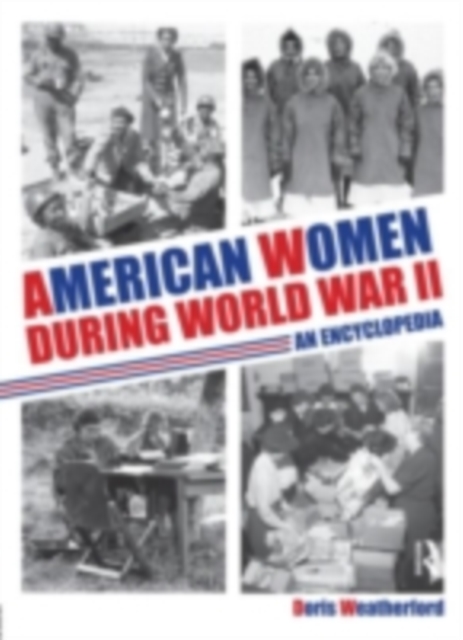
American Women during World War II
American Women during World War II documents the lives and stories of women who contributed directly to the war effort via official and semi-official military organizations, as well as the millions of women who worked in civilian defense industries, ranging from aircraft maintenance to munitions manufacturing and much more. It also illuminates how the war changed the lives of women in more traditional home front roles. All women had to cope with rationing of basic household goods, and most women volunteered in war-related programs. Other entries discuss institutional change, as the war affected every aspect of life, including as schools, hospitals, and even religion.
American Women during World War II provides a handy one-volume collection of information and images suitable for any public or professional library.
'Overall it's a splendid, fascinating piece of impeccably well researched work and in its aim to be a \"handy\" reference resource,it more than succeeds!' - Oscar Courtney, Reference Reviews
\"Many encyclopedias and dictionaries have been published on World War II, with some coverage of women, but Weatherford’s work fills a major gap in reference books on this era. The encyclopedia will be of use to college and university libraries as well as public and high school libraries. …Highly recommended.\" —Vanette Schwartz, Feminist Collections, Vol. 31, Num. 3, Summer 2010
Doris Weatherford has published on American women for over twenty years, including the four-volume History of Women in the United States: A State-by-State Reference. She’s associated with the Center for Florida History at Florida Southern College and the National Women’s History Museum in Washington D.C.
eBook


Nursing Civil Rights
In Nursing Civil Rights, Charissa J. Threat investigates the parallel battles against occupational segregation by African American women and white men in the U.S. Army.
As Threat reveals, both groups viewed their circumstances with the Army Nurse Corps as a civil rights matter. Each conducted separate integration campaigns to end the discrimination they suffered. Yet their stories defy the narrative that civil rights struggles inevitably arced toward social justice. Threat tells how progressive elements in the campaigns did indeed break down barriers in both military and civilian nursing. At the same time, she follows conservative threads to portray how some of the women who succeeded as agents of change became defenders of exclusionary practices when men sought military nursing careers. The ironic result was a struggle that simultaneously confronted and reaffirmed the social hierarchies that nurtured discrimination.
eBook