
Catalogue Search | MBRL


Are you sure you want to remove the book from the shelf?

{{itemTitle}}
41
result(s) for
"World War, 1939-1945-Pacific Area"
Sort by:

Australia 1943 : the liberation of New Guinea
By January 1943, Australia had emerged from the shadow of war in a strong position. The victories in 1942 at Kokoda, Guadalcanal, Buna, Gona and Sanananda had secured the northern coastlines of Papua and Australia. Australian forces were now poised for a full scale offensive to liberate New Guinea from the Japanese, the largest and most complicated operations in their history. Australia 1943 explores the high point of Australia's influence on operations and strategy in the South West Pacific, a campaign that has been traditionally overshadowed by the drama of Kokoda. It investigates critical operations from January 1943 to April 1944, including Salamaua, Lae/Nadzab, Finschhafen, Shaggy Ridge, the Markham Valley and the Huon Peninsula. Australia 1943 is the first detailed single-volume study of Australia's military operations in the Pacific during 1943 - Australia's 'finest hour' in the Second World War.
Book

Richard Sorge, the GRU and the Pacific War
Sorge's activities between 1930 and 1942 have tended to be lauded as those of a superlative human intelligence operator and the Soviet Union's GRU (Soviet military intelligence unit) as the optimum of spy-masters.
eBook

To Have and Have Not
Jonathan Marshall makes a provocative statement: it was not ideological or national security considerations that led the United States into war with Japan in 1941. Instead, he argues, it was a struggle for access to Southeast Asia's vast storehouse of commodities-rubber, oil, and tin-that drew the United States into the conflict. Boldly departing from conventional wisdom, Marshall reexamines the political landscape of the time and recreates the mounting tension and fear that gripped U.S. officials in the months before the war. Unusual in its extensive use of previously ignored documents and studies, this work records the dilemmas of the Roosevelt administration: it initially hoped to avoid conflict with Japan and, after many diplomatic overtures, it came to see war as inevitable. Marshall also explores the ways that international conflicts often stem from rivalries over land, food, energy, and industry. His insights into \"resource war,\" the competition for essential commodities, will shed new light on U.S. involvement in other conflicts-notably in Vietnam and the Persian Gulf. This title is part of UC Press's Voices Revived program, which commemorates University of California Press's mission to seek out and cultivate the brightest minds and give them voice, reach, and impact. Drawing on a backlist dating to 1893, Voices Revived makes high-quality, peer-reviewed scholarship accessible once again using print-on-demand technology. This title was originally published in 1995.
eBook

World War II. The Pacific
Written from a British perspective, this book discusses some of the key moments during the Pacific campaigns of World War II, along with personal anecdotes of soldiers and civilians.
Book
War, Conflict and Security in Japan and Asia Pacific, 1941-1952
Louis Allen's work on Japan dominated his prodigious output as a scholar, researcher and writer and received great attention internationally. This collection focuses on Japan and the Pacific War, the post-war conflicts in Burma, Malaya and Indochina, and the immediate post-war years in the context of Japan, security and reconciliation.
eBook

Retribution : the battle for Japan, 1944-45
By the summer of 1944 it was clear that Japan's defeat was inevitable, but how the drive to victory would be achieved remained to be seen. The ensuing drama--that ended in Japan's utter devastation--was acted out across the vast stage of Asia. In recounting the saga of this time and place, Max Hastings gives us incisive portraits of the theater's key figures--MacArthur, Nimitz, Mountbatten, Chiang Kai-shek, Mao, Roosevelt, Churchill, and Stalin. But he is equally adept in his portrayals of the ordinary soldiers and sailors--American, British, Russian, Chinese, and Japanese--caught in some of the war's bloodiest campaigns. With unprecedented insight, Hastings discusses Japan's war against China, now all but forgotten in the West, MacArthur's follies in the Philippines, the Marines at Iwo Jima and Okinawa, and the Soviet blitzkrieg in Manchuria. He analyzes the decision-making process that led to the bombing of Hiroshima and Nagasaki--which, he convincingly argues, ultimately saved lives. Finally, he delves into the Japanese wartime mind-set, which caused an otherwise civilized society to carry out atrocities that haunt the nation to this day.
BOOK

Southwest Passage
At a time when few Americans had visited Australia, journalist John Lardner sailed down under with the U.S.armed forces as one of the first American war correspondents in the Pacific theater.
eBook

World War Two. Against the rising sun
\"World War Two: Against The Rising Sun focuses on the war in the East. The story is told through the eyes of servicemen and civilians on both sides of the conflict, giving a full and thorough picture of the war and why it happened.'-- Amazon.
Book
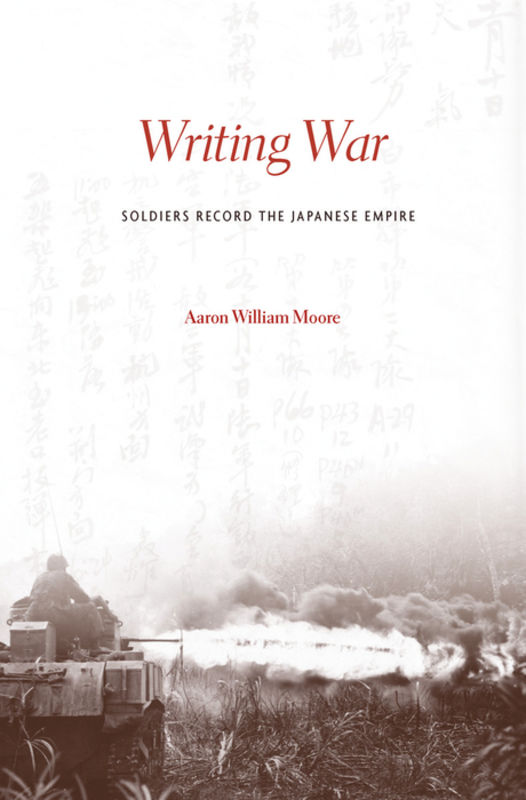
Writing war : soldiers record the Japanese Empire
Writing War examines over two hundred diaries, and many more letters, postcards, and memoirs, written by Chinese, Japanese, and American servicemen in the Pacific from 1937 to 1945. As he describes conflicts that have often been overlooked by historians, Aaron William Moore reflects on diaries as tools in the construction of modern identity.
eBook