
Catalogue Search | MBRL


Are you sure you want to remove the book from the shelf?

{{itemTitle}}
3,012
result(s) for
"World maps"
Sort by:

Lloyd's maritime atlas of world ports and shipping places 2020-2021
Published since 1951, Lloyd's Maritime Atlas is the oldest and most respected atlas in the shipping industry. A comprehensive reference for locating the world's busiest ports and shipping places, this new edition has been fully updated and enhanced with brand new maps and features to alleviate the demands on today's busy shipping professional.
Book

An Ottoman cosmography : translation of Cihānnümā
Cihannüma is the summa of Ottoman geography and one of the axial texts of Islamic intellectual history. Katib Çelebi (d. 1657) sought to combine the Islamic geographical tradition with the new European discoveries, atlases and surveys. His cosmography included a comprehensive description of the regions of the world, extending westward from Japan and as far as the eastern Ottoman provinces. Ebu Bekr b. Behram ed-Dimaski (d. 1691) continued with a survey of the Arab countries and the remaining Ottoman provinces of Anatolia. Ibrahim Müteferrika combined the two, with additional notes and maps of his own, in one of the earliest Ottoman printed books, Kitab-i Cihannüma (1732). Our translation includes the entire text of MuÞteferrik?a's edition, distinguishing clearly between the contributions of the three authors. Based on Katib Çelebi's original manuscript we have made hundreds of corrections to Müteferrika's text. Additional corrections are based on comparison with Katib Çelebi's Arabic, Persian, Turkish, Latin and Italian sources.
eBook


The Piri Reis map of 1513
One of the most beautiful maps to survive the Great Age of Discoveries, the 1513 world map drawn by Ottoman admiral Piri Reis is also one of the most mysterious. Gregory McIntosh has uncovered new evidence in the map that shows it to be among the most important ever made.
This detailed study offers new commentary and explication of a major milestone in cartography. Correcting earlier work of Paul Kahle and pointing out the traps that have caught subsequent scholars, McIntosh disproves the dubious conclusion that the Reis map embodied Columbus's Third Voyage map of 1498, showing that it draws instead on the Second Voyage of 1493-1496. He also refutes the popular misinterpretation that Reis's depictions of Antarctica are evidence of either ancient civilizations or extraterrestrial visitation. McIntosh brings together all that has been previously known about the map and also assembles for the first time the translations of all inscriptions on the map and analyzes all place-names given for New World and Atlantic islands. His work clarifies long-standing mysteries and opens up new ways of looking at the history of exploration.
eBook


Children and Implicated Actors Within Social Worlds/Arenas Maps: Reconsidering Situational Analysis From a Childhood Studies Perspective
We discuss situational analysis as an auspicious method for researchers in childhood studies due to its critical-reflexive approach towards power relations, marginalization, and relationalities of collective action—which are topical issues within childhood studies. Especially the position of \"implicated actors\" (CLARKE & MONTINI, 1993, p.45), a key concept of social worlds/arenas theory, seems conducive towards research about children. However, we also raise concerns about potentially re-marginalizing children in and through research when it is assumed that, as implicated actors, they are not involved in social worlds/arenas and therefore also not involved in social action. We discuss the methodological potentials and pitfalls of social worlds/arenas maps and the use of the concept of implicated actors to analyze children and childhood. We draw from empirical projects and central conceptual debates within childhood studies and focus on three theses: With social worlds/arenas maps 1. researchers are at risk of rendering children invisible; 2. researchers cannot (yet) capture the intragenerational relations of children (as implicated actors); 3. researchers cannot fully account for a relational understanding of children and childhood. Based on these considerations, we suggest how to enable and reconsider the analysis of children and childhood with social worlds/arenas maps using situational analysis.
Journal Article
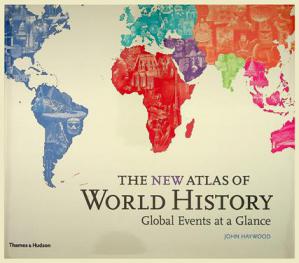
The new atlas of world history : global events at a glance
Features 55 colour maps that cover the whole of human history, from 6 million years ago to present. Timelines include important cultures, events, and developments. Maps and timelines also come with concise introductions that summarize key data such as the world's five largest cities and total world population for the relevant year. An extensive glossary of peoples, nations and cultures gives added depth to the maps and timelines.
Book

Making an Impression: The Display of Maps in Sixteenth-Century Venetian Homes
Sixteenth-century Venetians decorated the walls of their homes with maps as well as pictures of all kinds. A large corpus of inventories of household goods records the location of these wall decorations and, together with books offering advice on the display of maps, provides evidence that maps were intentionally placed in the most public spaces in the house. The manuals also confirm the impression gained from the inventories that the maps were valued for their ability to construct a public identity for the owner. They were versatile objects that could demonstrate that the owner was a cultured, cosmopolitan man educated about the world, reinforce his professional or trade standing, or enhance a military persona, all to the glorification of the family name.
Journal Article

Timelines : the events that shaped history
An original new way of appreciating the vast series of events that have shaped world history, allowing complete and quick comparability between different periods and regions. In Timelines, John Haywood presents a grand sweep of global history in an immediately accessible format. Using concise, insightful, and engaging text summaries alongside timelines, maps, and illustrations, Haywood takes the reader from the origins of our first ancestors up to the present day. A short essay introduces and summarizes the most important political and cultural landmarks, with a clear timeline then presenting events in four categories: \"Politics & Economy,\" \"Religion & Philosophy,\" \"Science & Technology,\" and \"Arts & Architecture.\"
Book

Mirror of the Worlde
The Mirror of the Worlde is an important addition to the canon of Elizabeth Tanfield Cary. Best known for her play The Tragedy of Mariam, Cary is revealed here as a sheltered but precocious child who translated the texts accompanying the maps in an early modern atlas when she was no more than twelve. This book identifies the source text and makes widely available for the first time the full transcription of Elizabeth Cary's manuscript translation of L'Epitome du Théâtre du Monde d'Abraham Ortelius (c. 1588). Dedicated to her mother's well-connected aristocratic uncle, Sir Henry Lee, The Mirror of the Worlde - one of the first known English versions of Ortelius - is a rich source of information about her childhood and education, the writers who influenced her, and the emerging themes and preoccupations that would come to inform her later work. Peterson's critical edition illuminates the strategies by which this savvy young writer finds means to comment on the atlas' descriptions, reveals an active and original authorial presence, and suggests a much earlier interest in Catholicism than biographers have hitherto considered. An impressive work of apprenticeship, The Mirror of the Worlde shows Cary honing her poetic craft, mastering the rhetoric of polite resistance, and, above all, thinking critically about the place of women in the wide, wonderful, and often violent world that Ortelius depicted.
eBook