
Catalogue Search | MBRL


Are you sure you want to remove the book from the shelf?

{{itemTitle}}
1,248
result(s) for
"World politics -- 21st century"
Sort by:


America's mission
America's Missionargues that the global strength and prestige of democracy today are due in large part to America's impact on international affairs. Tony Smith documents the extraordinary history of how American foreign policy has been used to try to promote democracy worldwide, an effort that enjoyed its greatest triumphs in the occupations of Japan and Germany but suffered huge setbacks in Latin America, Vietnam, and elsewhere. With new chapters and a new introduction and epilogue, this expanded edition also traces U.S. attempts to spread democracy more recently, under presidents Clinton, Bush, and Obama, and assesses America's role in the Arab Spring.
eBook

The rise and fall of peace on Earth
\"The Rise and Fall of Peace on Earth examines that singularly peaceful quarter century. Its initial three chapters describe how and why peace came to be established in three important parts of the world: Europe (Chapter 1), where it was most firmly embedded; East Asia (Chapter 2), which was more peaceful than at any other time in its modern history; and the Middle East (Chapter 3), the least peaceful of the three regions during those 25 years. These chapters also describe and explain how and why the unprecedentedly peaceful conditions in each of the three regions came to an end. The fourth and final chapter explores the prospects for the revival of peace in the future\"-- Provided by publisher.
Book

How enemies become friends
Is the world destined to suffer endless cycles of conflict and war? Can rival nations become partners and establish a lasting and stable peace?How Enemies Become Friendsprovides a bold and innovative account of how nations escape geopolitical competition and replace hostility with friendship. Through compelling analysis and rich historical examples that span the globe and range from the thirteenth century through the present, foreign policy expert Charles Kupchan explores how adversaries can transform enmity into amity--and he exposes prevalent myths about the causes of peace.
Kupchan contends that diplomatic engagement with rivals, far from being appeasement, is critical to rapprochement between adversaries. Diplomacy, not economic interdependence, is the currency of peace; concessions and strategic accommodation promote the mutual trust needed to build an international society. The nature of regimes matters much less than commonly thought: countries, including the United States, should deal with other states based on their foreign policy behavior rather than on whether they are democracies. Kupchan demonstrates that similar social orders and similar ethnicities, races, or religions help nations achieve stable peace. He considers many historical successes and failures, including the onset of friendship between the United States and Great Britain in the early twentieth century, the Concert of Europe, which preserved peace after 1815 but collapsed following revolutions in 1848, and the remarkably close partnership of the Soviet Union and China in the 1950s, which descended into open rivalry by the 1960s.
In a world where conflict among nations seems inescapable,How Enemies Become Friendsoffers critical insights for building lasting peace.
eBook


Strategic Vision
One of the wise men of American foreign policy explains America's vital role in achieving global stability and provides a long-term strategic vision for America.
eBook

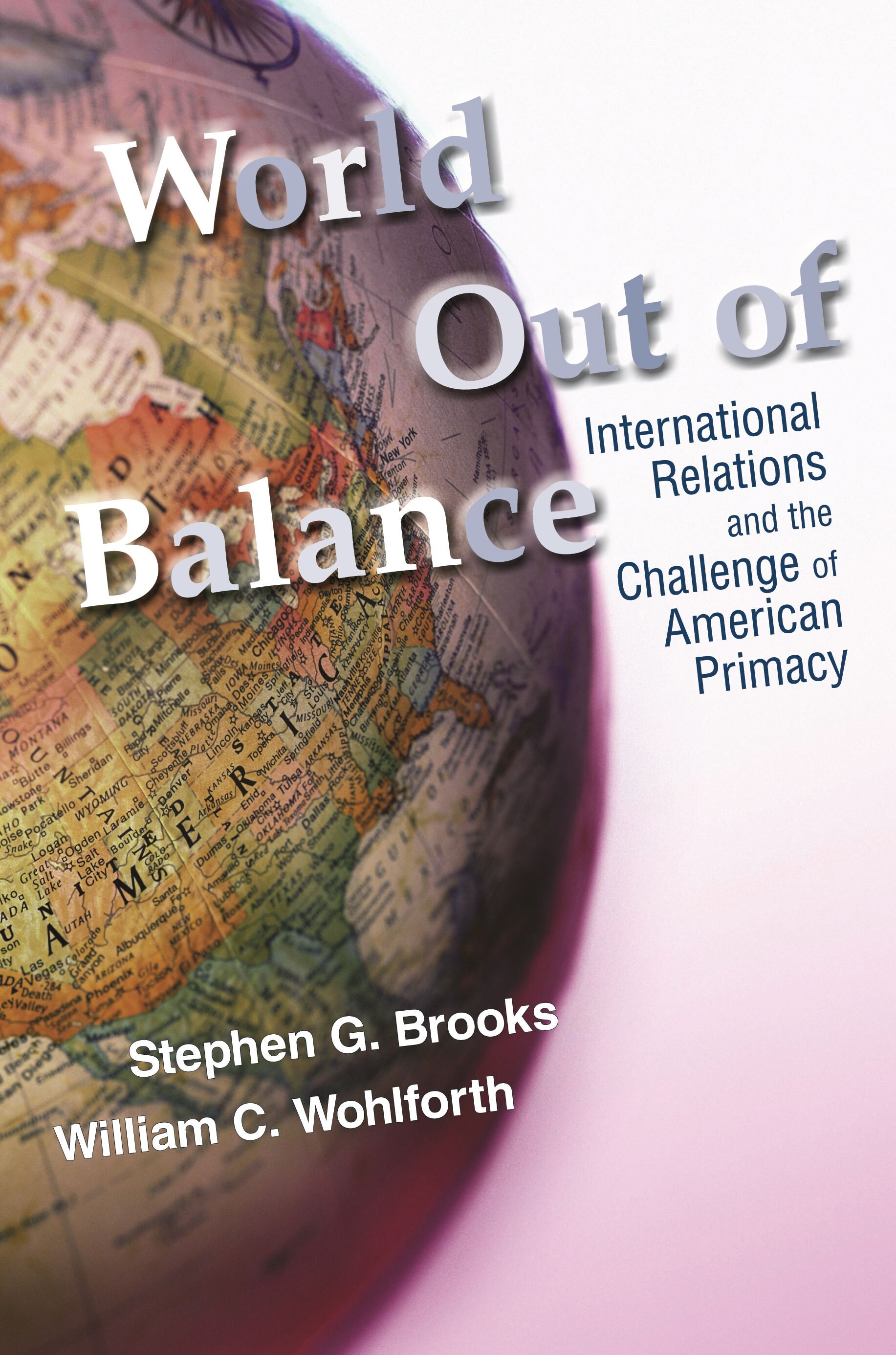
World Out of Balance
World Out of Balanceis the most comprehensive analysis to date of the constraints on the United States' use of power in pursuit of its security interests. Stephen Brooks and William Wohlforth overturn conventional wisdom by showing that in a unipolar system, where the United States is dominant in the scales of world power, the constraints featured in international relations theory are generally inapplicable. In fact, the authors argue that the U.S. will not soon lose its leadership position; rather, it stands before a twenty-year window of opportunity for reshaping the international system.
Although American primacy in the world is unprecedented, analysts routinely stress the limited utility of such preeminence. The authors examine arguments from each of the main international relations theories--realism, institutionalism, constructivism, and liberalism. They also cover the four established external constraints on U.S. security policy--international institutions, economic interdependence, legitimacy, and balancing. The prevailing view is that these external constraints conspire to undermine the value of U.S. primacy, greatly restricting the range of security policies the country can pursue. Brooks and Wohlforth show that, in actuality, the international environment does not tightly constrain U.S. security policy.World Out of Balanceunderscores the need for an entirely new research agenda to better understand the contours of international politics and the United States' place in the world order.
eBook

The rise of populism : Stephen K. Bannon vs. David Frum : the Munk debates
\"Throughout the Western world, politics is undergoing a sea-change. Long-held notions of the role of government, trade and economic policy, foreign policy, and immigration are being challenged by populist thinkers and movements. Does this surging populist agenda in Western nations signal a permanent shift in our politics? Or is it a passing phenomenon that will remain at the fringes of society and political power? Will our politics continue to be shaped by the post-war consensus on trade, inclusive national identity, and globalization, or by the agenda of insurgent populist politics, parties, and leaders? The twenty-third semi-annual Munk Debate pits former Donald Trump advisor Stephen K. Bannon against columnist and public intellectual David Frum to debate the future of the liberal political order.\"-- Provided by publisher.
Book

The Economics of Killing
Globalisation has created an interconnected world, but has not diminished violence, militarism and inequality. This book describes how the entrenched power of global elites has created a deadly cycle of violence, enacted through the military industrial complex. Vijay Mehta shows how attempts at peaceful national development, environmental sustainability and human rights are routinely blocked by Western powers. He locates the 2008 financial crisis in US attempts to block China's model of development. He shows how Europe and the US conspire with regional dictators to prevent countries from developing advanced industries, and how this system has fed terrorism. The Economics of Killing argues that a different world is possible, based on policies of disarmament, demilitarisation and sustainable development.
eBook