
Catalogue Search | MBRL


Are you sure you want to remove the book from the shelf?

{{itemTitle}}
223
result(s) for
"World politics Forecasting."
Sort by:


Geopolitical Economy
Geopolitical Economy radically reinterprets the historical evolution of the world order, as a multi-polar world emerges from the dust of the financial and economic crisis. Radhika Desai offers a radical critique of the theories of US hegemony, globalisation and empire which dominate academic international political economy and international relations, revealing their ideological origins in successive failed US attempts at world dominance through the dollar. Desai revitalizes revolutionary intellectual traditions which combine class and national perspectives on ‘the relations of producing nations’. At a time of global upheavals and profound shifts in the distribution of world power, Geopolitical Economy forges a vivid and compelling account of the historical processes which are shaping the contemporary international order.
eBook


Strategic Vision
One of the wise men of American foreign policy explains America's vital role in achieving global stability and provides a long-term strategic vision for America.
eBook

The Lockwood Analytical Method for Prediction (LAMP) : a method for predictive intelligence analysis
\"The Lockwood Analytical Method for Prediction (LAMP) is a systematic technique for predicting short-term, unique behaviors. Using primarily qualitative empirical data, LAMP allows the analyst to predict the most likely outcomes for specific research questions across a wide range of intelligence problems, such as cyber threats in the U.S., the possibility of an Al Qaeda attack, the likelihood of Iran providing nuclear capability to terrorist groups, or the future actions of the Mexican drug cartel. LAMP offers an innovative and powerful method for organizing all available information based on the perceptions of the national actors, using it to make relevant predictions as to which alternate future is most likely to occur at a given moment in time. Its transparent structure enables anyone to see how an analyst gets from point A to point B to produce an intelligence estimate. LAMP differs from other analytical techniques in that it is based on determining the relative probability of a range of alternate futures, rather than attempting to determine the quantitative probability of their occurrence. After explaining its theoretical framework, the text leads the reader through the process of predictive analysis before providing practical case studies showing how LAMP is applied against real world problems, such as the possible responses of Israel, the U.S., and Lebanon to the behavior of Hezbollah or the competing visions of the future of Afghanistan. Evaluation of the method is provided with the case studies to show the effectiveness of the LAMP predictions over time. The book is complemented by a website with downloadable software for use by students of intelligence in conducting their own predictive analysis. It will be an essential tool for the analyst and the student, not only for national security issues but also for competitive intelligence\"-- Provided by publisher.
Book

Maxwell's demon and the golden apple : global discord in the new millennium
Mixing myth, entropy, and Angry Birds, Randall Schweller brings a novel perspective to international studies.
Just what exactly will follow the American century? This is the question Randall L. Schweller explores in his provocative assessment of international politics in the twenty-first century.
Schweller considers the future of world politics, correlating our reliance on technology and our multitasking, distracted, disorganized lives with a fragmenting world order. He combines the Greek myth of the Golden Apple of Discord, which explains the start of the Trojan War, with a look at the second law of thermodynamics, or entropy.
\"In the coming age, \" Schweller writes, \"disorder will reign supreme as the world succumbs to... entropy, an irreversible process of disorganization that governs the direction of all physical changes taking place in the universe.\" Interweaving his theory of global disorder with issues on the world stage—coupled with a disquisition on board games and the cell phone app \"Angry Birds\"—Schweller's thesis yields astonishing insights.
Maxwell's Demon and the Golden Apple will appeal to leaders of multinational corporations and government programs as well as instructors of undergraduate courses in international relations.
eBook

Strategic vision : America and the crisis of global power
In 1991, the United States was the only global superpower. It seemed that the 21st century, like the 20th, would belong to America. Then came the stock market bubble, the costly foreign unilateralism of the younger Bush presidency, and the financial catastrophe of 2008. Meanwhile, China was rising and the Middle East was awakening politically. Today it is clear that America is vulnerable--to domestic and international decline and unregulated greed. Speaking from decades of experience, Brzezinski considers the implications of the changing distribution of global power, ponders why America's global appeal is waning, speculates on the likely geopolitical consequences if America declines by 2025 (will China assume America's central role in world affairs?), and describes a vision of a resurgent America: responsive to challenges, strategically deliberate, and historically enlightened in its global engagement with the new East.--Publisher description.
Book
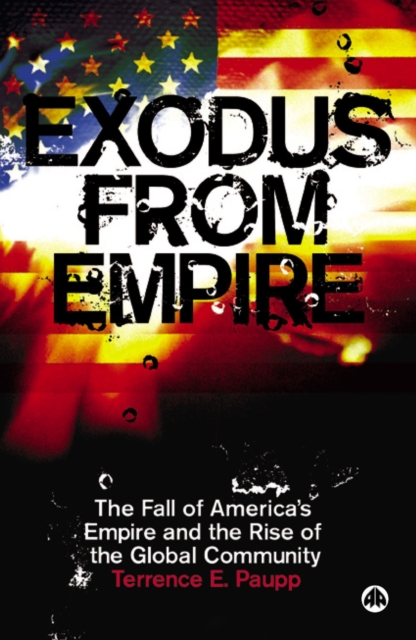
Exodus From Empire
This book lays out a comprehensive vision for a new world order based on cooperation between the developing world and leading Left countries in Latin America.
Arguing that the ravages of corporate capitalism are unsustainable, Terrence E. Paupp presents an energetic critique of the problems of empire, and looks ahead to a global countermovement against the IMF and US hegemony.
eBook


Alternatives: The United States Confronts the World
Immanuel Wallerstein draws on a lifetime of study of long-term historical change to shed light in his newest book on the consequences of the recent, significant turn in U.S. foreign and economic policies. Alternatives shows how the U.S. has been in decline since the 1970s and how these longer trends dovetail with current Bush administration policies, which he describes as an attempt to reverse the decline in ways that are disastrous to the future of the country and the world. The book's middle section is a log of insightful commentaries written between 2001 and 2004 detailing how the Bush administration has broken the pattern of foreign policies set by six presidents from Richard Nixon to Bill Clinton. Wallerstein suggests that a threshold has been crossed that will make it difficult for future presidents to practice the kind of 'soft' multilateralism in foreign policy they have used in the past and maintain effective alliances. He also shows, surprisingly, why 'globalization' already is dead, especially in terms of the United States' ability to dominate economically in the manner that it has since WWII. He calls for a major revision of U.S. policies, and not an attempt merely to return to the pre-Bush foreign policy. In conclusion, Wallerstein's visionary book speaks to the challenges the U.S. must face if it is to play a meaningful and progressive role in the world-system.
eBook