
Catalogue Search | MBRL


Are you sure you want to remove the book from the shelf?

{{itemTitle}}
4,863
result(s) for
"World politics Philosophy."
Sort by:


Politics of the Event
Despite occupying a central role and frequently being used in the study of international politics, the concept of the \"event\" remains in many ways unchallenged and unexplored. By combining the philosophy of Gilles Deleuze and his concept of the event with the example of 9/11 as an historical event, this book problematises the role and meaning of \"events\" in international politics.
Lundborg seeks to demonstrate how the historical event can be analysed as a practice of inscribing temporal borders and distinctions. Specifically he shows how this practice relies upon an ongoing process of capturing various movements - of thought, sense, experience and becoming. However the book also demonstrates how these same movements express a life and reality that elude complete capture, highlighting the potential for alternative encounters with the event, encounters that constantly threaten to undermine the limits and imaginary completeness of the historical event.
This book offers an exciting new way of thinking about the politics of encountering events, arguing that at the heart of such encounters there are always elements of uncertainty and contingency that cannot be fully resolved or fixed. It will be of great interest to students and scholars of international relations, cultural studies and history.
eBook

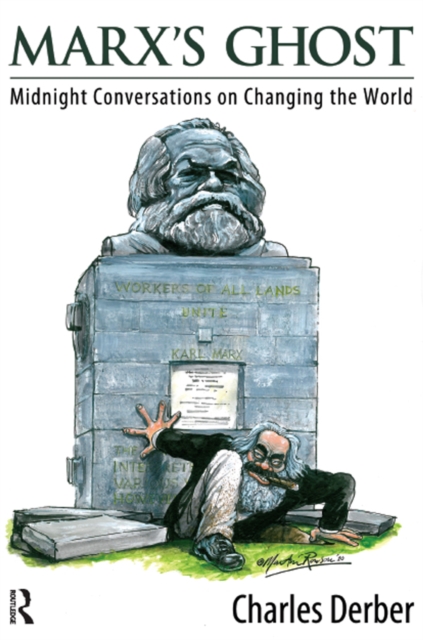
Marx's Ghost
Renowned American sociologist Charles Derber imagines a surprise encounter with Karl Marx's ghost in London's Highgate cemetery, leading to a night-long conversation about the problems plaguing the world. The economic crisis, climate change, war, the future of capitalism and the 'Arab Spring' are all discussed. The ghost reconsiders his theories as he speaks eloquently about American labour, environmental, gender and anti-racist struggles. The engrossing, funny and provocative conversation, with appearances from other ghosts such as John Maynard Keynes, offers new insights into the relevance and flaws of Marx's thought, indicating how we can get to a better world.
eBook


History and Neorealism
Neorealists argue that all states aim to acquire power and that state cooperation can therefore only be temporary, based on a common opposition to a third country. This view condemns the world to endless conflict for the indefinite future. Based upon careful attention to actual historical outcomes, this book contends that, while some countries and leaders have demonstrated excessive power drives, others have essentially underplayed their power and sought less position and influence than their comparative strength might have justified. Featuring case studies from across the globe, History and Neorealism examines how states have actually acted. The authors conclude that leadership, domestic politics, and the domain (of gain or loss) in which they reside play an important role along with international factors in raising the possibility of a world in which conflict does not remain constant and, though not eliminated, can be progressively reduced.
eBook


Political Religion: From the Global and the Regional to Jerusalem and Back
Instead of Christians fighting one another, he wanted Christians to go to the East and fight Muslims. Since European kingdoms were financially exhausted, one means to fund the successive Crusades was to borrow money from those who had it. According to reliable sources, Palestinian prisons are now home to dozens of Islamic prisoners not categorized as members of Hamas or Islamic Jihad, but as Hamas Extremists, which I believe is a subtle and disguised name for ISIS.
Journal Article

Debating modern revolution : the evolution of revolutionary ideas
\"Revolution is an idea that has been one of the most important drivers of human activity since its emergence in its modern form in the 18th century. From the American and French revolutionaries who upset a monarchical order that had dominated for over a millennium up to the Arab Spring, this notion continues but has also developed its meanings. Equated with democracy and legal equality at first and surprisingly redefined into its modern meaning, revolution has become a means to create nations, change the social order, and throw out colonial occupiers, and has been labelled as both conservative and reactionary. In this concise introduction to the topic, Jack R. Censer charts the development of these competing ideas and definitions in four chronological sections. Each section includes a debate from protagonists who represent various forms of revolution and counterrevolution, allowing students a firmer grasp on the particular ideas and individuals of each era. This book offers a new approach to the topic of revolution for all students of world history\"-- Provided by publisher.
Book