
Catalogue Search | MBRL


Are you sure you want to remove the book from the shelf?

{{itemTitle}}
15
result(s) for
"Writing, Invisible History."
Sort by:

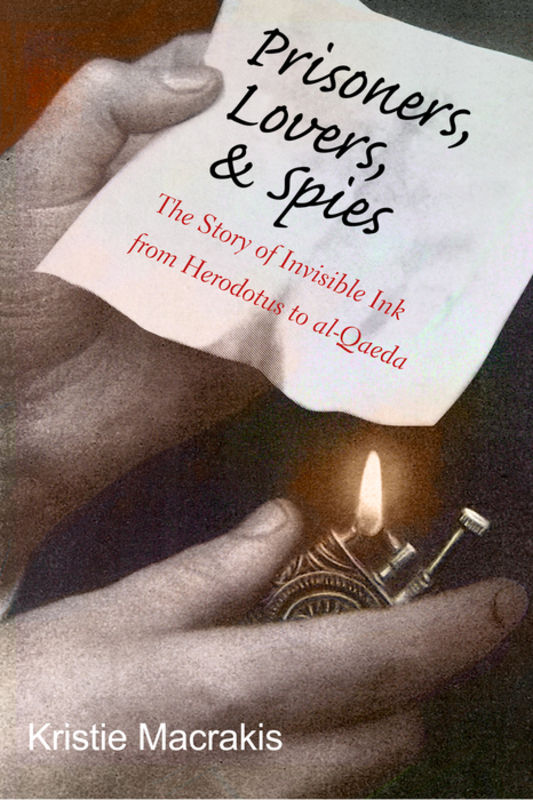
Prisoners, Lovers, and Spies
Prisoners, Lovers, and Spiesis a book about concealing and revealing secret communications. It is the first history of invisible writing, uncovered through stories about scoundrels and heroes. Spies were imprisoned or murdered, adultery unmasked, and battles lost because of faulty or intercepted secret communications. Yet, successfully hidden writing helped save lives, win battles, and ensure privacy; occasionally it even changed the course of history.Kristie Macrakis combines a storyteller's sense of drama with a historian's respect for evidence in this page-turning history of intrigue and espionage, love and war, magic and secrecy. From the piazzas of ancient Rome to the spy capitals of the Cold War, Macrakis's global history reveals the drama and importance of invisible ink. From Ovid's advice to use milk for illicit love notes, to John Gerard's dramatic escape from the tower of London aided by orange juice ink messages, to al-Qaeda's hidden instructions in pornographic movies, this book presents spellbinding stories of secret messaging that chart its evolution in sophistication and its impact on history. An appendix includes fun kitchen chemistry recipes for readers to try out at home.
eBook
Reading Obama
Derided by the Right as dangerous and by the Left as spineless, Barack Obama puzzles observers. InReading Obama, James T. Kloppenberg reveals the sources of Obama's ideas and explains why his principled aversion to absolutes does not fit contemporary partisan categories. Obama's commitments to deliberation and experimentation derive from sustained engagement with American democratic thought. In a new preface, Kloppenberg explains why Obama has stuck with his commitment to compromise in the first three years of his presidency, despite the criticism it has provoked.
Reading Obamatraces the origins of his ideas and establishes him as the most penetrating political thinker elected to the presidency in the past century. Kloppenberg demonstrates the influences that have shaped Obama's distinctive worldview, including Nietzsche and Niebuhr, Ellison and Rawls, and recent theorists engaged in debates about feminism, critical race theory, and cultural norms. Examining Obama's views on the Constitution, slavery and the Civil War, the New Deal, and the civil rights movement, Kloppenberg shows Obama's sophisticated understanding of American history. Obama's interest in compromise, reasoned public debate, and the patient nurturing of civility is a sign of strength, not weakness, Kloppenberg argues. He locates its roots in Madison, Lincoln, and especially in the philosophical pragmatism of William James and John Dewey, which nourished generations of American progressives, black and white, female and male, through much of the twentieth century, albeit with mixed results.
Reading Obamareveals the sources of Obama's commitment to democratic deliberation: the books he has read, the visionaries who have inspired him, the social movements and personal struggles that have shaped his thinking. Kloppenberg shows that Obama's positions on social justice, religion, race, family, and America's role in the world do not stem from a desire to please everyone but from deeply rooted--although currently unfashionable--convictions about how a democracy must deal with difference and conflict.
eBook

Inside Paradise Lost
Inside \"Paradise Lost\"opens up new readings and ways of reading Milton's epic poem by mapping out the intricacies of its narrative and symbolic designs and by revealing and exploring the deeply allusive texture of its verse. David Quint's comprehensive study demonstrates how systematic patterns of allusion and keywords give structure and coherence both to individual books ofParadise Lostand to the overarching relationship among its books and episodes. Looking at poems within the poem, Quint provides new interpretations as he takes readers through the major subjects ofParadise Lost-its relationship to epic tradition and the Bible, its cosmology and politics, and its dramas of human choice.
Quint shows how Milton radically revises the epic tradition and the Genesis story itself by arguing that it is better to create than destroy, by telling the reader to make love, not war, and by appearing to ratify Adam's decision to fall and die with his wife. The Milton of thisParadise Lostis a Christian humanist who believes in the power and freedom of human moral agency. As this indispensable guide and reference takes us inside the poetry of Milton's masterpiece,Paradise Lostreveals itself in new formal configurations and unsuspected levels of meaning and design.
eBook

On Adam Smith's Wealth of Nations
Adam Smith was a philosopher before he ever wrote about economics, yet until now there has never been a philosophical commentary on the Wealth of Nations. Samuel Fleischacker suggests that Smith's vastly influential treatise on economics can be better understood if placed in the light of his epistemology, philosophy of science, and moral theory. He lays out the relevance of these aspects of Smith's thought to specific themes in the Wealth of Nations, arguing, among other things, that Smith regards social science as an extension of common sense rather than as a discipline to be approached mathematically, that he has moral as well as pragmatic reasons for approving of capitalism, and that he has an unusually strong belief in human equality that leads him to anticipate, if not quite endorse, the modern doctrine of distributive justice. Fleischacker also places Smith's views in relation to the work of his contemporaries, especially his teacher Francis Hutcheson and friend David Hume, and draws out consequences of Smith's thought for present-day political and philosophical debates. The Companion is divided into five general sections, which can be read independently of one another. It contains an index that points to commentary on specific passages in Wealth of Nations. Written in an approachable style befitting Smith's own clear yet finely honed rhetoric, it is intended for professional philosophers and political economists as well as those coming to Smith for the first time.
eBook

The Twilight of the Middle Class
In The Twilight of the Middle Class, Andrew Hoberek challenges the commonly held notion that post-World War II American fiction eschewed the economic for the psychological or the spiritual. Reading works by Ayn Rand, Ralph Ellison, Saul Bellow, Phillip Roth, Flannery O'Connor, Thomas Pynchon, Don DeLillo, and others, he shows how both the form and content of postwar fiction responded to the transformation of the American middle class from small property owners to white-collar employees. In the process, he produces \"compelling new accounts of identity politics and postmodernism that will be of interest to anyone who reads or teaches contemporary fiction. Hoberek argues that despite the financial gains and job security enjoyed by the postwar middle class, the transition to white-collar employment paved the way for its current precarious state in a country marked by increasingly deep class divisions. Postwar fiction provided the middle class with various imaginative substitutes for its former property-owning independence, substitutes that since then have not only allowed but abetted this class's downward mobility. To read this fiction in the light of the middle-class experience is thus not only to restore the severed connections between literary and economic \"history in the second half of the twentieth \"century, but to explore the roots of the contemporary crisis of the middle class.
eBook

The Hidden Past of Invisible Ink
For many people, the words invisible ink readily conjure up images of childhood fun with lemon juice and a candle, or spy messages during wartime. And there is a good reason for this association, because secret writing has long been part of the worlds of both magical entertainment and international intrigue. But it also has an overlooked long, colorful, and little-known history.
Journal Article

The Bells in Their Silence
Nobody writes travelogues about Germany. The country spurs many anxious volumes of investigative reporting--books that worry away at the \"German problem,\" World War II, the legacy of the Holocaust, the Wall, reunification, and the connections between them. But not travel books, not the free-ranging and impressionistic works of literary nonfiction we associate with V. S. Naipaul and Bruce Chatwin. What is it about Germany and the travel book that puts them seemingly at odds? With one foot in the library and one on the street, Michael Gorra offers both an answer to this question and his own traveler's tale of Germany.
Gorra uses Goethe's account of his Italian journey as a model for testing the traveler's response to Germany today, and he subjects the shopping arcades of contemporary German cities to the terms of Benjamin's Arcades project. He reads post-WendeBerlin through the novels of Theodor Fontane, examines the role of figurative language, and enlists W. G. Sebald as a guide to the place of fragments and digressions in travel writing.
Replete with the flaneur's chance discoveries--and rich in the delights of the enduring and the ephemeral, of architecture and flood--The Bells in Their Silenceoffers that rare traveler's tale of Germany while testing the very limits of the travel narrative as a literary form.
eBook

Technology as Prospective Ontology
Starting from common-sense notions of 'furniture of the world' a process ontology is developed in which prospective is an integral part. Technology as configurations that work (precariously) embodies expectations which structure further development. Examples (a cloned puppy, hotel keys, DC airplanes, stem cells, and overpasses on Long Island) are used to develop the notion of material narratives that are \"written\", not just by engineers and designers/producers, but also by users: \"reading\" implies some further \"writing\". In contrast to prevailing notions of technological control (through manipulation of building blocks), the \"writing\" of nanotechnology is modulation of the invisible and impredictable - an extreme example of unruly technology and repair work after the fact, where in practice control is a gesture not so different from magic. Because ontology cannot be other than prospective, it is political throughout. Thus, prospective technology highlights ontological politics.
Journal Article

The Rites of Identity
The Rites of Identityargues that Kenneth Burke was the most deciding influence on Ralph Ellison's writings, that Burke and Ellison are firmly situated within the American tradition of religious naturalism, and that this tradition--properly understood as religious--offers a highly useful means for considering contemporary identity and mitigating religious conflict.
Beth Eddy adds Burke and Ellison to a tradition of religious naturalism that traces back to Ralph Waldo Emerson but received its most nuanced expression in the work of George Santayana. Through close readings of the essays and fiction of Burke and Ellison, Eddy shows the extent to which their cultural criticisms are intertwined. Both offer a naturalized understanding of piety, explore the psychological and social dynamics of scapegoating, and propose comic religious resources. And both explicitly connect these religious categories to identity, be it religious, racial, national, ethnic, or gendered. Eddy--arguing that the most socially damaging uses of religious language and ritual are connected to the best uses that such language has to offer--finds in Burke and Ellison ways to manage this precarious situation and to mitigate religious violence through wise use of performative symbolic action.
By placing Burke and Ellison in a tradition of pragmatic thought,The Rites of Identityuncovers an antiessentialist approach to identity that serves the moral needs of a world that is constantly negotiating, performing, and ritualizing changes of identity.
eBook