
Catalogue Search | MBRL


Are you sure you want to remove the book from the shelf?

{{itemTitle}}
319
result(s) for
"Written communication Social aspects."
Sort by:

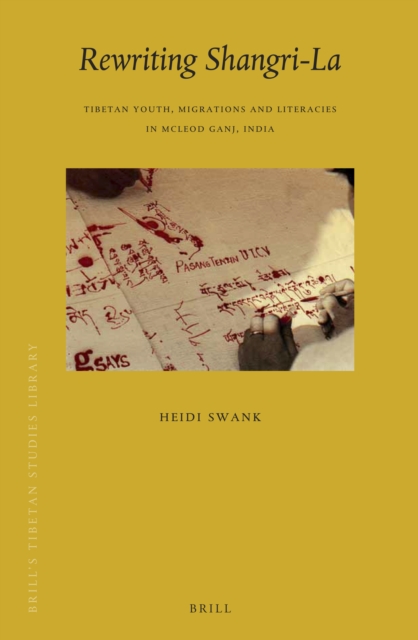
Rewriting Shangri-La : Tibetan youth, migrations and literacies in McLeod Ganj, India
In Rewriting Shangri-La: Migrations and Everyday Literacies among Tibetan Youth in McLeod Ganj, India, Heidi Swank examines differing histories of migration and exile through the lens of everyday literacies. The youth on whom this ethnography focuses live in a community that has long been romanticized by Tibetans and non-Tibetans alike, positioning these youth to see themselves as keepers of a modern day Shangri-la. Through this ethnography - based on a decade of research - Heidi Swank suggests that through seemingly mundane writings (grocery lists, text messages, etc.) these youth are shifting what Shangri-la means by renogotiating important aspects of life in this Tibetan community to better match their lived - not romanticized - experiences as exiles in rural India.
eBook

Writing for engagement : responsive practice for social action
\"As engagement becomes a trendy academic buzzword, we need sustained examinations of what this might mean in practice. This book investigates and models what writing studies scholars have found, both positive and negative, as they use writing to engage with and, ideally, better the communities in which they work\"-- Provided by publisher.
Book



Letter Writing in Late Modern Europe
Letter-writing instruction grew in importance as a learning tool in the Late Modern period because of its practical application to real-life situations. The vernacular had become the language of the educated, and the rising middle classes needed literacy skills to prepare for their vocations. The British Empire was growing and changing. Industrial centers were forming and trade to foreign ports increased, both of which demanded language competence. Letter writing reinforced grammar and composition skills in order for students to be successful. This study will investigate how schoolmasters used letter-writing assignments to improve literacy, teach grammar rules, and develop writing strategies, paying special attention to the earliest stages of this process, in the seventeenth and eighteenth centuries.
eBook


Kongo Graphic Writing and Other Narratives of the Sign
Written symbols, religious objects, oral traditions, and body language have long been integrated into the Kongo system of graphic writing of the Bakongo people in Central Africa as well as their Cuban descendants. The comprehensiveKongo Graphic Writing and Other Narratives of the Signprovides a significant overview of the social, religious, and historical contexts in which the Kongo kingdom developed and spread to the Caribbean.Author Bárbaro Martínez-Ruiz, a practitioner of the Palo Monte devotional arts, illustrates with graphics and rock art how the Bakongo's ideographic and pictographic signs are used to organize daily life, enable interactions between humans and the natural and spiritual worlds, and preserve and transmit cosmological and cosmogonical belief systems.Exploring cultural diffusion and exchange, collective memory and identity,Kongo Graphic Writing and Other Narratives of the Signartfully brings together analyses of the complex interconnections among Kongo traditions of religion, philosophy and visual/gestural communication on both sides of the African Atlantic world.
eBook

Writing for love and money : how migration drives literacy learning in transnational families
\"This book tells the story of how families separated across borders write--and learn new ways of writing--in pursuit of love and money. According to the UN, 244 million people currently live outside their countries of birth. The human drama behind these numbers is that parents are often separated from children, brothers from sisters, lovers from each other. Migration, undertaken in response to problems of the wallet, also poses problems for the heart. Writing for Love and Money shows how families separated across borders turn to writing to address these problems. Based on research with transnational families in Latin America, Eastern Europe, and North America, it describes how people write to sustain meaningful relationships across distance and to better their often impoverished circumstances. Despite policy makers' concerns about \"brain drain,\" the book reveals that immigrants' departures do not leave homelands wholly educationally hobbled. Instead, migration promotes experiences of literacy learning in transnational families as they write to reach the two life goals that globalization consistently threatens: economic solvency and familial intimacy.\" -- Provided by publisher.
Book
Writing and Society
How does writing relate to speech? What impact does it have on social organisation and development? How do unwritten languages differ from those that have a written form and tradition? This book is a general account of the place of writing in society. Drawing on contemporary and historical examples, from clay tablets to touchscreen displays, the book explores the functions of writing and written language, analysing its consequences for language, society, economy and politics. It examines the social causes of illiteracy, demonstrating that institutions of central importance to modern society are built upon writing and written texts, and are characterised by specific forms of communication. It explores the social dimensions of spelling and writing reform, as well as of digital literacy, a new mode of expression and communication posing novel challenges to the student of language in society.
eBook