
Catalogue Search | MBRL


Are you sure you want to remove the book from the shelf?

{{itemTitle}}
2,947
result(s) for
"XII"
Sort by:

Characterization of congenital factor XII deficiency in Taiwanese patients: identification of one novel and one common mutation
BackgroundFactor XII (FXII) deficiency is an interesting condition that causes prolonged activated partial thromboplastin time without bleeding diathesis. FXII may be not important in hemostasis, but still plays roles in thrombosis and inflammation. In order to raise clinical awareness about this condition, we studied patients with severe FXII deficiency and their relatives.MethodsConsecutive severely FXII deficient patients presenting from 1995 to 2020 were recruited from two medical centers in Taiwan. Index patients and their families were tested for FXII function, antigen and F12 gene. F12 variants were constructed into the pIRES-hrGFP vector and expressed on human embryonic kidney cells (HEK293T). FXII antigen and activity were analyzed.ResultsWe found five severely FXII deficient patients, three women and two men, aged 44–71 years. FXII antigen results ranged from undetectable to 43.7%. Three different mutations were identified: c.1681C>A (p.Gly542Ser), c.1561G>A (p.Glu502Lys), and a novel mutation c.1556T>A (p.Leu500Gln). HEK293T cells expressed consistently low FXII activity with all mutations. FXII antigen expression was similar to the wild type in c.1681C>A (p.Gly542Ser), but reduced in c.1556T>A (p.Leu500Gln) and c.1561G>A (p.Glu502Lys).ConclusionsWe report five unrelated patients with severe FXII deficiency, one of whom carried a novel, cross-reacting material negative mutation c.1556T>A (p.Leu500Gln).
Journal Article
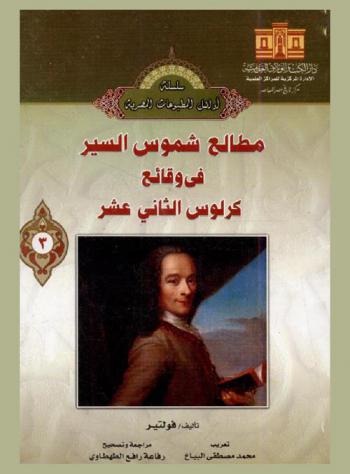
مطالع شموس السير في وقائع كرلوس الثاني عشر
هذا الكتاب هو العدد الثالث من سلسلة \"أوائل المطبوعات المصرية\" التي تقدمها دار الكتب المصرية لعشاق المعرفة وذلك فى إطار إعادة إنتاج وتوزيع تراثنا الفكري وأوائل ما نشرته المطبعة المصرية في عهودها الأولى وقد جاء تعريب هذا الكتاب بأوامر حضرة رفاعة أفندي الطهطاوس ناظر مدرسة الألسن آنذاك الذي وضع خطة لترجمة مجموعة من الكتب التي تغطي تاريخ العالم في مختلف عصوره وعمل على تنفيذها من خلال بعض خريجي مدرسة الألسن، أما أهمية الكتاب فتأتي للعديد من الأمور التي يمكن إجمال بعضها فيما يلى : أولا : الكتاب من أوائل الكتب التي تم تعريبها في عهد محمد علي، ثانيا : يؤرخ الكتاب تاريخ السويد منذ القرن السادس عشر وحتى أوائل القرن التاسع عشر وهي فترات مهمة مع أنها انتهت بهزائم وكوارث بعد أن بدأت بانتصارات رائعة وتطرق لتاريخ بلاد أخرى كالدانمارك وروسيا والنمسا وأوكرانيا، ثالثا : تم تدريس الكتاب بعد ترجمته في بعض المدارس التي أنشأها محمد علي باشا وكان كتابا تثقيفيا على درجة عالية لكل من طالعه من المصريين حيث عرض لتجارب أمم أخرى وكيف عاشت لفترات حالة من التدهور بسبب اختلاط أمور الدين والدنيا والبحث عن المنافع الشخصية على حساب الأمة بأسرها، رابعا : أورد الكتاب بعض المعلومات عن كيفية تكوين نظم جاسوسية لمصلحة ملك ما أو دولة ما، الأمر الذي ظهر في شبكة التجسس التي أراد كرلوس الثاني عشر تكوينها لمصلحة مشروعه، خامسا : أورد فولتير الكثير من الأمور التي سمعها بنفسه من معاصرين للأحداث في بولندة وروسيا والدولة العثمانية وغيرها، مما يزيد من مصداقية المعلومات التي أوردها، كما أن الكتاب وثيق الصلة بتاريخ المسألة الشرقية والدولة العثمانية التي كانت تسيطر على أوروبا الشرقية.
Book

Coagulation factor XII haploinsufficiency is protective against venous thromboembolism in a population-scale multidimensional analysis
Coagulation factor XII has been identified as a potential drug target that could prevent thrombosis without increasing the risk of bleeding. However, human data to support the development of factor XII-directed therapeutics are lacking. To assess the role of factor XII in venous thromboembolism, we examine genetic variation in the coding region of the
F12
locus across 703,745 participants in the UK Biobank and NIH All of Us biorepositories. We find that heterozygous carriers of nonsense, frameshift, and essential splice site variants in
F12
are protected against venous thromboembolism without an increased risk of bleeding or infection. We also show that
F12
variant carriers generally experience a quantitative (type I) defect in circulating factor XII levels, though a subset of participants was also identified with possible qualitative (type II) deficiency. In vitro plasma-based thrombin generation is reduced at factor XII concentrations reflective of those seen in
F12
variant carriers. We also show that
F12
heterozygous mice are protected against venous thromboembolism and display an intermediate phenotype between wild-type and
F12
-null animals. We conclude that heterozygous loss of
F12
represents a haploinsufficient state characterized by protection against venous thromboembolism and that therapeutically inhibiting factor XII is likely to be safe and effective.
Lowering the levels of coagulation factor XII may prevent thrombosis without increasing the risk of bleeding. Here, Haj et al. use a large human dataset to show that this is the case for people carrying mutations that lower the levels of factor XII.
Journal Article


Genetic analysis of a pedigree with hereditary coagulation factor XII deficiency
Analyze the clinical phenotype and gene mutations of a family with hereditary FXII deficiency, and preliminarily explore its phenotypic manifestations. The routine coagulation indicators and related coagulation factors were measured.Thromboelastography and thrombin generation tests simulated coagulation and anticoagulation states in vitro and in vivo. PCR direct sequencing was utilized to analyze all exons and flanking sequences of the F12 gene in the proband, confirming suspected mutations through reverse sequencing, and identifying corresponding mutation sites in family members. Using ClustalX-2.1-win to analyze the conservation of the variant, and employing online software to predict the pathogenicity of mutations. The proband exhibited significantly prolonged APTT (169.1 s) and a pronounced decrease in FXII: C to 1.0%. Thromboelastography testing indicated a diminished function of the endogenous coagulation system, while thrombin generation testing revealed a normal ability for thrombin production in the proband. Gene sequencing revealed that the proband harbored a deletion mutation c.303_304delCA in exon 5 and a substitution mutation c.800 + 1G > A in intron 8. All three bioinformatics software indicated that the mutations were pathogenic and could lead to the production of a terminator, potentially altering the structure and function of the protein. The deletion mutation c.303_304delCA and substitution mutation c.800 + 1G > A are associated with a decreased in FXII levels in this family, with the c.800 + 1G > A mutation being the first reported mutation worldwide.
Journal Article

The battle for the Catholic past in Germany, 1945-1980
\"Were Pope Pius XII and the Catholic Church in Germany unduly singled out after 1945 for their conduct during the National Socialist era? Mark Edward Ruff explores the bitter controversies that broke out in the Federal Republic of Germany from 1945 to 1980 over the Catholic Church's relationship to the Nazis. He explores why these cultural wars consumed such energy, dominated headlines, triggered lawsuits and required the intervention of foreign ministries. He argues that the controversies over the church's relationship to National Socialism were frequently surrogates for conflicts over how the church was to position itself in modern society--in politics, international relations and the media. More often than not, these exchanges centered on problems perceived as arising from the postwar political ascendancy of Roman Catholics and the integration of Catholic citizens into the societal mainstream\"--Provided by publisher.
Book

Coagulation Factor XII Is an Antibacterial Protein That Acts Against Bacterial Infection via Its Heavy Chain
Coagulation factor XII (FXII), the initiator of the intrinsic coagulation pathway, is not involved in hemostasis but is associated with pathological thrombosis. Bacterial infections activate coagulation cascades, although the underlying mechanisms remain not fully understood. Here, we revealed that FXII exhibits antibacterial activity through its heavy chain (hFXII) against Pseudomonas aeruginosa (P. aeruginosa), a Gram-negative bacterium. We constructed an FXII-deficient (FXII−/−) mouse model and demonstrated that FXII plays a critical role in antibacterial functions. FXII and hFXII significantly reduced bacterial loads via intravenous injection, confirming their antibacterial activity in FXII−/−. To further investigate the pathophysiological implications of FXII in the P. aeruginosa-induced disseminated intravascular coagulation (DIC) mouse model, FXII and hFXII effectively reduced DIC-related bacterial infections, alleviated organ damage, and decreased fibrin deposition, consequently improving survival rates. This study indicates that FXII exhibits both in vitro and in vivo antibacterial activity, primarily mediated through its heavy chain. In thrombotic diseases triggered by Gram-negative bacterial infections, the antibacterial functions of FXII may influence the progression of the disease. These results not only redefine the critical role of the intrinsic coagulation pathway in innate immune defense but also provide novel insights into the prevention and treatment of severe infection-related diseases.
Journal Article

Three sisters, three queens
United in sisterhood by birth and marriage, Katherine of Aragon, Queen of England; Margaret Tudor, Queen of Scots; and Mary Tudor, Queen of France immediately recognize each other as both allies and rivals in the treacherous world of court and national politics. Their bonds extend beyond natural and expeditious loyalties, as romance, scandal, war, and religion inextricably unite these three for better or for worse.
BOOK

Kallikrein directly interacts with and activates Factor IX, resulting in thrombin generation and fibrin formation independent of Factor XI
Kallikrein (PKa), generated by activation of its precursor prekallikrein (PK), plays a role in the contact activation phase of coagulation and functions in the kallikrein-kinin system to generate bradykinin. The general dogma has been that the contribution of PKa to the coagulation cascade is dependent on its action on FXII. Recently this dogma has been challenged by studies in human plasma showing thrombin generation due to PKa activity on FIX and also by murine studies showing formation of FIXa-antithrombin complexes in FXI deficient mice. In this study, we demonstrate high-affinity binding interactions between PK(a) and FIX(a) using surface plasmon resonance and show that these interactions are likely to occur under physiological conditions. Furthermore, we directly demonstrate dose- and time-dependent cleavage of FIX by PKa in a purified system by sodium dodecyl sulfate-polyacrylamide gel electrophoresis analysis and chromogenic assays. By using normal pooled plasma and a range of coagulation factor-deficient plasmas, we show that this action of PKa on FIX not only results in thrombin generation, but also promotes fibrin formation in the absence of FXII or FXI. Comparison of the kinetics of either FXIa-or PKa-induced activation of FIX suggest that PKa could be a significant physiological activator of FIX. Our data indicate that the coagulation cascade needs to be redefined to indicate that PKa can directly activate FIX. The circumstances that drive PKa substrate specificity remain to be determined.
Journal Article