
Catalogue Search | MBRL


Are you sure you want to remove the book from the shelf?

{{itemTitle}}
300,546
result(s) for
"Xi, Jinping"
Sort by:


Examining Strategic Narratives in Chinese Official Discourse under Xi Jinping
Research suggests that over the last two decades China has undergone dramatic changes in its communication climate. The former mono-glossic environment has made way for a plurality of voices, now debating (non-sensitive) political, social and economic issues on online fora. While this has contributed to a more consultative state-society relationship, the leadership still wields the conductor’s baton over the ensemble of voices to ensure adherence to the main melody. The uneasy coexistence of transformation and conservatism is especially salient when it comes to propaganda and soft power, which the Chinese authorities fully deploy to disseminate their vision of the ‘China story’ abroad and to legitimize continued CCP rule at home. This paper examines the various strategic narratives that cumulatively constitute this ‘China story’, designed for the international as well as domestic audiences. It looks into divergences/convergences with the political discourse of previous generations of leadership by examining argumentation patterns and discursive strategies used in speeches and texts produced by top-level officials and their ‘core’ leader, Xi Jinping. While, on the surface, new slogans, such as ‘the Chinese dream’, the ‘New Normal’, the ‘Four Comprehensives’, the ‘Community of Common Destiny’ appear to be Xi Jinping’s hallmark, and cumulatively contribute to the all-encompassing official doctrine of ‘Xi Jinping Thought’, no paradigmatic ideological change emerges from the narratives. Yet, the strategies utilised to spread ‘the China story’ are more diverse, the conductor’s baton is held more tightly, the main melody is chanted more loudly and the echoes are carried further abroad over the mountains and seas via the new Silk Road initiatives to present an alternative world order of ‘Socialism with Chinese characteristics’.
Journal Article


Firm Control
How has the Xi Jinping administration recentralised authority over China's politics and economy? Studies of Xi's rule often suggest that his \"core leader\" status, revolutionary heritage, and informal network of loyalists underpin this consolidation of central control. In contrast, this article focuses on the state sector to highlight how the Xi administration's recentralisation of authority is grounded in existing governance mechanisms and techniques: central leading small groups, the cadre management system, Party committees, and campaigns. Using policy documents and an original dataset on central state-owned enterprise leaders, I provide evidence that the Xi administration has leveraged each of these four methods to reclaim central authority relative to the preceding Hu Jintao administration. These findings contribute to scholarship on adaptive authoritarian governance and economic reform in China by underscoring that administrations can use existing instruments of central control in divergent ways.
Journal Article
اقتباسات \الرئيس الصيني\ شي جين بينغ من وحي الثقافة الصينية القديمة
هذا الكتاب الشيق يحوي بين طياته عددا من المقولات التي اقتبسها الرئيس الصيني شي جين بينغ، من الكلاسيكيات الرائعة في الفكر الصيني القديم، وهي مقولات حول السياسة والإدارة والحكم وسيادة القانون، والعلاقات الدولية، بالإضافة إلى مقولات حول احترام الشعب وتأسيس الفضيلة، واحترام المعتقدات والتعليم والابتكار وغيرها، مصحوبا بالنصوص الأصلية مع التفسير والتعقيب.
Book
New Wine in Old Bottles
This paper discusses Xi Jinping’s policy of religious sinicisation (zhongguohua 中国化) and the subsequent revision of the Regulations on Religious Affairs. I argue that Xi’s fear of foreign influence has driven the direction of recent changes in religious policy in favour of indigenous or indigenised religions. I show that the effort to sinicise religions and the consequent strengthening of the existing regulatory framework risks exacerbating the challenges that the Xi regime seeks to confront in the first place.
Journal Article


A Show of Strength or Weakness? China's Motivation for Temporary and Tactical Détente in the US-China Strategic Competition
This paper seeks to explain China's motivations for pursuing its temporary and tactical détente with the United States in 2023 that culminated in a summit in San Francisco at the end of that year. Against the background of the country's increasingly assertive foreign policy under Xi Jinping, this paper evaluates two hypotheses for its motivations behind the San Francisco détente: Is China seeking a temporary and tactical détente to repair the damage to its reputation and solidify economic ties with important partners in the West and elsewhere with the aim to stabilize its domestic economy, or is it seeking a window of opportunity to see its strategic environment better consolidated and more favorable for the expansion its global influence? This paper acknowledges that both explanations - strategic weakness and compromise - have explanatory power and are not necessarily mutually exclusive. At the same time, the country's efforts to consolidate an international order among like-minded states in the anti-US bloc offer a more compelling explanation for its tactical détente with the United States since 2023. Finally, this paper notes some caveats and implications of this conclusion and offers suggestions for further study.
Journal Article
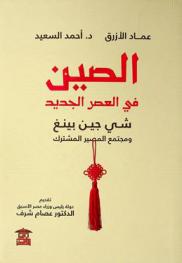
الصين في العصر الجديد : شي جين بينغ ومجتمع المصير المشترك
في السنوات العشر الماضية، خطت الصين خطوات واسعة - وتحديدا منذ تولي الرئيس شي جين بينغ كبرى على الساحة الدولية، حولت الصين إلى لاعب شي جين بينغ .زعامة الحزب الشيوعي الصيني وئاسة الصين على طريق التنمية الداخلية، والتي نقلت المجتمع ومجتمع المصير المشترك الصيني نقلات نوعية على الأصعدة كافة، ونقلات أساسي ومهم على مسرح أحداث العالم. وخلال فترة حكمه طرح الرئيس الصيني للعالم مبادرة وفكرة. أما المبادرة فهي \"الحزام والطريق\". المشروع التنموي العملاق الذي سارع معظم دول العالم للانضمام إليه والاستفادة منه، وأما الفكرة فهي \"مجتمع المصير المشترك للبشرية\"، والتي تكشف للعالم أن الصين تسعى لوجود عالم بلا قطب أوحد، ولا تتمنى أن يكون العالم قائما على تبعية وخدمة بعض سكانه للبعض الآخر. وهنا في هذا العمل البحثي الذي يفك شفرة الصين في عشر سنوات حزبا ودولة ودبلوماسية. يقدم الباحثان: الأستاذ عماد الأزرق المتخصص في الشأن الصيني خلال 15 عاما فضاها في أروقة الصحافة الصينية وأخبار الصين ودكتور أحمد السعيد المتخصص في الشأن الصيني عبر رحلته الطويلة مع اللغة والنشر والثقافة والدراسات الأكاديمية الصينية: أجوبة عما يجول في خاطر القارئ العربي حول الصين. وهذا الكتاب هو دراسة وبحث وتوثيق جديد من نوعه عربيا، ومليء بالمعلومات والاكتشافات التي سيجد فيها القارئ إجابات على كثير من تساؤلاته عن الصين
Book

Two Integrations: Theoretical evolution and its contemporary significance to Xi Jinping Thought on Culture
Marxism is the fundamental guiding ideology upon which the Communist Party of China (CPC) and the country are founded and thrive. During the revolutionary period, the CPC successfully explored the path of integrating the basic tenets of Marxism with China’s specific realities (the “First Integration”), achieving the theoretical breakthrough of adapting Marxism to the Chinese context: Mao Zedong Thought. After the founding of the People’s Republic of China, the CPC led the people in embarking on the journey of socialist modernization. Since the reform and opening-up, the CPC has continued to advance this integration, constantly enriching and developing the theoretical system of socialism with Chinese characteristics in keeping with the times. Entering the New Era, General Secretary Xi Jinping creatively proposed the “Second Integration”—the integration of the basic tenets of Marxism with China’s fine traditional culture. Together with “the First Integration,” they constitute the “Two Integrations,” a significant theoretical innovation. These two are dialectically unified: the First Integration serves as the logical premise for the Second Integration, while the second completes this logic, elevating “integration” to a new height. As another form of mental emancipation, the Second Integration fosters confidence in China’s history, culture, and civilization. It defines the Chinese civilizational dimension of Xi Jinping Thought on Culture, transforming fine traditional Chinese culture into a valued, structural, and constructive force for the great rejuvenation of the Chinese nation. The Two Integrations, especially the Second Integration, represent an original contribution of Xi Jinping Thought on Socialism with Chinese Characteristics for a New Era. It not only opens a new realm for adapting Marxism to the Chinese context and the needs of the times but also provides theoretical guidance for renewing the ancient Chinese civilization with a new mission and creating a new model for human advancement, demonstrating the Communist Party of China’s commitment to its civilizational responsibility for all humanity.
Journal Article