
Catalogue Search | MBRL


Are you sure you want to remove the book from the shelf?

{{itemTitle}}
4
result(s) for
"Xinjiang Uygur Zizhiqu (China) Social policy."
Sort by:

Social policies and ethnic conflict in China : lessons from Xinjiang
\"The Xinjiang Uygur Autonomous Region is one of China's most strategically important, resource-rich and largest regions but also one of the country's most troublesome, the region now being synonymous with ethnic conflict and nationalist movements. This detailed and compelling study sets out to explore how the Chinese government has governed Xinjiang in light of growing tensions in the region exploring initiatives such as the partner assistance programme to understand the extent to which attempts to reverse the deteriorating situation have been effective. Furthermore, this study also provides compelling insights into how policies vary in different regions, focusing in particular on the role played by officials in interpreting and implementing these policies within their specific locale. It shows that Communist Party strategy and policy become messy when introduced at a micro-level as local governments interpret how these policies should work within their particular region. As such, this text is invaluable to students and scholars of policy-making and implementation in China\"-- Provided by publisher.
Book

China's Spatial (Dis)integration
This book is intended to provide the narratives and analytics of China's spatial (dis)integration.Indeed, the Chinese nation is far too large and spatially complicated and diversified to be misinterpreted.
eBook

Xinjiang
Eastern Turkestan, now known as Xinjiang or the New Territory, makes up a sixth of China's land mass. Absorbed by the Qing in the 1880s and reconquered by Mao in 1949, this Turkic-Muslim region of China's remote northwest borders on formerly Soviet Central Asia, Afghanistan, Kashmir, Mongolia, and Tibet, Will Xinjiang participate in twenty-first century ascendancy, or will nascent Islamic radicalism in Xinjiang expand the orbit of instability in a dangerous part of the world? This comprehensive survey of contemporary Xinjiang is the result of a major collaborative research project begun in 1998. The authors have combined their fieldwork experience, linguistic skills, and disciplinary expertise to assemble the first multifaceted introduction to Xinjiang. The volume surveys the region's geography; its history of military and political subjugation to China; economic, social, and commercial conditions; demography, public health, and ecology; and patterns of adaption, resistance, opposition, and evolving identities.
eBook
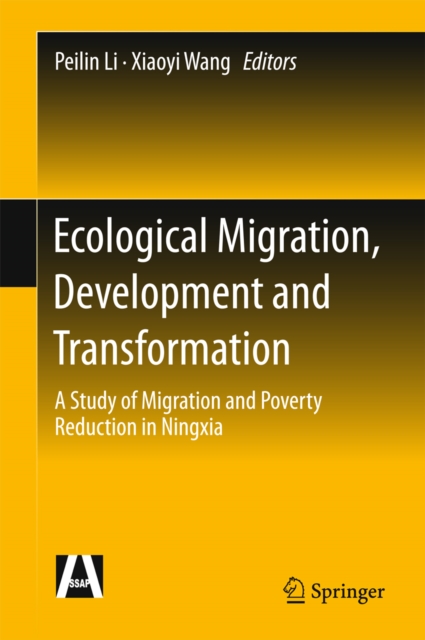
Ecological Migration, Development and Transformation
After over 30 years of reform and opening up, China's aggregate economic volume is now the second largest in the world. Over the past decade many provinces in the western region of China have implemented ecological migration projects of different scales, which have attracted considerable attention both in China and abroad.
eBook