
Catalogue Search | MBRL


Are you sure you want to remove the book from the shelf?

{{itemTitle}}
668
result(s) for
"YOSEMITE"
Sort by:


Choreographies of Landscape
As an international ecotourism destination, Yosemite National Park welcomes millions of climbers, sightseers, and other visitors from around the world annually, all of whom are afforded dramatic experiences of the natural world. This original and cross-disciplinary book offers an ethnographic and performative study of Yosemite visitors in order to understand human connection with and within natural landscapes. By grounding a novel \"eco-semiotic\" analysis in the lived reality of parkgoers, it forges surprising connections, assembling a collective account that will be of interest to disciplines ranging from performance studies to cultural geography.
eBook

Good night Yosemite
\"Young explorers are treated to an enchanting tour of one of the greatest and most scenic parks on the planet. Overflowing with majestic waterfalls, breathtaking mountain views, and abundant wildlife, this charming book captures the essence of Yosemite.\"--Publisher's website.
Book
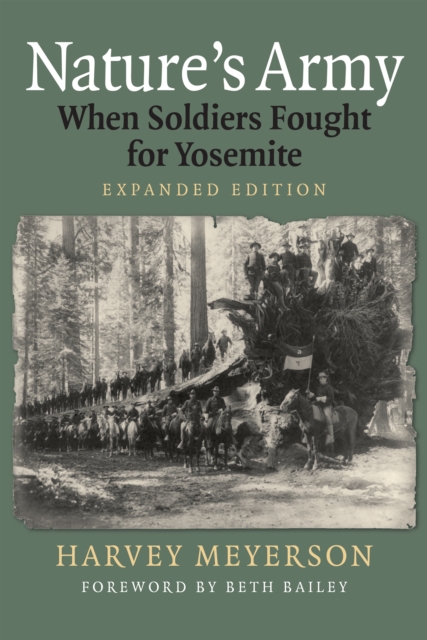
Nature's Army
Blessings on Uncle Sam's soldiers! They have done their job
well, and every pine tree is waving its arms for joy .-John
Muir
Muir's words and this book both celebrate a crucial but largely
forgotten episode in our nation's history-how a generation prior to
the creation of a National Park Service, the US Army ran Yosemite
National Park in an unusual alliance with the fabled
preservationist John Muir and his Sierra Club. Harvey Meyerson
brings that largely forgotten episode in our nation's history to
life and uses it as a touchstone for a reconsideration of a century
of civilian-military cooperation in environmental protection and
infrastructure construction whose impact and relevance still
resonate.
Despite the worldwide renown and popularity of Yosemite National
Park, few people know that its first stewards were drawn from the
so-called Old Army. From 1890 until the establishment of the
National Park Service in 1916, these soldiers proved to be
extremely competent and farsighted wilderness managers. Meyerson
recaptures the forgotten history of these early environmentalists
and how they set significant standards for the future oversight of
our national parks.
The army, Meyerson suggests, had actually been well prepared to
assume this stewardship. During its first hundred years-and despite
the interruptions of warfare-its soldiers had crisscrossed the
American landscape, preparing maps and writing detailed reports
describing climate, weather, physical terrain, ecosystems, and the
diverse flora and fauna populating the lands they explored and
often protected during an era of wide-open exploitation of natural
resources. Such experience made the army better suited than any
other federal agency to oversee the early national parks
system.
Combining environmental, military, political, and cultural
history, Meyerson's study is especially timely in light of
Yosemite's enormous popularity (four million visitors annually) and
recent controversies pitting conservation forces against dam
builders and proponents of expanded public access.
eBook

Granite and grace : seeking the heart of Yosemite
\"Granite and grace: seeking the heart of Yosemite reflects on Valerie and Michael Cohen's fifty-year encounter with the granite in the high country of Yosemite National Park, where they seek a sense of belonging in an era called the Anthropocene. By creating a dialogue between geological and literary representations, where the geological becomes metaphorical, while science turns mythological, these essays shaped by on-the-rock encounters with landforms, open up important experiential and pragmatic dimensions.\"-- Provided by publisher.
Book

Nature's Mountain Mansion
Nature's Mountain Mansion is the first anthology on
Yosemite that focuses exclusively on the nineteenth century, the
critical period in which Yosemite was \"discovered\" by an expanding
nation and transformed into one of the country's most visited
national parks. While there are volumes that provide readings about
Yosemite in the nineteenth century, few provide critical-sometimes
even disparaging-eyewitness reflections on the Yosemite experience,
and none include excerpts from the government documents that
defined the future of the park, such as the Yosemite Valley Grant
Act of 1864. This anthology collects selections from fiction,
nonfiction, and government documents that demonstrate the glory,
the brutality, and the controversies surrounding this extraordinary
and much-loved landscape. Some selections have not appeared in
print since their original publication, while others have not been
republished or excerpted for decades.
eBook


Large-scale recovery of an endangered amphibian despite ongoing exposure to multiple stressors
Amphibians are one of the most threatened animal groups, with 32% of species at risk for extinction. Given this imperiled status, is the disappearance of a large fraction of the Earth’s amphibians inevitable, or are some declining species more resilient than is generally assumed? We address this question in a species that is emblematic of many declining amphibians, the endangered Sierra Nevada yellowlegged frog (Rana sierrae). Based on >7,000 frog surveys conducted across Yosemite National Park over a 20-y period, we show that, after decades of decline and despite ongoing exposure tomultiple stressors, including introduced fish, the recently emerged disease chytridiomycosis, and pesticides, R. sierrae abundance increased sevenfold during the study and at a rate of 11% per year. These increases occurred in hundreds of populations throughout Yosemite, providing a rare example of amphibian recovery at an ecologically relevant spatial scale. Results from a laboratory experiment indicate that these increases may be in part because of reduced frog susceptibility to chytridiomycosis. The disappearance of nonnative fish from numerous water bodies after cessation of stocking also contributed to the recovery. The large-scale increases in R. sierrae abundance that we document suggest that, when habitats are relatively intact and stressors are reduced in their importance by active management or species’ adaptive responses, declines of some amphibians may be partially reversible, at least at a regional scale. Other studies conducted over similarly large temporal and spatial scales are critically needed to provide insight and generality about the reversibility of amphibian declines at a global scale.
Journal Article

Count to sleep Yosemite
Learn to count and see the sights of Yosemite National Park at the same time.
Book

Evidence of fuels management and fire weather influencing fire severity in an extreme fire event
Following changes in vegetation structure and pattern, along with a changing climate, large wildfire incidence has increased in forests throughout the western United States. Given this increase, there is great interest in whether fuels treatments and previous wildfire can alter fire severity patterns in large wildfires. We assessed the relative influence of previous fuels treatments (including wildfire), fire weather, vegetation, and water balance on fire-severity in the Rim Fire of 2013. We did this at three different spatial scales to investigate whether the influences on fire severity changed across scales. Both fuels treatments and previous low to moderate-severity wildfire reduced the prevalence of high-severity fire. In general, areas without recent fuels treatments and areas that previously burned at high severity tended to have a greater proportion of high-severity fire in the Rim Fire. Areas treated with prescribed fire, especially when combined with thinning, had the lowest proportions of high severity. The proportion of the landscape burned at high severity was most strongly influenced by fire weather and proportional area previously treated for fuels or burned by low to moderate severity wildfire. The proportion treated needed to effectively reduce the amount of high severity fire varied by spatial scale of analysis, with smaller spatial scales requiring a greater proportion treated to see an effect on fire severity. When moderate and high-severity fire encountered a previously treated area, fire severity was significantly reduced in the treated area relative to the adjacent untreated area. Our results show that fuels treatments and low to moderate-severity wildfire can reduce fire severity in a subsequent wildfire, even when burning under fire growth conditions. These results serve as further evidence that both fuels treatments and lower severity wildfire can increase forest resilience.
Journal Article