
Catalogue Search | MBRL


Are you sure you want to remove the book from the shelf?

{{itemTitle}}
585
result(s) for
"Yale University."
Sort by:

Yale University : an architectural tour
\"Author and photographer Patrick L. Pinnell beautifully captures Yale's and New Haven's architecture and urbanism across more than 300 years. The guide also reveals much about the academic aspirations and educational philosophy that helped shape the buildings of Yale. The visitor will be guided on an insider's tour of the campus, and alumni will delight in new insights about their alma mater\"-- Provided by publisher.
Book
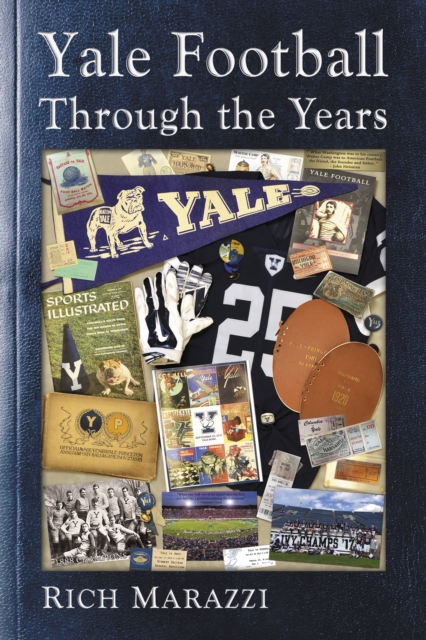
Yale Football Through the Years
Chronicling Yale football from its 1872 inception to the present, this volume offers a comprehensive coverage of the most important games, including all Yale-Harvard contests, most Yale-Princeton games, record-making performances, great plays and more.
eBook


Class Divide
Members of the Yale College class of 1964-the first class to matriculate in the 1960s-were poised to take up the positions of leadership that typically followed an Ivy League education. Their mission gained special urgency from the inspiration of John F. Kennedy's presidency and the civil rights movement as it moved north. Ultimately these men proved successful in traditional terms-in the professions, in politics, and in philanthropy-and yet something was different. Challenged by the issues that would define a new era, their lives took a number of unexpected turns. Instead of confirming the triumphal perspective they grew up with in the years after World War II, they embraced new and often conflicting ideas. In the process the group splintered.InClass Divide, Howard Gillette Jr. draws particularly on more than one hundred interviews with representative members of the Yale class of '64 to examine how they were challenged by the issues that would define the 1960s: civil rights, the power of the state at home and abroad, sexual mores and personal liberty, religious faith, and social responsibility. Among those whose life courses Gillette follows from their formative years in college through the years after graduation are the politicians Joe Lieberman and John Ashcroft, the Harvard humanities professor Stephen Greenblatt, the environmental leader Gus Speth, and the civil rights activist Stephen Bingham.Although their Ivy League education gave them access to positions in the national elite, the members of Yale '64 nonetheless were too divided to be part of a unified leadership class. Try as they might, they found it impossible to shape a new consensus to replace the one that was undone in their college years and early adulthood.
Members of the Yale College class of 1964-the first class to matriculate in the 1960s-were poised to take up the positions of leadership that typically followed an Ivy League education. Their mission gained special urgency from the inspiration of John F. Kennedy's presidency and the civil rights movement as it moved north. Ultimately these men proved successful in traditional terms-in the professions, in politics, and in philanthropy-and yet something was different. Challenged by the issues that would define a new era, their lives took a number of unexpected turns. Instead of confirming the triumphal perspective they grew up with in the years after World War II, they embraced new and often conflicting ideas. In the process the group splintered.
InClass Divide, Howard Gillette Jr. draws particularly on more than one hundred interviews with representative members of the Yale class of '64 to examine how they were challenged by the issues that would define the 1960s: civil rights, the power of the state at home and abroad, sexual mores and personal liberty, religious faith, and social responsibility. Among those whose life courses Gillette follows from their formative years in college through the years after graduation are the politicians Joe Lieberman and John Ashcroft, the Harvard humanities professor Stephen Greenblatt, the environmental leader Gus Speth, and the civil rights activist Stephen Bingham.
Although their Ivy League education gave them access to positions in the national elite, the members of Yale '64 nonetheless were too divided to be part of a unified leadership class. Try as they might, they found it impossible to shape a new consensus to replace the one that was undone in their college years and early adulthood.
eBook

Ninth house
\"Galaxy \"Alex\" Stern is the most unlikely member of Yale's freshman class. Raised in the Los Angeles hinterlands by a hippie mom, Alex dropped out of school early and into a world of shady drug-dealer boyfriends, dead-end jobs, and much, much worse. In fact, by age twenty, she is the sole survivor of a horrific, unsolved multiple homicide. Some might say she's thrown her life away. But at her hospital bed, Alex is offered a second chance: to attend one of the world's most prestigious universities on a full ride. What's the catch, and why her? Still searching for answers, Alex arrives in New Haven tasked by her mysterious benefactors with monitoring the activities of Yale's secret societies. Their eight windowless \"tombs\" are the well-known haunts of the rich and powerful, from high-ranking politicos to Wall Street's biggest players. But their occult activities are more sinister and more extraordinary than any paranoid imagination might conceive. They tamper with forbidden magic. They raise the dead. And, sometimes, they prey on the living.\"-- Publisher's description.
Book

Democracies at war
Why do democracies win wars? This is a critical question in the study of international relations, as a traditional view--expressed most famously by Alexis de Tocqueville--has been that democracies are inferior in crafting foreign policy and fighting wars. In Democracies at War, the first major study of its kind, Dan Reiter and Allan Stam come to a very different conclusion. Democracies tend to win the wars they fight--specifically, about eighty percent of the time.
eBook

American art : selections from the Yale University Art Gallery
\"This volume presents an engaging selection of highlights and introduces readers to the richness and diversity of the Yale University Art Gallery's holdings of American art. An introductory essay outlines pivotal moments in the three-hundred-year history of collecting, exhibiting, and teaching with American art at Yale and commemorates the fiftieth anniversary of the founding of the Friends of American Arts at Yale, whose support continues to ensure the excellence of the collection. The more than one hundred object entries that follow create a narrative that charts the multiplicity of experiences and accomplishments of artists and artisans living and working in North America-- from the earliest days of European settlement to the present. Among the catalogued objects are works by some of the best-known names in American art as well as recent acquisitions and masterpieces that represent diverse American identities. A dazzling range of media is displayed, including paintings and sculpture, medals, prints and drawings, photographs, jewelry, furniture, and decorative arts. Each object is illustrated with a full-page image and is accompanied by a one-page discussion that focuses on its contribution to the history of American art.\"--Back cover.
Book

On the Cusp
How did the 1950s become \"The Sixties\"? This is the question at the heart of Daniel Horowitz's On the Cusp. Part personal memoir, part collective biography, and part cultural history, the book illuminates the dynamics of social and political change through the experiences of a small, and admittedly privileged, generational cohort.
A Jewish \"townie\" from New Haven when he entered Yale College in fall 1956, Horowitz reconstructs the undergraduate career of the class of 1960 and follows its story into the next decade. He begins by looking at curricular and extracurricular life on the all-male campus, then ranges beyond the confines of Yale to larger contexts, including the local drama of urban renewal, the lingering shadow of McCarthyism, and decolonization movements around the world. He ponders the role of the university in protecting the prerogatives of class while fostering social mobility, and examines the growing significance of race and gender in American politics and culture, spurred by a convergence of the personal and the political. Along the way he traces the political evolution of his classmates, left and right, as Cold War imperatives lose force and public attention shifts to the civil rights movement and the war in Vietnam.
Throughout Horowitz draws on a broad range of sources, including personal interviews, writings by classmates, reunion books, issues of the Yale Daily News, and other undergraduate publications, as well as his own letters and college papers. The end product is a work consistent with much of Horowitz's previously published scholarship on postwar America, further exposing the undercurrent of discontent and dissent that ran just beneath the surface of the so-called Cold War consensus.
eBook

Yale needs women : how the first group of girls rewrote the rules of an Ivy League giant
\"Yale University, along with the rest of the Ivy League, kept its gates closed to women until the class of 1969. The reason for letting them in? As an incentive for men to attend. Yale Needs Women is the story of why the most elite schools in the nation refused women for so long, and what the first women to enter those halls faced when they stepped onto campus\"-- Provided by publisher.
Book

Sports and freedom : the rise of big-time college athletics
Perhaps more than any other two colleges, Harvard and Yale gave form to American intercollegiate athletics--a form that was inspired by the Oxford-Cambridge rivalry overseas, and that was imitated by colleges and universities throughout the United States. Focusing on the influence of these prestigious eastern institutions, this fascinating study traces the origins and development of intercollegiate athletics in America from the mid-nineteenth century to the early twentieth century. Smith begins with an historical overview of intercollegiate athletics and details the evolution of individual sports--crew, baseball, track and field, and especially football. Then, skillfully setting various sports events in their broader social and cultural contexts, Smith goes on to discuss many important issues that are still relevant today: student-faculty competition for institutional athletic control; the impact of the professional coach on big-time athletics; the false concept of amateurism in college athletics; and controversies over eligibility rules. He also reveals how the debates over brutality and ethics created the need for a central organizing body, the National Collegiate Athletic Association, which still runs college sports today. Sprinkled throughout with spicy sports anecdotes, from the Thanksgiving Day Princeton-Yale football game that drew record crowds in the 1890s to a meeting with President Theodore Roosevelt on football violence, this lively, in-depth investigation will appeal to serious sports buffs as well as to anyone interested in American social and cultural history.
eBook