
Catalogue Search | MBRL


Are you sure you want to remove the book from the shelf?

{{itemTitle}}
28
result(s) for
"Yellow Peril"
Sort by:

From Yellow Peril to Model Minority and Back to Yellow Peril
During the COVID-19 pandemic, some perceptions of Asian Americans in the United States shifted as anti-Asian hate crimes escalated. However, little is known about how these shifting views manifest in K–12 schools. This qualitative case study uses Asian critical race theory to examine how two Southeast Asian American students faced exclusion and erasure before and during the COVID-19 pandemic and how their Southeast Asian American teacher advocated for them at a public elementary school in the Pacific Northwest. Implications include how researchers can pursue inquiries about Asian American students’ holistic development and how in-service and pre-service teachers can address anti-Asian xenophobia.
Journal Article

'The China Syndrome': Imagining Western Decline in the Age of 'The Rise of China'
This paper explores the persistent association between China and the apocalypse in Western political thought. Using the 1979 film The China Syndrome as a starting point, it examines how China is depicted as the specter of global catastrophe: as a society unable to recover from its own nineteenth-century collapse, and the post-apocalyptic form assumed by Europe itself. Through the writings of John Stuart Mill and Niall Ferguson, the paper highlights how the trope of \"apocalyptic China\" has evolved with shifts in global power, reflecting Western anxieties about its own decline and the perceived inevitability of China's rise.
Journal Article

\China's Chernobyl\: COVID-19 Narratives of Collapse and Global Domination
In COVID-19's first months, US politicians and media forecast that a contrast between Chinese deception and incapability and Western success against the pandemic might fatally sink internal confidence in China's party-state. They also predicted that it would diminish China externally,
as it came to be seen as endangering the world by spreading biological pollution. A \"China's Chernobyl\" prediction became the latest \"China collapse\" wish-fulfillment. This speculation rests on two contradictory yet co-existing Yellow Peril tropes: \"deceit and incompetence\" and \"world domination.\"
However, no empirical basis exists for either notion: China prevailed against the pandemic and lacks the capacity for global hegemony. \"China's Chernobyl\" is most relevant then as a wish that creates a belief, that China should and could collapse. That in turn bolsters the US-led mobilization
to counter China as a \"strong competitor\" and frames China as the common enemy, thereby promoting Western transnational and US internal cohesion.
Journal Article

Visions of China: Political Friendship and Animosities in Southern African Science Fiction
Using contemporary science fiction as a barometer, we can see the African imaginary to be seemingly preoccupied with the idea of China and with forecasting various dystopian scenarios regarding the future of China-Africa relations. Yet, through an examination of three short stories from Southern Africa - Tendai Huchu's 'The Sale' (2013), Abigail Godsell's 'Taal' (2009) and Mandisi Nkomo's 'Heresy' (2013) - I explore a complex relationship whose participants are intimately aligned: China and Africa have an historical connection that asks us to take seriously the practice and potential of political friendship. Through a close reading of these short stories, it becomes possible to consider how the relationship need not result in Chinese neocolonialism and exploitation. Working with the conceptual framework of political friendship, I illustrate how these short stories cumulatively serve to unravel easy distinctions between the friend and the enemy, thereby intimating that, in the future, southern Africa can benefit from approaching China as both friend and enemy.
Journal Article

The Fear of 'Yellow Peril' and the Emergence of European Federalist Movement
As an outcome of the dialectical narrative of European superiority in the nineteenth century (expressed in racial terms), the military and economic development of Japan and China created anxieties that have been shown to have a place in the history of Europe from the 1890s to the late 1930s. The term 'yellow peril' gave descriptive value to this anxiety. This essay argues that fear of the 'yellow peril' contributed to the emergence of the European federalist movement between the early 1900s and the 1930s. Fear of the 'yellow peril' was not the only factor responsible for the emergence of federalist movements, but operated alongside numerous other influences and discourses, many of which historians have identified. My concentration on the 'yellow peril' is due to its complete neglect by historians to date.
Journal Article

Exploring Racial Microaggressions Toward Chinese Immigrant Women in Greater Boston During Covid
This study was an initial qualitative exploration to (a) capture varied experiences of racial microaggressions directed at Chinese immigrant women before and during Covid and (b) investigate different forms and levels of microaggressions based on socioeconomic status, age, and other characteristics. Racial microaggressions were examined by interviewing 12 foreign‐born, Chinese immigrant women aged 23 to 80 years old, with most of the participants identified as middle class or above. Building upon previous scholarship on racial and gendered microaggressions, an analytical framework was developed using 12 major themes to identify and interpret discriminatory behaviors. Our main findings suggest that the research sample encountered more blatant hate incidents and expressed heightened concern over their physical safety in the post‐Covid period. Young women, compared to their older counterparts, were more inclined to report microaggression episodes and distinguish more subtle forms of discrimination. These findings could serve as preliminary evidence for future research.
Journal Article

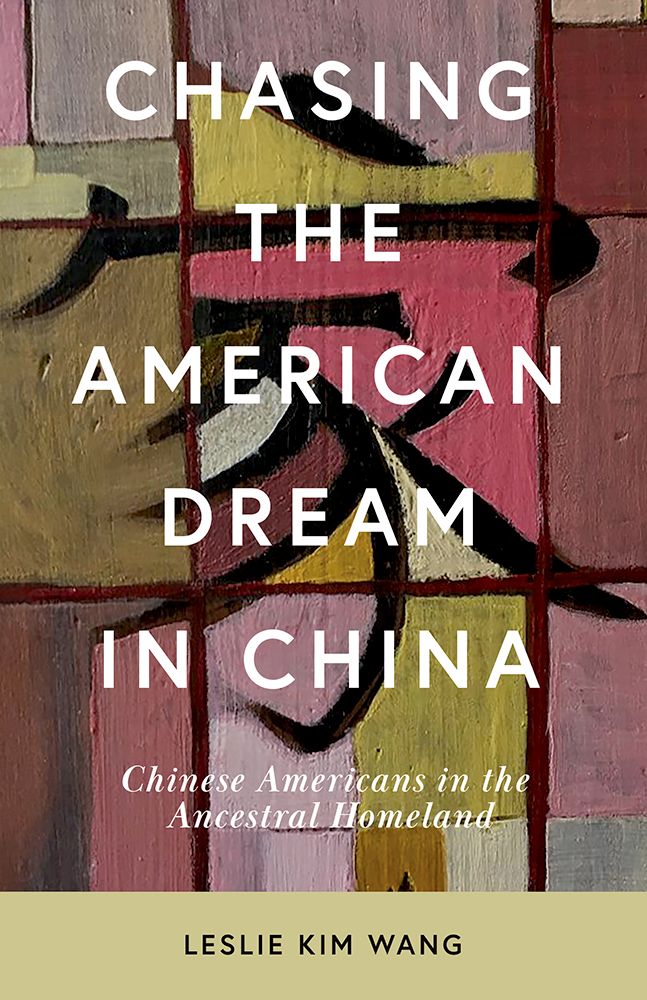
Chasing the American Dream in China
Few studies have highlighted the stories of middle-class children of immigrants who move to their ancestral homelands—countries with which they share cultural ties but haven’t necessarily had direct contact. Chasing the American Dream in China addresses this gap by examining the lives of highly educated American-born Chinese (ABC) professionals who “return” to the People’s Republic of China to build their careers. Analyzing the motivations and experiences of these individuals deepens our knowledge about transnationalism among the second-generation as they grapple with complex issues of identity and societal belonging in the ethnic homeland. This book demonstrates how these professional migrants maneuver between countries and cultures to further their careers and maximize opportunities in the rapidly changing global economy. When used strategically, the versatile nature of their ethnic identities positions them as indispensable bridges between the global superpowers of China and the United States in their competition for global dominance.
eBook

Sidney L. Gulick
El presente artículo tiene como fin investigar algunos de los procesos históricos que sentaron las bases del llamado yellow peril en la primera mitad del siglo XX en Estados Unidos. La retórica sobre el peligro amarillo alentó el temor de Occidente respecto a los asiáticos, y ese rechazo se tradujo en políticas concretas de corte racista en países como Estados Unidos. Este fervor antijaponés vino promovido en ocasiones desde los medios de comunicación norteamericanos, como fue el caso de los periódicos de William Randolph Hearst. En este contexto de tensiones internacionales y raciales, personalidades como Sidney Lewis Gulick trataron de impulsar y promover la concordia y la amistad entre Japón y Estados Unidos a través de libros, artículos de prensa y la fundación de asociaciones en favor de las relaciones entre los países. Gulick planteó este tipo de acercamientos desde una posición crítica respecto al papel de Occidente en Asia Oriental. En su opinión, los occidentales debían partir de que el llamado yellow peril tuvo un antecedente desde el que se gestó: el white peril, es decir, el peligro que el colonialismo occidental supuso para buena parte de Asia.
This article aims to research several of the historical processes that laid the foundations for the so-called yellow peril emerging in the first half of the twentieth century in the United States. The rhetoric of the yellow peril fueled the West’s fear of Asian people and this rejection eventually translated into specific, racist policies in countries like the United States. This anti-Japanese fervor was occasionally promoted by the North American media, such as in the case of William Randolph Hearst’s newspapers. In this context of international and racial tensions, public figures like Sidney Lewis Gulick attempted to support the concord and friendship between Japan and the United States through books, press reports and the founding of associations in favor of international relations. Gulick approached this kind of rapprochement from a critical perspective towards the role of the West in East Asia. As he viewed it, Westerners should start from the premise that the “yellow peril” had a predecessor it derived from, the “white peril”; that is, the threat posed by Western colonialism for a large part of Asia.
Journal Article

Japanese Immigrant Settler Colonialism in the U.S.-Mexican Borderlands and the U.S. Racial-Imperialist Politics of the Hemispheric “Yellow Peril”
The scholarship on the “Yellow Peril” looks at Japanese immigrants (Issei) as an object of anti-Asian racialization in domestic politics or as a distraction in U.S.-Japanese bilateral diplomacy. Seldom do historians consider its ramifications outside those contexts. They also lack perspective on the impact of Issei practice on the geopolitics of Yellow Peril, which spread from California to the U.S.-Mexican borderlands and beyond. This article examines the role of Issei settler colonialism, as well as its unintended consequences, in the formation of discourse on the transborder Yellow Peril. That discourse propelled white America to reaffirm its commitment to the Monroe Doctrine, shifting the nature of U.S. diplomacy from the endeavor to keep European rivals out of the Western Hemisphere to one that sought to exclude the Japanese racial enemy from America’s “backyard.” It culminated in the construction of a hemispheric national security regime.
Journal Article