
Catalogue Search | MBRL


Are you sure you want to remove the book from the shelf?

{{itemTitle}}
867
result(s) for
"Yemen, North"
Sort by:

Nasser's Gamble
Nasser's Gambledraws on declassified documents from six countries and original material in Arabic, German, Hebrew, and Russian to present a new understanding of Egypt's disastrous five-year intervention in Yemen, which Egyptian president Gamal Abdel Nasser later referred to as \"my Vietnam.\" Jesse Ferris argues that Nasser's attempt to export the Egyptian revolution to Yemen played a decisive role in destabilizing Egypt's relations with the Cold War powers, tarnishing its image in the Arab world, ruining its economy, and driving its rulers to instigate the fatal series of missteps that led to war with Israel in 1967.
Viewing the Six Day War as an unintended consequence of the Saudi-Egyptian struggle over Yemen, Ferris demonstrates that the most important Cold War conflict in the Middle East was not the clash between Israel and its neighbors. It was the inter-Arab struggle between monarchies and republics over power and legitimacy. Egypt's defeat in the \"Arab Cold War\" set the stage for the rise of Saudi Arabia and political Islam.
Bold and provocative,Nasser's Gamblebrings to life a critical phase in the modern history of the Middle East. Its compelling analysis of Egypt's fall from power in the 1960s offers new insights into the decline of Arab nationalism, exposing the deep historical roots of the Arab Spring of 2011.
eBook

Beyond the Periphery—Israel's Intervention in the Yemen Civil War in the 1960s
In recent years, archival material concerning Israel's intervention during the 1960s civil war in Yemen has come to light. The article examines and interprets the events of the war and the motives behind the intervention using the recently declassified materials and the fresh insight these afford. The article argues that Israel was driven by fear of Nasser and the domino effect Arab nationalism might spread through the Arab Middle East to intervene in the war in support of the Imam's forces via the British mercenaries operating in Yemen. In a deeper sense, Israel's chief concern was the re-emergence of the 1958 regional crisis, and as such it chose to respond through the extension of an “Alliance of the Periphery.”
Journal Article


Dialect Atlas of North Yemen and Adjacent Areas
Since the author's publication of Die nordjemenitischen Dialekte. Teil 1: Atlas in 1985, a lot of new field work has been done in North Yemen and adjacent areas. Therefore a new atlas of the region in English suggested itself. The atlas consists of 192 fully coloured maps with 30 phonetical and phonological maps, 100 morphological and 60 lexical ones.
eBook

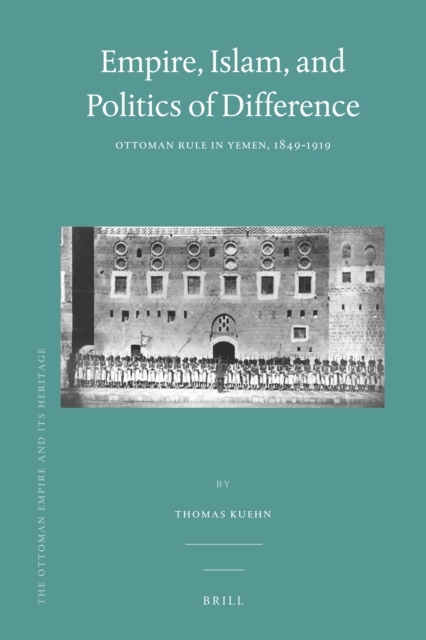
Empire, Islam, and politics of difference : Ottoman rule in Yemen, 1849-1919
Drawing on a broad range of sources in Ottoman Turkish and Arabic this book offers a new interpretation of late Ottoman imperial rule in Yemen and situates the Ottoman Empire among competing imperial powers in the long nineteenth century.
eBook

Brutality in an Age of Human Rights
In Brutality in an Age of Human Rights , Brian Drohan
demonstrates that British officials' choices concerning
counterinsurgency methods have long been deeply influenced or even
redirected by the work of human rights activists. To reveal how
that influence was manifested by military policies and practices,
Drohan examines three British counterinsurgency campaigns-Cyprus
(1955-1959), Aden (1963-1967), and the peak of the \"Troubles\" in
Northern Ireland (1969-1976). This book is enriched by Drohan's use
of a newly available collection of 1.2 million colonial-era files,
International Committee of the Red Cross files, the extensive
Troubles collection at Linen Hall Library in Belfast, and many
other sources.
Drohan argues that when faced with human rights activism,
British officials sought to evade, discredit, and deflect public
criticism of their actions to avoid drawing attention to brutal
counterinsurgency practices such as the use of torture during
interrogation. Some of the topics discussed in the book, such as
the use of violence against civilians, the desire to uphold human
rights values while simultaneously employing brutal methods, and
the dynamic of wars waged in the glare of the media, are of
critical interest to scholars, lawyers, and government officials
dealing with the conflicts in Iraq and Afghanistan, and those to
come in the future.
eBook