
Catalogue Search | MBRL


Are you sure you want to remove the book from the shelf?

{{itemTitle}}
73
result(s) for
"Yemen (Republic) -- Politics and government"
Sort by:

Chaos in Yemen
Chaos in Yemen challenges recent interpretations of Yemen’s complex social, political and economic transformations since unification in 1990. By offering a new perspective to the violence afflicting the larger region, it explains why the ‘Abdullah ‘Ali Salih regime has become the principal beneficiary of these conflicts. Adopting an inter-disciplinary approach, the author offers an alternative understanding of what is creating discord in the Red Sea region by integrating the region’s history to an interpretation of current events. In turn, by refusing to solely link Yemen to the \"global struggle against Islamists,\" this work sheds new light on the issues policy-makers are facing in the larger Middle East. As such, this study offers an alternative perspective to Yemen’s complex domestic affairs that challenge the over-emphasis on the tribe and sectarianism. Offering an alternative set of approaches to studying societies facing new forms of state authoritarianism, this timely contribution will be of great relevance to students and scholars of the Middle East and the larger Islamic world, Conflict Resolution, Comparative Politics, and International Relations.
Isa Blumi , Assistant Professor at Georgia State University’s History Department and Middle East Institute, is author of numerous articles on the modern Middle East’s history that focus especially on late imperial rivalries in the Arabian Gulf and Yemen as well as issues of Muslim identity in the context of modernity. A former Fulbright-Hayes, Woodrow Wilson, SSRC, ACLS, and AIYS fellow, among his publications is the book, Rethinking the Late Ottoman Empire (2003) and articles appearing in International Journal of Middle East Studies, Comparative Studies of South Asia, Africa and the Middle East, and Journal of Ethnic and Migration Studies.
Introduction 1. Yemen’s Social Pathologies beyond the Strategic Mainstream 2. The Local Scramble for Ascendancy and the Rise of Modern Polities 3. The Contingent State: The Dynamics of Administrating Yemen 4. The Frontier as a Measure of Modern State Power 5. Unification and the Roots of Salih’s Authoritarian Push. Conclusion
\"Blumi's Chaos in Yemen brings a fresh perspective to our thinking about the current crises in Yemen and for this alone Chaos is definitely worth a read... Blumi's Chaos in Yemen is an interesting read of contemporary Yemeni history and society, but it is also an important contribution to the ways that we think about Yemen.\" - Charles Schmitz; Yemen Update, Number 52: 2010
\"Isa Blumi’s inquiry into the historical and contemporary dynamics of state–society relations in Yemen could hardly be more timely given scholarly and policy interest in the antecedents of Yemen’s current revolutionary movement...readers certainly stand to benefit from Blumi’s careful historical analysis of the dialect relationships between local, state, and imperial power in the late Ottoman period and from his efforts to put this analysis to use in untangling the dynamics of Salih’s regime today.\" - Stacey Philbrick Yadav, Department of Political Science, Hobart and William Smith Colleges, Geneva, N.Y.; International Journal of Middle East Studies 43 (2011)
\"[I]t is a scholarly work written by someone who has a full command of the sources, including the Ottoman archives. Many of his footnotes give fascinating additions to what is in the text, and the bibliography will be greatly appreciated by his fellow scholars.\" - Noel Brehony; The British-Yemeni Society
eBook
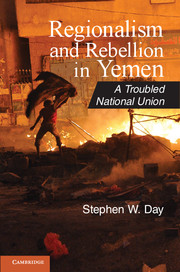
Regionalism and Rebellion in Yemen
Based on years of in-depth field research, this book unravels the complexities of the Yemeni state and its domestic politics with a particular focus on the post-1990 years. The central thesis is that Yemen continues to suffer from regional fragmentation which has endured for centuries. En route the book discusses the rise of President Salih, his tribal and family connections, Yemen's civil war in 1994, the war's consequences later in the decade, the spread of radical movements after the US military response to 9/11 and finally developments leading to the historic events of 2011. This book sets a new standard for scholarship on Yemeni politics and it is essential reading for anyone interested in the modern Middle East, the 2011 Arab revolts and twenty-first-century Islamic politics.
eBook

Regime and Periphery in Northern Yemen
For nearly six years, the government of Yemen has conducted military operations north of the capital against groups of its citizens known as \"Huthis.\" In spite of using all means at its disposal, the government has been unable to subdue the Huthi movement. This book presents an in-depth look at the conflict in all its aspects. The authors detail the various stages of the conflict and map out its possible future trajectories.
eBook


The Price of Wealth
The emerging consensus that institutions shape political and economic outcomes has produced few theories of institutional change and no defensible theory of institutional origination. Kiren Aziz Chaudhry shows how state and market institutions are created and transformed in Saudi Arabia and Yemen, two countries that typify labor and oil exporters in the developing worlds.
In a world where the international economy dramatically affects domestic developments, the question of where institutions come from becomes at once more urgent and more complex. In both Saudi Arabia and Yemen, fundamental state and market institutions forged during a period of isolation at the end of World War I were destroyed and reshaped not once but three times in response to exogenous shocks. Comparing boom-bust cycles, Chaudhry exposes the alternating social and organizational origins of institutions, arguing that both broad changes in the international economy and specific forms of international integration shape institutional outcomes. Labor and oil exporters thus experience identical economic cycles but generate radically different state, market, and financial institutions in response to different resource flows.
Chaudhry supplemented years of field work in Saudi Arabia and Yemen with extensive analysis of previously unavailable materials in the Saudi national archives.
The emerging consensus that institutions shape political and economic outcomes has produced few theories of institutional change and no defensible theory of institutional origination. Kiren Aziz Chaudhry shows how state and market institutions are created and transformed in Saudi Arabia and Yemen, two countries that typify labor and oil exporters in the developing worlds.In a world where the international economy dramatically affects domestic developments, the question of where institutions come from becomes at once more urgent and more complex. In both Saudi Arabia and Yemen, fundamental state and market institutions forged during a period of isolation at the end of World War I were destroyed and reshaped not once but three times in response to exogenous shocks.Comparing boom-bust cycles, Chaudhry exposes the alternating social and organizational origins of institutions, arguing that both broad changes in the international economy and specific forms of international integration shape institutional outcomes. Labor and oil exporters thus experience identical economic cycles but generate radically different state, market, and financial institutions in response to different resource flows. Chaudhry supplemented years of field work in Saudi Arabia and Yemen with extensive analysis of previously unavailable materials in the Saudi national archives.
eBook

Regionalism and rebellion in Yemen : a troubled national union
\"Like other Arab revolutions in 2011, it is said that Yemen's rebellion was modeled on street protests in Tunis and Cairo. As this erudite new study explains, however, what happened in Yemen is far from being a mere echo of events elsewhere. In fact, the popular uprisings which came as a surprise in Tunisia and Egypt, Libya and Syria, were already well underway in Yemen. As early as 2007, this country on the southern tip of the Arabian Peninsula was embroiled in sit-ins, demonstrations, and open rebellion against the government. The author ably demonstrates how Yemen's political upheaval is rooted in divisions and conflicts of the past, especially the country's troubled national unification in 1990. Based on years of in-depth field research, this book unravels the complexities of the Yemeni state and its domestic politics with a particular focus on the post-1990 years. The central thesis is that Yemen continues to suffer from regional fragmentation which has endured for centuries. En route the book discusses the rise of President Salih, his tribal and family connections, Yemen's civil war in 1994, the war's consequences later in the decade, the spread of radical movements after the US military response to 9/11, and finally developments leading to the historic events of 2011. Politics in this strategically important country is crucial for many reasons, not least on account of its links to al-Qaeda terrorism. The United States and western allies have good reason to regard Yemen as a security risk. This book sets a new standard for scholarship on Yemeni politics, and it is essential reading for anyone interested in the modern Middle East, the 2011 Arab revolts, and 21st century Islamic politics\"-- Provided by publisher.
Book

The price of wealth : economies and institutions in the Middle East
Kiren Aziz Chaudhry shows how state and market institutions are created and transformed in Saudi Arabia and Yemen, two countries that typify labor and oil exporters in the developing worlds.
eBook