
Catalogue Search | MBRL


Are you sure you want to remove the book from the shelf?

{{itemTitle}}
88
result(s) for
"Yeshivas."
Sort by:

The Golden age of the Lithuanian yeshivas
\"The Golden Age of the Lithuanian Yeshivas tells the story of the final years of Orthodox Jewish schools in Lithuania, from the eve of World War I to the outbreak of World War II. The Lithuanian yeshiva established a rigorous standard for religious education in the early 1800s that persisted for over a century. Although dramatically reduced and forced into exile in Russia and Ukraine during WWI, the yeshivas survived the war, with yeshiva heads and older students forming the nucleus of the institutions. During the economic depression of the 1930s, students struggled for food and their leaders journeyed abroad in search of funding, but their determination and commitment to the yeshiva system continued. The Soviet occupation of Lithuania and the coming of WWII marked the beginning of the end of the Yeshivas, however, and the Holocaust ensured the final destruction of this venerable institution. The Golden Age of the Lithuanian Yeshivas is the first book-length work on the modern history of the Lithuanian yeshivas published in English. Through exhaustive historical research of every yeshiva, Ben-Tsiyon Klibansky brings to light for the first time the stories, lives, and inner workings of this long-lost world\"-- Provided by publisher.
BOOK

Yeshiva fundamentalism : piety, gender, and resistance in the ultra-Orthodox world
2009 Choice Outstanding Academic Title
The ultra-Orthodox yeshiva, or Jewish seminary, is a space reserved for men, and for a focus on religious ideals. Fundamentalist forms of piety are usually believed to be quite resistant to change. In Yeshiva Fundamentalism , Nurit Stadler uncovers surprising evidence that firmly religious and pious young men of this community are seeking to change their institutions to incorporate several key dimensions of the secular world: a redefinition of masculinity along with a transformation of the family, and participation in civic society through the labor market, the army, and the construction of organizations that aid terror victims. In their private thoughts and sometimes public actions, they are resisting the demands placed on them to reject all aspects of the secular world.
Because women are not allowed in the yeshiva setting, Stadler's research methods had to be creative. She invented a way to simulate yeshiva learning with young yeshiva men by first studying with an informant to learn key religious texts, often having to do with family life, sexuality, or participation in the larger society. This informant then invited students over to discuss these texts with Stadler and himself outside of the yeshiva setting. This strategy enabled Stadler to gain access to aspects of yeshiva life in which a woman is usually unable to participate, and to hear unofficial thoughts and reactions which would have been suppressed had the interviews taken place within the yeshiva.
Yeshiva Fundamentalism provides an intriguing — and at times surprising — glimpse inside the all-male world of the ultra-orthodox yeshivas in Israel, while providing insights relevant to the larger context of transformations of fundamentalism worldwide. While there has been much research into how contemporary feminism has influenced the study of fundamentalist groups worldwide, little work has focused on ultra-Orthodox men's desires to change, as Stadler does here, showing how fundamentalist men are themselves involved in the formulation of new meanings of piety, gender, modernity and relations with the Israeli state.
eBook

The Theological Sources of the Torah and Labor (Torah U’melakha) Yeshivas
In this article, I seek to reveal the theological sources of the Israeli high school yeshivas designated “Torah U’melakha” (Torah and labor). High school yeshivas are schools for 9th–12th grade boys that offer religious studies in the first half of the day and secular studies, i.e., science and languages, in the second half. These schools serve mainly religious Zionist and modern orthodox society. Torah U’melakha yeshivas are high school yeshivas that are unique for combining vocational studies in the curriculum, such that graduates acquire a trade and can serve in the army and join the labor force in their field of expertise. Over the years, some of the Torah U’melakha yeshivas were subsequently closed and others changed their nature from vocational to technological. However, the educational trend toward “Torah and labor” has not disappeared. Vocational education, which became technological as well, has been assimilated in nearly all high school yeshivas, which, to a great degree, made the Torah U’melakha yeshivas redundant. The ideological and theological value of engaging in “Torah and work” became embedded in the pedagogic consciousness of religious Zionism and is continuing to infuse the many high school yeshivas in Israel and elsewhere.
Journal Article
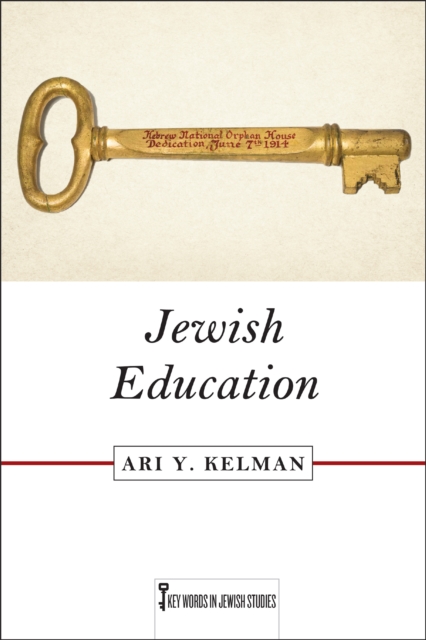
Jewish Education
Most writing about Jewish education has been preoccupied with two questions: What ought to be taught?And what is the best way to teach it?Ari Y Kelman upends these conventional approaches by asking a different question: How do people learn to engage in Jewish life?.
eBook
“The Workshop for the Nation’s Soul” vs. “A Rabbi Factory”—Contrasting the Lithuanian Yeshiva with the Rabbinical Seminary
The central institutional model that served Jewish Orthodoxy in its struggle with the threat to the tradition of the modern era and from which grew its intellectual leadership was ultimately the model of the Lithuanian Yeshiva. However, from the second half of the nineteenth-century, new models of Jewish higher education institutions emerged and were even adopted by Orthodox circles. How, then, did the trustees of the Lithuanian yeshiva model see the new institutional models? Our discussion will focus on the modern yeshivas and rabbinical seminaries that accepted the Orthodox halakhic view, including the Tahkemoni rabbinical seminary in Warsaw, the Hildesheimer Seminary in Berlin (1873–1938), and the Seminary for the Diaspora in Jerusalem (1956). The Lithuanian rabbis held to the supremacy of the Lithuanian Yeshiva model. However, until World War II, they saw the Orthodox rabbinical seminary as an institute suitable to its time and place—Germany, most of whose Jews were liberal—and did not consider it able to produce a Torah scholar worthy of his name. They opposed the establishment of rabbinical seminaries in Eastern Europe and the Land of Israel, and after the war, when the issue of establishing a rabbinical seminary in Jerusalem was raised, they rejected the Orthodox rabbinical seminary outright and no longer recognized its contribution to its time and place—Germany.
Journal Article

Narrating the Law
InNarrating the LawBarry Scott Wimpfheimer creates a new theoretical framework for considering the relationship between law and narrative and models a new method for studying talmudic law in particular. Works of law, including the Talmud, are animated by a desire to create clear usable precedent. This animating impulse toward clarity is generally absent in narratives, the form of which is better able to capture the subtleties of lived life. Wimpfheimer proposes to make these different forms compatible by constructing a narrative-based law that considers law as one of several \"languages,\" along with politics, ethics, psychology, and others that together compose culture. A narrative-based law is capable of recognizing the limitations of theoretical statutes and the degree to which other cultural languages interact with legal discourse, complicating any attempts to actualize a hypothetical set of rules. This way of considering law strongly resists the divide in traditional Jewish learning between legal literature (Halakhah) and nonlegal literature (Aggadah) by suggesting the possibility of a discourse broad enough to capture both.Narrating the Lawactivates this mode of reading by looking at the Talmud's legal stories, a set of texts that sits uncomfortably on the divide between Halakhah and Aggadah. After noticing that such stories invite an expansive definition of law that includes other cultural voices,Narrating the Lawalso mines the stories for the rich descriptions of rabbinic culture that they encapsulate.
eBook

Ladin in Lineage: Through the Doors of Jewish Gendered Life at Yeshiva University's Stern College for Women
This article traces the crossings of religion and gender, American Orthodox and secular Judaism, teachers and students, religious educational institutions and the lives that inhabit them. Highlighting Jewishness and transness as intersecting forms of crossing, it explores periods of personal and institutional transition in the lives of Professor Joy Ladin, Yeshiva University's first openly transgender employee, and three of her former students. Experimenting methodologically with form and source, this piece combines interview with textual and theoretical analysis to link the Jewish gendered lives of its interlocutors—who emerge from different locations across the Orthodox-secular Jewish spectrum—with one another, and with larger communal and institutional forms of American Judaism they index. In doing so, this essay connects gender, religion, and education as intersecting forms of lineage, which pass through the interlocutors' and institution's historical and contemporary worlds. Activating crossing as a form of Jewish learning and queer scavenging, the piece enacts a method of Jewish institutional and embodied knowledge production that moves across lived and textual religion, articulating an alternate path through current struggles for queer/trans religious lives. This path does not opt to lose or loosen these lives from American Orthodox life and its textual discourse, but rather, it links them to both, and to one another.
Journal Article


Roth in the Archives
An account of a lawyer who descends into madness while working to reconcile a group of Holocaust survivors with their Americanized Jewish neighbors, Roth's text has been celebrated for its shrewd social commentary and parable-like density (one critic has called it a \"medieval morality play\").1 Scholars have focused on multiple aspects of the text-its insights into the psychic fallout of assimilation, its use of the doppelganger motif, its running parody of psychoanalysis, and more.2 But one fact about \"Eli, the Fanatic\" has almost entirely eluded critics-that its basic scenario is drawn from an actual episode that occurred in 1948 in Mount Kisco, New York. [...]we are encouraged to broaden our sense of the archive for a given historical period or event to include fictional retellings, even when these might appear to veer into allegory.
Journal Article

Young Men in Israeli Haredi Yeshiva Education
The internal tensions and conflicts central to Haredi Lithuanian yeshivas in contemporary Israel are described with a focus on the rabinical authorities' attempts to respond to these difficulties and the changes the Haredi community is experiencing as a result.
eBook