
Catalogue Search | MBRL


Are you sure you want to remove the book from the shelf?

{{itemTitle}}
31,829
result(s) for
"Youth Culture"
Sort by:


Skateboarding and the ‘Tired Generation’
This article extends current discussions of ageing through a study of the continuing involvement in skateboarding of individuals who are no longer young adults. We qualitatively examine The Tired Video which features older and mostly middle-aged male skaters as our case study. This is done in light of discourses of ageing and a lack of studies examining how older participants remain involved in lifestyle sports typically associated with youth and risk. Our findings reveal four main processes, which we argue assist older skaters to establish an ongoing sense of inclusion in skateboarding. These are modification, dedication, humour and homage. Our study can also contribute insights to other scenes that have reached a ‘coming of age’ where they no longer accurately fit the description of being a youth culture alone, and the need to redirect thinking about ageing away from notions of imminent departure and deficit over to positive adaptations.
Journal Article


Digital Passages: Migrant Youth 2.0
Increasingly, young people live online, with the vast majority of their social and cultural interactions conducted through means other than face-to-face conversation. How does this transition impact the ways in which young migrants understand, negotiate, and perform identity? That's the question taken up by Digital Passages: Migrant Youth 2.0, a ground-breaking analysis of the ways that youth culture online interacts with issues of diaspora, gender, and belonging. Drawing on surveys, in-depth interviews, and ethnography, Koen Leurs builds an interdisciplinary portrait of online youth culture and the spaces it opens up for migrant youth to negotiate power relations and to promote intercultural understanding.
eBook

Youth culture in China : from Red Guards to netizens
\"The lives and aspirations of young Chinese (those between 14 and 26 years old) have been transformed in the past five decades. By examining youth cultures around three historical points - 1968, 1988 and 2008 - this book argues that present-day youth culture in China has both international and local roots. Paul Clark describes how the Red Guards and the sent-down youth of the Cultural Revolution era carved out a space for themselves, asserting their distinctive identities, despite tight political controls. By the late 1980s, Chinese-style rock music, sports and other recreations began to influence the identities of Chinese youth, and in the twenty-first century, the Internet offers a new, broader space for expressing youthful fandom and frustrations. From the 1960s to the present, this book shows how youth culture has been reworked to serve the needs of the young Chinese\"-- Provided by publisher.
Book

Exploring Hong Kong Youth Culture via a Virtual Reality Tour
The advantages of employing virtual reality tours in teaching are attributed to the virtual reality experience it provides to the students. In the case of teaching popular culture, benefits from the potential of VR tour are amplified by the empirical significance that would lead to the students’ imagination and reflection. In addition, an online VR tour suggests a flexibility that allows students to learn anyplace anytime, satisfying the need for blended learning and distance learning, which is a very critical mode of teaching and learning during the COVID-19 pandemic. This article discusses the advantages and challenges of blending “virtual reality” into the teaching of popular culture, and, furthermore, the implications of VR in tertiary education are discussed by examining the research that is conducted through the application of a VR tour in the course: Hong Kong Popular Culture. Sixty-eight students participated in the course. After implementing the VR tour, a questionnaire survey and interviews were conducted. In addition, students wrote essays to reflect on the youth culture of contemporary Hong Kong after the explanation of the tour, and these were also examined. We observed the positive responses from the students and the way in which the VR tour could enhance the learning qualities in the course on cultural studies.
Journal Article

Youth cultures, transitions, and generations : bridging the gap in youth research
\"Within the diversity of contemporary youth research there are two dominant streams that can be categorized under the broad headings of 'transitions' and 'cultures' perspectives. This collection sets forth a challenge to youth studies, with the contributors arguing that social change means it is no longer possible to understand the experience of young people through this transitions/cultures prism. The future of youth studies, it is argued, will require new conceptual foundations, capable of bridging the gap between transitions and cultures approaches to researching youth. The chapters, including contributions from some of the most established names in contemporary youth studies, draw on a wide variety of alternative concepts, including generation, assemblage, field and belonging to rethink how the study of young lives should be pursued in the coming decades. \"-- Provided by publisher.
Book
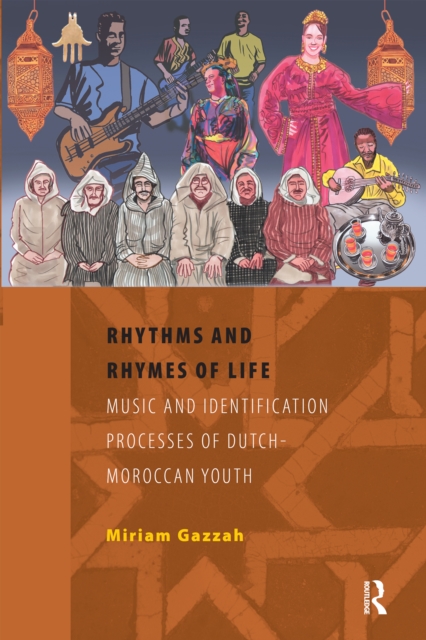
Rhythms and Rhymes of Life
Rhythms and Rhymes of Life: Music and Identification Processes of Dutch-Moroccan Youth is a comprehensive anthropological study of the social significance of music among Dutch-Moroccan youth. In the Netherlands, a Dutch-Moroccan music scene has emerged, including events and websites. Dutch-Moroccan youth are often pioneers in the Dutch hiphop scene, using music as a tool to identify with or distance themselves from others. They (re)present and position themselves in society through music and musical activities. The chapters deal with the development of the Dutch-Moroccan music scene, the construction of Dutch-Moroccan identity, the impact of Islam on female artists and the way Dutch-Moroccan rappers react to stereotypes about Moroccans. All along, Dutch society, its struggles with multiculturalism and its debates on integration, the position of Islam and fear of terrorism, form the backdrop to this story.
eBook

Goth girl
\"There are only three things fifteen-year-old Victoria Markham truly enjoys: English class, her signature \"Goth Girl\" look, and art. It's just that she tends to do the last one late at night, with spray paint, in public places. It isn't long before Vic is caught red-handed and forced into community service with a bunch of stereotypes: there's Rachael, the princess; Russell and Peter, a pair of fist-bumping punks; and Zach, the rich jock, who Vic is secretly crushing on. The motley crew has to collaborate to produce a mural for Halifax, but getting it organized is like herding cats. On top of all that, Vic's mother's boyfriend, the only father figure Vic has ever known and the one who taught her to paint, left them both. Vic's mother is still reeling, her relationship with her daughter strained. She doesn't understand Vic's insistence on spiking her hair, piercing her nose and lip, and wearing black clothing and heavy makeup. Vic is convinced her mother doesn't care enough to find out what's really behind the get-up. Tensions run high as Vic tries to figure out who she is: Victoria Markham, or Goth Girl?\"-- Provided by publisher.
Book

YOUTH AND CULTURAL PRACTICE
The study of youth played a central role in anthropology in the first half
of the twentieth century, giving rise to a still-thriving cross-cultural
approach to adolescence as a life stage. Yet the emphasis on adolescence as a
staging ground for integration into the adult community often obscures young
people's own cultural agency or frames it solely in relation to adult
concerns. By contrast, sociology has long considered youth cultures as central
objects of study, whether as deviant subcultures or as class-based sites of
resistance. More recently, a third approach-an anthropology of
youth-has begun to take shape, sparked by the stimuli of modernity and
globalization and the ambivalent engagement of youth in local contexts. This
broad and interdisciplinary approach revisits questions first raised in earlier
sociological and anthropological frameworks, while introducing new issues that
arise under current economic, political, and cultural conditions. The
anthropology of youth is characterized by its attention to the agency of young
people, its concern to document not just highly visible youth cultures but the
entirety of youth cultural practice, and its interest in how identities emerge
in new cultural formations that creatively combine elements of global
capitalism, transnationalism, and local culture.
Journal Article