
Catalogue Search | MBRL


Are you sure you want to remove the book from the shelf?

{{itemTitle}}
5,412
result(s) for
"Youth Political activity."
Sort by:


The third world in the global 1960s (Protest, culture and society, volume 8)
Decades after the massive student protest movements that consumed much of the world, the 1960s remain a significant subject of scholarly inquiry. While important work has been done regarding radical activism in the United States and Western Europe, events in what is today known as the Global South-Asia, Africa, and Latin America-have yet to receive the requisite attention they deserve. This volume inserts the Third World into the study of the 1960s by examining the local and international articulations of youth protest in various geographical, social, and cultural arenas. Rejecting the notion that the Third World existed on the periphery, it situates the events of the 1960s in a more inclusive context, building a richer, more nuanced understanding of the Global 1960s that better reflects the dynamism of the period.
eBook


Rebel Girls
From anti-war walkouts to anarchist youth newspapers, rallies against educational privatization, and workshops on fair trade, teenage girls are active participants and leaders in a variety of social movements. Rebel Girls: Youth Activism and Social Change Across the Americas illuminates the experiences and perspectives of these uniquely positioned agents of social change. Jessica K. Taft introduces readers to a diverse and vibrant transnational community of teenage girl activists in the San Francisco Bay Area, Mexico City, Caracas, Buenos Aires, and Vancouver. Expansive in scope and full of rich details, Taft brings to life the voices of these inspiring activists who are engaged in innovative and effective organizing for global and local social justice, highlighting their important contributions to contemporary social movements and social theory.Rebel Girls explores how teenage girls construct activist identities, rejecting and redefining girlhood and claiming political authority for youth in the process. Taft examines the girl activists' social movement strategies and collective political practices, detailing their shared commitments to process-based political education, participatory democracy, and hopeful enthusiasm. Ultimately, Rebel Girls has substantial implications for social movements and youth organizations, arguing that adult social movements could learn a great deal from girl activists and making clear the importance of increased collaboration between young people and adults.
eBook


Citizens in the Making in Post-Soviet States
The political outlook of young people in the countries of the former Soviet Union is crucial to their countries' future political development. This is particularly relevant now as the first generation without firsthand experience of communism at first hand is approaching adulthood. Based on extensive original research and including new survey research amongst young people, this book examines young people's political outlook in countries of the former Soviet Union; it compares and contrasts Russia, where authoritarianism has begun to reassert itself, and Ukraine, which experienced a democratic breakthrough in the aftermath of the Orange Revolution.
The book examines questions such as: How supportive is this new generation of the new political order? What images of the Soviet Union prevail in the minds of young people? How much trust does youth place in current political and public institutions? Addressing these questions is crucial to understanding the extent to which the current regimes can survive on the wave of public support. The book argues that Russian adolescents tend to place more trust in the incumbent president and harbour more regrets about the disintegration of the Soviet Union than their peers in Ukraine; it demonstrates that young people distrust political parties and politicians, and that patriotic education shapes social and political values.
eBook


Occupied by Memory
Occupied by Memory explores the memories of the first Palestinian intifada. Based on extensive interviews with members of the \"intifada generation,\" those who were between 10 and 18 years old when the intifada began in 1987, the book provides a detailed look at the intifada memories of ordinary Palestinians. These personal stories are presented as part of a complex and politically charged discursive field through which young Palestinians are invested with meaning by scholars, politicians, journalists, and other observers. What emerges from their memories is a sense of a generation caught between a past that is simultaneously traumatic, empowering, and exciting - and a future that is perpetually uncertain. In this sense, Collins argues that understanding the stories and the struggles of the intifada generation is a key to understanding the ongoing state of emergency for the Palestinian people. The book will be of interest not only to scholars of the Middle East but also to those interested in nationalism, discourse analysis, social movements, and oral history.
eBook

Political Muslims : understanding youth resistance in a global context
In \"Political Muslims,\" Abbas, Hamid, and their contributors seek to provide a new perspective on Muslim youth, presenting them as agents of creative social change--as emerging adults who are participating in cultural, organizational, community, and socially oriented projects to positively influence socio-political transformation in response to the everyday challenges they face. Each case study brings the reader to a new geographic location, providing original contributions on how a new generation of Muslim youth are engaging in issues relating to their faith, gender, identity, community, social injustice, and globalization, and confronting social change and the negative impacts of Islamophobia and radicalization.
Book
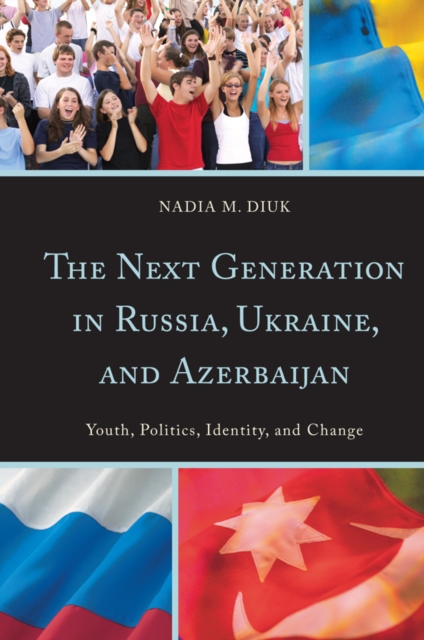
The next generation in Russia, Ukraine, and Azerbaijan
In the past twenty years, the countries that used to make up the former Soviet Union have seen plenty of change. There have been revolutions, youth-led protest movements, and other forms of incredible political upheaval. At the center of all of this were young leaders fighting to be heard and clamoring for change. In Nadia Diuk's meticulously researched and insightful book. The Next Generation in Russia, Ukraine, and Azerbaijan, she shows how those young leaders have risen up and become a part of the new political system. Using unique public opinion polling data and personal interviews, she explores how the new generation of leaders is shaping the political system and how the young people of today continue to exhort pressure for reform. This book is important to anyone interested in Eastern European studies, political transitions, protest movements, or youth and politics.
eBook