
Catalogue Search | MBRL


Are you sure you want to remove the book from the shelf?

{{itemTitle}}
21
result(s) for
"Zivilisationsprozess."
Sort by:

Der weibliche Anteil am Prozess der Zivilisation
Das größte Hindernis, das dem Prozess der Erkenntnis innerhalb der Frauenbewegung im Wege steht, ist das Faktum, das männliche Geschlecht als gegnerisches, gar feindliches zu betrachten, denn es ist keineswegs der Verursacher der Unterdrückung der Frauen, sondern, ebenso wie das weibliche, Resultat des Prozesses unserer Zivilisation.Dass in diesem Prozess das weibliche Geschlecht und seine gesellschaftliche Bedeutung zunehmend in den Hintergrund oder, besser gesagt, in die Abhängigkeit der männlichen Spezies gedrängt wurde, kann nicht allein der Schuld der Männer zugeschrieben werden, denn sie sind, ebenso wie die Frauen, Produkte ihrer jeweiligen historischen Epoche und der darin vorherrschenden Ideologien. Männer wie Frauen sind zu je fünfzig Prozent an der Entwicklung der Geschichte, dem Prozess der Zivilisation beteiligt. Warum dieser Prozess in der Vorherrschaft der Männer mündete, diese Frage kann nur in der Bemühung um die reflexive Aufarbeitung unseres jahrtausendealten Werdeganges, unserer anthropologischen Entwicklungsgeschichte beantwortet werden.Deshalb ist es um so wichtiger, dass sich die Frauen in diesen historischen Forschungsprozess einbringen, um ihr zukünftiges Schicksal als dem Mann ebenbürtige und damit gleichberechtigte Individuen beschleunigen zu können.
eBook

Violence and the civilising process in Cambodia
\"in this insightful new study tracing the history of violence in Cambodia, the authors evaluate the extent to which Elias's theories can be applied in a non-western context. Drawing from historical and contemporary archival sources, constabulary statistics, victim surveys and newspaper reports, Broadhurst, Bouhours and Bouhours chart trends and forms of violence throughout Cambodia from the mid nineteenth century through the present day. Analyzing periods of colonization, anti-colonial wars, interdependence, civil war, the revolutionary terror of the 1970s and post-conflict development, the authors assess whether violence has decreased and whether such a decline can be attributed to Elias's civilizing process, identifying a series of universal factors that have historically reduced violence.\" -- Published description.
Book

The measure of civilization
In the last thirty years, there have been fierce debates over how civilizations develop and why the West became so powerful.The Measure of Civilizationpresents a brand-new way of investigating these questions and provides new tools for assessing the long-term growth of societies. Using a groundbreaking numerical index of social development that compares societies in different times and places, award-winning author Ian Morris sets forth a sweeping examination of Eastern and Western development across 15,000 years since the end of the last ice age. He offers surprising conclusions about when and why the West came to dominate the world and fresh perspectives for thinking about the twenty-first century.
Adapting the United Nations' approach for measuring human development, Morris's index breaks social development into four traits--energy capture per capita, organization, information technology, and war-making capacity--and he uses archaeological, historical, and current government data to quantify patterns. Morris reveals that for 90 percent of the time since the last ice age, the world's most advanced region has been at the western end of Eurasia, but contrary to what many historians once believed, there were roughly 1,200 years--from about 550 to 1750 CE--when an East Asian region was more advanced. Only in the late eighteenth century CE, when northwest Europeans tapped into the energy trapped in fossil fuels, did the West leap ahead.
Resolving some of the biggest debates in global history,The Measure of Civilizationputs forth innovative tools for determining past, present, and future economic and social trends.
eBook

Millennium : from religion to revolution : how civilization has changed over a thousand years
\"History's greatest tour guide--Ian Mortimer--takes us on an eye-opening and expansive journey through the last millennium of human innovation. We are an astonishing species. Over the past millennium of plagues and exploration, revolution and scientific discovery, women's rights and technological advances, human society has changed beyond recognition. ln Millennium, bestselling historian Ian Mortimer takes the reader on a whirlwind tour of the last ten centuries of Western history. It is a journey into a past vividly brought to life--and bursting with ideas--that pits one century against another in his quest to measure which century saw the greatest change. We journey from a time when there was a fair chance of your village being burned to the ground by invaders--and dried human dung was a recommended cure for cancer--to a world in which explorers sailed into the unknown and civilizations came into conflict with each other on an epic scale. Here is a story of brilliant scientists, fearless adventurers, cold-hearted entrepreneurs, and strong-minded women--a story of discovery, invention, revolution, and cataclysmic shifts in perspective. Millennium is a journey into the past like no other. Our understanding of human development will never be the same again\"--Jacket.
Book
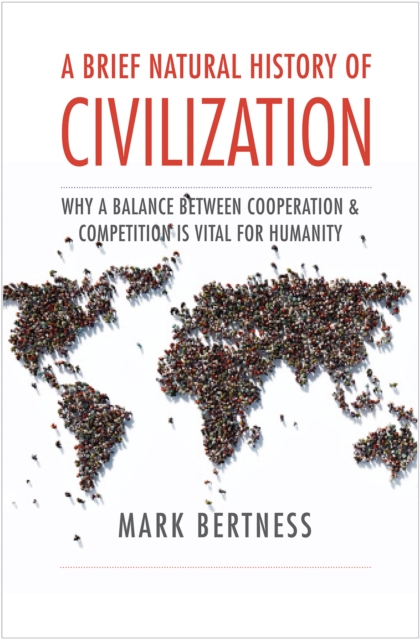
A Brief Natural History of Civilization
A compelling evolutionary narrative that reveals how human civilization follows the same ecological rules that shape all life on Earth Offering a bold new understanding of who we are, where we came from, and where we are going, noted ecologist Mark Bertness argues that human beings and their civilization are the products of the same self-organization, evolutionary adaptation, and natural selection processes that have created all other life on Earth. Bertness follows the evolutionary process from the primordial soup of two billion years ago through today, exploring the ways opposing forces of competition and cooperation have led to current assemblages of people, animals, and plants. Bertness's thoughtful examination of human history from the perspective of natural history provides new insights about why and how civilization developed as it has and explores how humans, as a species, might have to consciously overrule our evolutionary drivers to survive future challenges.
eBook

The delusions of invulnerability : wisdom and morality in ancient Greece, China and today
How were the aims of philosophy and the responsibilities of philosophers conceived in ancient Greece and China?How were the learned elite recruited and controlled; how were their speculations and advice influenced by the different types of audiences they faced and the institutions in which they worked?.
eBook

Zur Genealogie des Zivilisationsprozesses: Friedrich Nietzsche und Norbert Elias
Philosopher Friedrich Nietzsche and sociologist Norbert Elias are both famous for their influential interpretations of modern European culture as a whole. Nietzsche'sOn the Genealogy of Moralsand Elias'The Civilizing Processcrossed disciplinary boundaries with respect to both content and method, and both books are still of great contemporary interest. This volume brings international specialists together for the first time to explore the connections between these two works.
eBook

What makes civilization? : the ancient near East and the future of the West
A vivid new account of the 'birth of civilization' in ancient Egypt and Mesopotamia where many of the foundations of modern life were laid
eBook
Zur Genealogie des Zivilisationsprozesses
Friedrich Nietzsche und Norbert Elias haben zivilisationsgeschichtliche Entwürfe Europas vorgelegt, die unter den Bedingungen einer stetig voranschreitenden Globalisierung weiter an Bedeutung gewinnen werden.Die philosophische Brisanz ihres Zugriffs wird v.a.
eBook