
Catalogue Search | MBRL


Are you sure you want to remove the book from the shelf?

{{itemTitle}}
3,723
result(s) for
"Zombie."
Sort by:


On the identification of zombie firms
A survey of the most prominent definitions of zombie firms, together with their replication on a common dataset for euro area firms spanning the years 2004-2019, shows limited overlap and low comparability in the sets of firms identified by several prominent studies. Such low comparability raises the concern that these definitions are less capturing true zombie firms but rather financially vulnerable ones, and that the policy discourse may be misguided by statements on effectively distinct groups of firms. Thus, a formalization of the classifications of zombie firms is introduced which helps to make order in the growing number of variations and identification methodologies. Such formalization allows the concept of binary identification to be extended to that of fuzzy zombie identification, which allows quantification of a certain degree of \"zombieness\". A general procedure to turn arbitrary binary classifications into fuzzy ones is also presented and is shown to successfully increase consistency between zombie definitions.
Journal Article

Zombies in the academy : living death in higher education
The theme of zombies is topical and provocative, with the potential to appeal to a wide range of readers. This book is an engaging call for recognition of the conditions of contemporary humanities research, teaching, and cultural and labour practices. The zombie trope offers an unusual perspective into discussions about the current crises in higher education, and the proposed structure of the book allows for the 3 editors to open up interdisciplinary discussion (with their 3 sections covering corporatisation & zombification, digital media & moribund content distribution, and zombie literacies & pedagogies). \"Zombies in the Academy\" taps into the current popular fascination with zombies and brings together scholars from a range of fields, including cultural and communications studies, sociology, film studies, and education, to give a critical account of the political, cultural, and pedagogical state of the university through the metaphor of zombiedom.
Book

Infected Empires
Given the current moment--polarized populations, increasing climate
fears, and decline of supranational institutions in favor of a
rising tide of nationalisms-- it is easy to understand the
proliferation of apocalyptic and dystopian elements in popular
culture. Infected Empires examines one of the most popular
figures in contemporary apocalyptic film: the zombie. This
harbinger of apocalypse reveals bloody truths about the human
condition, the wounds of history, and methods of contending with
them. Infected Empires considers parallels in the zombie
genre to historical and current events on different political,
theological and philosophical levels, and proposes that the zombie
can be read as a figure of decolonization and an allegory of
resistance to oppressive structures that racialize, marginalize,
disable, and dispose of bodies. Studying films from around the
world, including Latin America, Asia, Africa, the US, and Europe,
Infected Empires presents a vision of a global zombie that
points toward a posthuman and feminist future.
eBook

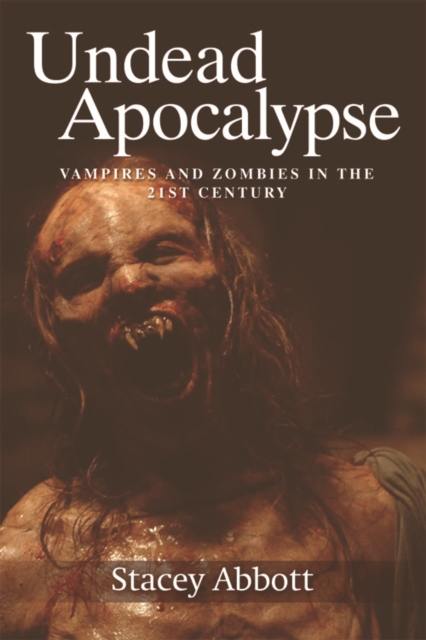
Undead apocalypse: vampires and zombies in the twenty-first century
Twenty-first century film and television is overwhelmed with images of the undead. Vampires and zombies have often been seen as oppositional: one alluring, the other repellant; one seductive, the other infectious. With case studies of films like I Am Legend and 28 Days Later, as well as TV programmes like Angel and The Walking Dead, this book challenges these popular assumptions and reveals the increasing interconnection of undead genres. Exploring how the figure of the vampire has been infused with the language of science, disease and apocalypse, while the zombie text has increasingly been influenced by the trope of the 'reluctant' vampire, Stacey Abbott shows how both archetypes are actually two sides of the same undead coin. When considered together they present a dystopian, sometimes apocalyptic, vision of twenty-first century existence.
eBook

The Orbán regime as the ‘perfect autocracy’: The emergence of the ‘zombie democracy’ in Hungary
All ECE countries have covered the same historical trajectory of ‘the third-generation autocracy’, but Hungary has been reaching its ‘perfection’, since the two-thirds, constitutional supermajority in the Hungarian case has allowed for the Orbán regime to complete this ‘reverse wave’ in all fields of society and turning it into a zombie democracy. The conceptual frame of this paper is that the decline of democracy and the turn to autocratisation can be presented in ECE in the three big stages of the Easy Dream, Chaotic Democracy and Neoliberal Autocracy in the three corresponding decades. The paper concentrates on the third stage in its three shorter periods taking 3–4 years as the DeDemocratisation, Autocratisation and DeEuropeanisation. The Hungarian case has been presented in this paper in a comparative ECE view as its worst-case scenario that also sheds light on the parallel developments in the fellow ECE countries.
Journal Article

Trends in Zombie Firms Research: A Bibliographic Review
The aim of the paper is to explore the knowledge infrastructure of research addressing the zombie issue using a bibliometric review approach combined with content analysis. The review includes 114 papers by 247 authors in 77 journals compiled using Web of Science database. The study demonstrates an exponential increase in research on the zombie issue after 2018, identifies four research streams within this topic, discusses their main findings so far, and proposes some research challenges and future research agenda of this relatively new research theme.
Journal Article

Infected Empires
Given the current moment--polarized populations, increasing climate
fears, and decline of supranational institutions in favor of a
rising tide of nationalisms-- it is easy to understand the
proliferation of apocalyptic and dystopian elements in popular
culture. Infected Empires examines one of the most popular
figures in contemporary apocalyptic film: the zombie. This
harbinger of apocalypse reveals bloody truths about the human
condition, the wounds of history, and methods of contending with
them. Infected Empires considers parallels in the zombie
genre to historical and current events on different political,
theological and philosophical levels, and proposes that the zombie
can be read as a figure of decolonization and an allegory of
resistance to oppressive structures that racialize, marginalize,
disable, and dispose of bodies. Studying films from around the
world, including Latin America, Asia, Africa, the US, and Europe,
Infected Empires presents a vision of a global zombie that
points toward a posthuman and feminist future.
eBook

It Came from the Water: The Rise of the Polish Vegan Zombie
Xawery Żuławski’s It Came from the Water (2022) offers a Polish contribution to global eco-zombie narratives by linking the rise of the undead to the pollution of the Baltic Sea. Through this local ecological lens, the movie reshapes traditional zombie tropes and introduces the vegan zombie, a figure embodying sustainable consumption. The article demonstrates how Żuławski transforms the undead into a source of cautious ecological hope, blending Poland’s environmental anxieties with international genre conventions to explore possibilities for sustainable human-nature engagement.
Journal Article