
Catalogue Search | MBRL


Are you sure you want to remove the book from the shelf?

{{itemTitle}}
210,551
result(s) for
"aesthetic"
Sort by:

Artistic dress at Liberty & Co : the early years
Liberty's dress department opened in 1884, headed by Edward William Godwin, an architect with a multi-faceted career and an important figure in the Aesthetic Movement. From the mid-nineteenth-century, women fought against restrictive clothing such as tight-laced corsets and heavy petticoats which were harmful to their health and chose instead to dress in looser fitting dresses, coloured with natural dyes and ornamented with embroidery and needlework. With archival materials and previously unpublished pattern books, Anna Buruma navigates Liberty's role in artistic dress.
BOOK

The Psychology of Static Imagery in the Book of Al-Mab’ath and Al-Maghazi: A Narrative Semiotic Study
The text represents a network of signs interconnected with each other, and this interconnection is determined by the nature of the elements composing the text. These may be grammatical, rhetorical, or structural relations, represented by metaphor, metonymy, and other techniques that help in uncovering threads of meaning and tracing its movements within that structure. This representation is \"a verbal activity where the speaker's role is not to control the use of semantic systems but to utilize them in light of the appropriate conditions for the discourse event\" (Al-Badi, 2024, p. 70), which is determined by the general context of the sentence and its integrated structural construction. The components of narration and their coherence within a single work, being an aesthetic feature, are based on the ideologization of reality as imaginative and its connection to levels of language to make it more realistic through interpretive relationships that generate new meanings. These meanings transcend the superficial appearance to the deeper level, which can only be grasped by delving into the backgrounds that shape the literary work (Khamri, 2024, p. 244). It explores the aesthetics of structure, which is considered a characteristic of everything that indicates beauty, is attributed to it, or is connected to what is beautiful and what is not beautiful (Alloush, 2024, p. 62).
Journal Article


Herder
Among his generation of intellectuals, the eighteenth-century German philosopher Johann Gottfried Herder is recognized both for his innovative philosophy of language and history and for his passionate criticism of racism, colonialism, and imperialism. A student of Immanuel Kant, Herder challenged the idea that anyone - even the philosophers of the Enlightenment - could have a monopoly on truth.
InHerder: Aesthetics against Imperialism, John K. Noyes plumbs the connections between Herder's anti-imperialism, often acknowledged but rarely explored in depth, and his epistemological investigations. Noyes argues that Herder's anti-rationalist epistemology, his rejection of universal conceptions of truth, knowledge, and justice, constitutes the first attempt to establish not just a moral but an epistemological foundation for anti-imperialism. Engaging with the work of postcolonial theorists such Dipesh Chakrabarty and Gayatri Spivak, this book is a valuable reassessment of Enlightenment anti-imperialism that demonstrates Herder's continuing relevance to postcolonial studies today.
eBook

Aesthetics of interaction in digital art
An art-historical perspective on interactive media art that provides theoretical and methodological tools for understanding and analyzing digital art.Since the 1960s, artworks that involve the participation of the spectator have received extensive scholarly attention. Yet interactive artworks using digital media still present a challenge for academic art history. In this book, Katja Kwastek argues that the particular aesthetic experience enabled by these new media works can open up new perspectives for our understanding of art and media alike. Kwastek, herself an art historian, offers a set of theoretical and methodological tools that are suitable for understanding and analyzing not only new media art but also other contemporary art forms. Addressing both the theoretician and the practitioner, Kwastek provides an introduction to the history and the terminology of interactive art, a theory of the aesthetics of interaction, and exemplary case studies of interactive media art.Kwastek lays the historical and theoretical groundwork and then develops an aesthetics of interaction, discussing such aspects as real space and data space, temporal structures, instrumental and phenomenal perspectives, and the relationship between materiality and interpretability. Finally, she applies her theory to specific works of interactive media art, including narratives in virtual and real space, interactive installations, and performance-with case studies of works by Olia Lialina, Susanne Berkenheger, Stefan Schemat, Teri Rueb, Lynn Hershman, Agnes Hegedüs, Tmema, David Rokeby, Sonia Cillari, and Blast Theory.
eBook

All ears
The world of international politics has recently been rocked by a seemingly endless series of scandals involving auditory surveillance: the NSA’s warrantless wiretapping is merely the most sensational example of what appears to be a universal practice today. What is the source of this generalized principle of eavesdropping?All Ears: The Aesthetics of Espionage traces the long history of moles from the Bible, through Jeremy Bentham’s “panacoustic\" project, all the way to the intelligence-gathering network called “Echelon.\" Together with this archeology of auditory surveillance, Szendy offers an engaging account of spycraft’s representations in literature (Sophocles, Shakespeare, Joyce, Kafka, Borges), opera (Monteverdi, Mozart, Berg), and film (Lang, Hitchcock, Coppola, De Palma). Following in the footsteps of Orpheus, the book proposes a new concept of “overhearing\" that connects the act of spying to an excessive intensification of listening. At the heart of listening Szendy locates the ear of the Other that manifests itself as the originary division of a “split-hearing\" that turns the drive for mastery and surveillance into the death drive.
eBook
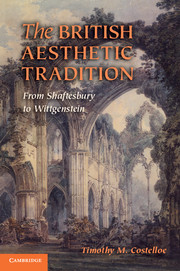
The British Aesthetic Tradition
The British Aesthetic Tradition: From Shaftesbury to Wittgenstein is the first single volume to offer readers a comprehensive and systematic history of aesthetics in Britain from its inception in the early eighteenth century to major developments in Britain and beyond in the late twentieth century. The book consists of an introduction and eight chapters, and is divided into three parts. The first part, The Age of Taste, covers the eighteenth-century approaches of internal sense theorists, imagination theorists and associationists. The second, The Age of Romanticism, takes readers from debates over the picturesque through British Romanticism to late Victorian criticism. The third, The Age of Analysis, covers early twentieth-century theories of Formalism and Expressionism to conclude with Wittgenstein and a number of views inspired by his thought.
eBook

Beautyscapes
Beautyscapes explores the global phenomenon of international medical travel, focusing on patient-consumers seeking cosmetic surgery outside their home country and on those who enable them to access treatment abroad, including surgeons and facilitators. It documents the journeys of those who travel for treatment abroad, as well as the nature and power relations of the IMT industry. Empirically rich and theoretically sophisticated, Beautyscapes draws on key themes of interest to students and researchers interested in globalisation and mobility to explain the nature and growing popularity of cosmetic surgery tourism. Richly illustrated with ethnographic material and with the voices of those directly involved in cosmetic surgery tourism, Beautyscapes explores cosmetic surgery journeys from Australia and China to East-Asia and from the UK to Europe and North Africa.
eBook

Radical Art and the Formation of the Avant-Garde
An authoritative re-definition of the social, cultural and
visual history of the emergence of the \"avant-garde\" in Paris and
London Over the past fifty years, the term \"avant-garde\"
has come to shape discussions of European culture and modernity,
ubiquitously taken for granted but rarely defined. This
ground-breaking book develops an original and searching methodology
that fundamentally reconfigures the social, cultural, and visual
context of the emergence of the artistic avant-garde in Paris and
London before 1915, bringing the material history of its formation
into clearer and more detailed focus than ever before. Drawing on a
wealth of disciplinary evidence, from socio-economics to histories
of sexuality, bohemia, consumerism, politics, and popular culture,
David Cottington explores the different models of cultural
collectivity in, and presumed hierarchies between, these two focal
cities, while identifying points of ideological influence and
difference between them. He reveals the avant-garde to be at once
complicit with, resistant to, and a product of the modernizing
forces of professionalization, challenging the conventional wisdom
on this moment of cultural formation and offering the means to
reset the terms of avant-garde studies.
eBook