
Catalogue Search | MBRL


Are you sure you want to remove the book from the shelf?

{{itemTitle}}
224
result(s) for
"al- Andalus"
Sort by:

Religious Buildings in Early al-Andalus: Origins, Consolidation and Prevalence in Urban Contexts
The arrival of Islam to the Iberian Peninsula at the beginning of the 8th c. brought important changes to the urbanism of cities which contributed to turn the previous late-antique realities into medieval Islamic settlements. Among all the transformations that took place, the introduction of mosques and the reconfiguration of cities’ religioscapes is one of the most relevant. The processes through which the earliest mosques were first inserted in urban landscapes in al-Andalus are unclear, since so far there are no remains that can be undoubtedly dated before the Umayyad period. From that moment on, and alongside the Umayyad organization of the Andalusi state, the founding of mosques becomes clearer and traceable, and their urban, religious and political roles more evident. This contribution seeks to identify how and why mosques appeared in the Iberian Peninsula, how they (re)configured religious spaces in cities, and how they contributed to consolidate their significance through specific written and architectural narratives. This topic will be explored also seeking for parallels and connections in the Bilād al-Shām region.
Journal Article

Lost civilization : the contested Islamic past in Spain and Portugal
\"Al-Andalus, the Iberian Islamic civilization centred on Cordoba in the tenth and eleventh centuries, has been a 'lost' civilization in several respects. Its history suppressed or denied for much of the nineteenth and twentieth centuries, it was regarded as a kind of 'historical parenthesis' with no lasting influence. Over the past twenty-five years, however, the history and archaeology of the Islamic period in the Iberian peninsula has undergone a complete transformation. Lost Civilization presents an introduction to this debate as it has played out in archaeology, taking a comparative civilizations approach that puts the formation of al-Andalus in context with corresponding developments elsewhere in Europe, North Africa and the Middle East.\"--BOOK JACKET.
Book

Tackling early medieval circulation of glazed ware in Sharq al-Andalus using a multidisciplinary approach: El Tolmo de Minateda (Spain)
This paper offers an analysis of a group of glazed ceramics that comes from El Tolmo de Minateda site and have been dated in the second half of the ninth century and beginning of the tenth century, before the proclamation of the Umayyad Caliphate by Abderraman III (929 CE). Three technological groups have been distinguished: transparent glazes of one or two colours, transparent polychrome glazes (represented by two pieces) and opaque polychrome glazes (represented by two ceramics) studied by SEM-EDS analysis. After the study, different al-Andalus glaze workshops have been identified as providers of glazed ware to El Tolmo de Minateda site. The initial hypothesis was that the ware consumed in El Tolmo was manufactured in Pechina, the closest early production centre. However, after the archaeometric analysis, it has been discarded, and all the indications of this study seem to point to Córdoba as a significant supplier. The data of this study provides a new perspective on how the internal regional distribution and marketing of goods took place in Al-Andalus during the late Emiral period (c. 875–929 CE), a subject that has yet to be explored.
Journal Article

Referencias sobre el patrimonio arquitectónico en Išbīliya a través de los autores y fuentes documentales árabes entre las épocas emiral y almorávide = References on the Architectural Heritage in Išbīliya through the Arab Authors and Documentary Sources between the Emiral and Almoravid Periods
El objetivo principal del presente artículo es abordar el estudio de la Sevilla islámica a través de los diferentes testimonios documentales que han llegado hasta nosotros, desde los primeros años de la conquista islámica hasta época almorávide. Sin embargo, y teniendo en cuenta los diferentes campos en los que nos podríamos centrar (realidad histórica, geográfica, política, social…), consideramos oportuno detenernos en el ámbito artístico, concretamente en aquellas construcciones que emanan del ejercicio del poder político y religioso en el mundo islámico como son la arquitectura palatina y religiosa, entre otras. Con esta finalidad, y convirtiéndose las fuentes escritas en el eje articulador de nuestro discurso, pretendemos destacar el valor que tienen los textos árabes como punto de partida para el conocimiento de este escenario, sin olvidarnos de lo necesario que resulta en la actualidad contar con diferentes estudios interdisciplinares para una mayor comprensión del tema.AbstractThe main objective of this article is to address the study of Islamic Seville through the may written testimonies that we have from the early years of Islamic conquest to the Almoravid period. Taking into account the different aspects on which we could focus (historical, geographical, political, social reality...), we consider it appropriate to delve on the artistic field, specifically on those constructions that stem from the exercise of political and religious power in the Islamic world such as palatine and religious architecture. To this end, and constructing our discourse through the written sources, we intend to highlight the value of Arab texts as a starting point for scholar research about this scenario, we also take into account the need of different interdisciplinary studies for a better understanding of the subject.
Journal Article
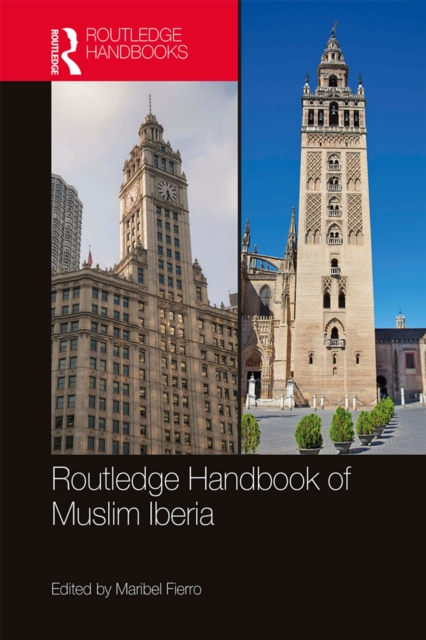
The Routledge Handbook of Muslim Iberia
This handbook offers an overview of the main issues regarding the political, economic, social, religious, intellectual and artistic history of the Iberian Peninsula during the period of Muslim rule (eighth-fifteenth centuries). A comprehensive list of primary and secondary sources attests the vitality of the academic study of al-Andalus (= Muslim Iberia) and its place in present-day discussions about the past and the present.
The contributors are all specialists with diverse backgrounds providing different perspectives and approaches. The volume includes chapters dealing with the destiny of the Muslim population after the Christian conquest and with the posterity of al-Andalus in art, literature and different historiographical traditions. The chapters are organized in the following sections:
Political history, concentrating on rulers and armies
Social, religious and economic groups
Intellectual and cultural developments
Legacy and memory of al-Andalus
Offering a synthetic and updated academic treatment of the history and society of Muslim Iberia, this comprehensive and up-to-date collection provides an authoritative and interdisciplinary guide. It is a valuable resource for both specialists and the general public interested in the history of the Iberian Peninsula, Islamic and Medieval studies.
eBook
La cultura material de Sevilla entre los siglos XI-XIII a través de la producción árabe escrita en época almohade. La importancia del legado ‘Abbādí
A partir del estudio y análisis de la documentación escrita el objetivo principal del presente artículo es dar a conocer aquellos datos vinculados con el pasado cultural de Išbīliya, centrados en el ámbito arquitectónico y recogidos por algunos autores árabes que vivieron en época almohade. Un momento en que Sevilla se convirtió en la capital andalusí de este nuevo movimiento, cuya importancia no solo ha quedado avalada por la historiografía tradicional y por las diferentes intervenciones arqueológicas realizadas en la ciudad, sino también por la amplia información que ha llegado hasta nosotros a través de los textos. Además, gracias a estos últimos podemos corroborar la pervivencia y relevancia que otras construcciones previas alcanzaron en este periodo, principalmente de época taifa, permitiéndonos así completar y establecer una comparación con las noticias que nos ofrecen el resto de autores precedentes. Based on the study and analysis of written documentation, the main objective of this article is to provide information on the cultural past of Išbīliya, focusing on the architectural sphere and collected by some Arab authors who lived in the Almohad period. At a time when Seville became the Andalusian capital of this new movement, the importance of which has been confirmed not only by traditional historiography and the various archaeological interventions carried out in the city, but also by the extensive information that has come down to us through texts. Moreover, thanks to the latter, we can corroborate the survival and relevance that other previous constructions reached in this period, mainly from the Taifa period, thus allowing us to complete and establish a comparison with the information provided by previous authors.
Journal Article

Al-Andalus en la Muqaddima de Ibn Jaldūn
A partir del texto árabe original de la Muqaddima, este trabajo analiza las referencias a al-Andalus en tanto que entidad geográfica, histórica y política, para determinar la imagen que Ibn Jaldūn tenía de esta región en sus distintas dimensiones. El estudio demuestra que el autor tunecino equiparó esta realidad política a otras naciones del mundo conocido y a través de numerosas referencias a la realidad andalusí ilustró procesos históricos, describió las fases experimentadas por las civilizaciones y explicó la arquitectura administrativa del poder. Su profunda comprensión de las civilizaciones del Mediterráneo, unido al conocimiento personal del occidente árabe-islámico, conducen al historiador tunecino a perseguir una historia total, en la que al-Andalus, contemplada como una civilización en decadencia en época del autor, será una pieza más que explique fenómenos económicos, sociológicos y culturales, así como un eslabón entre dos realidades históricas: las grandes dinastías islámicas y los poderes cristiano y otomano.
Journal Article
La ‘fila’ de agua valenciana y otras medidas de aforo. La verdadera naturaleza de un sistema de medición de caudales de origen andalusí
Los caudales de agua de riego se han medido tradicionalmente en Valencia mediante una medida de aforo llamada fila, de la que hasta ahora se desconocía su verdadera naturaleza y valor, a pesar de ser un tema ampliamente discutido desde hace siglos. En este artículo se plantea una solución a esta discusión, estableciéndose que la fila o hila, de herencia andalusí, tenía una triple condición según la cantidad de agua disponible. Así, habitualmente era la cantidad de agua que podía pasar por un orificio con una medida concreta, cuando disminuía el nivel era una cantidad de agua proporcional a toda la disponible, y si había mucha escasez era una cantidad de tiempo durante el cual disponer de toda el agua. Además, se establece cual fue el valor de la fila en Valencia en época medieval y moderna, su posible equivalencia con otras medidas de aforo, y se propone cual fue su valor en época andalusí, antes de la conquista.
Journal Article

Más allá del medievalismo y el arabismo
El presente artículo pretende contribuir a superar las visiones eurocéntricas y occidentalistas del estudio sobre Al-Ándalus mediante el análisis crítico de dos disciplinas: el medievalismo y el arabismo. En la primera parte se describe el medievalismo como un ejercicio de occidentalismo; en la segunda se examina el arabismo español como una mirada proveniente del mundo colonial francés. Al final se incorporan algunas aportaciones de la teoría decolonial latinoamericana y de la corriente del medievalismo poscolonial anglosajón para situar ciertas líneas de análisis y reflexión que convocan a una mirada poscolonial y no eurocéntrica del fenómeno andalusí.
This article aims to contribute to overcoming the Eurocentric and Occidentalist views of Al-Andalus through the critical analysis of two disciplines: medievalism and Arabism. First, medievalism is described as an exercise in Occidentalism. Secondly, Spanish Arabism is analysed as a discursive corpus originating inthe French colonial world. The text concludes by incorporating certain contributions from Latin American decolonial theory and from contemporary Anglo-American postcolonial medievalism, to locate certain lines of analysis and reflection that call for a postcolonial and non-Eurocentric view of the Andalusian phenomenon.
Journal Article