
Catalogue Search | MBRL


Are you sure you want to remove the book from the shelf?

{{itemTitle}}
62,836
result(s) for
"animal communication"
Sort by:

Is anyone listening? : what animals are saying to each other and to us
\"If you could ask a dolphin one question, what would it be? What might a dolphin ask you? In her studies of marine mammal communication, researcher and author Denise Herzing has asked these and related questions for nearly forty years. In this wide-ranging and accessible book, Herzing connects research on dolphin communication to findings from Jane Goodall on chimpanzees, Dian Fossey on mountain gorillas, Cynthia Moss on African elephants, and others driving today's exploration of animal language. Considering dolphins and other nonhuman animals as colleagues instead of research subjects, she asks us to meet animals as both speakers and listeners, learning from what others have to tell us, regardless of our agendas. Our ancestors evolved with plants, animals, and the earth itself. We breathe the same oxygen, walk in the same woods, and feel the same wind and water as other life. Understanding animal communication, Herzing reminds us, helps us start to appreciate that we are mutually curious species, carefully considering each other\"-- Provided by publisher.
BOOK
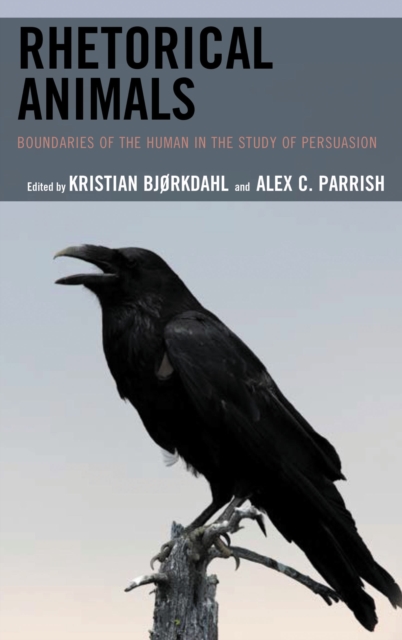
Rhetorical animals
For this edited volume, the editors solicited chapters that investigate the place of nonhuman animals in the purview of rhetorical theory; what it would mean to communicate beyond the human community; how rhetoric reveals our \"brute roots.\" In other words, this book investigates themes that enlighten us about likely or possible implications of the animal turn within rhetorical studies. The present book is unique in its focus on the call for nonanthropocentrism in rhetorical studies. Although there have been many hints in recent years that rhetoric is beginning to consider the implications of the animal turn, as yet no other anthology makes this its explicit starting point and sustained objective. Thus, the various contributions to this book promise to further the ongoing debate about what rhetoric might be after it sheds its long-standing humanistic bias.
eBook


The Evolution of Animal Communication
Gull chicks beg for food from their parents. Peacocks spread their tails to attract potential mates. Meerkats alert family members of the approach of predators. But are these--and other animals--sometimes dishonest? That's what William Searcy and Stephen Nowicki ask inThe Evolution of Animal Communication. They take on the fascinating yet perplexing question of the dependability of animal signaling systems.
The book probes such phenomena as the begging of nesting birds, alarm calls in squirrels and primates, carotenoid coloration in fish and birds, the calls of frogs and toads, and weapon displays in crustaceans. Do these signals convey accurate information about the signaler, its future behavior, or its environment? Or do they mislead receivers in a way that benefits the signaler? For example, is the begging chick really hungry as its cries indicate or is it lobbying to get more food than its brothers and sisters?
Searcy and Nowicki take on these and other questions by developing clear definitions of key issues, by reviewing the most relevant empirical data and game theory models available, and by asking how well theory matches data. They find that animal communication is largely reliable--but that this basic reliability also allows the clever deceiver to flourish. Well researched and clearly written, their book provides new insight into animal communication, behavior, and evolution.
eBook

How and why do animals communicate?
This entertaining book shows how animals communicate to share information, attract mates, or scare away enemies. They sing, growl, howl, spray smelly scents, and make their body parts bigger. Have fun comparing the ways you communicate with the ways animals do.
Book

You talkin’ to me? Functional breed selection may have fundamentally influenced dogs’ sensitivity to human verbal communicative cues
Background
The ability to learn from humans via observation was considered to be equally present across properly socialized dogs. We showed recently that cooperative working breeds learned from a human demonstrator more effectively. We hypothesized that functional breed selection could affect sensitivity to human attention-eliciting behavior. Accordingly, we ran the first ever study on dogs that compared the effect of ostensive and neutral verbal communication in a social learning scenario. We used the detour paradigm around a transparent V-shaped fence with either ostensive (addressing the receiver both with words and specific, attention-eliciting prosody) or neutral speech (monotonous reciting of a short poem) demonstration. The other features (gestures, movement) of the demonstration sequence were kept identical between the two conditions. We tested (
N
= 70) companion dogs from 17 cooperative and 16 independent breeds in three 1-min trials. Subjects had to obtain the reward by detouring around the fence.
Results
Detour latencies of the cooperative dogs improved after both ostensive and neutral speech demonstrations. The independent dogs did not improve their detour latency in either of the conditions. Remarkably, ostensive verbal utterances elicited longer relative looking time towards the demonstrator, cooperative dogs looked longer at the demonstrator, and longer looking time resulted in more successful detours.
Conclusions
Our study provides the first indication that functional breed selection had a significant impact on dogs’ sensitivity to ostensive human communication, which, apart from being crucially important for social learning from humans, until now was considered as a uniformly present heritage of domestication in dogs.
Graphical Abstract
Journal Article


Compositionality in Different Modalities: A View from Usage-Based Linguistics
The field of linguistics concerns itself with understanding the human capacity for language. Compositionality is a key notion in this research tradition. Compositionality refers to the notion that the meaning of a complex linguistic unit is a function of the meanings of its constituent parts. However, the question as to whether compositionality is a defining feature of human language is a matter of debate: usage-based and constructionist approaches emphasize the pervasive role of idiomaticity in language, and argue that strict compositionality is the exception rather than the rule. We review the major discussion points on compositionality from a usage-based point of view, taking both spoken and signed languages into account. In addition, we discuss theories that aim at accounting for the emergence of compositional language through processes of cultural transmission as well as the debate of whether animal communication systems exhibit compositionality. We argue for a view that emphasizes the analyzability of complex linguistic units, providing a template for accounting for the multimodal nature of human language.
Journal Article


Allometry of Alarm Calls: Black-Capped Chickadees Encode Information About Predator Size
Many animals produce alarm signals when they detect a potential predator, but we still know little about the information contained in these signals. Using presentations of 15 species of live predators, we show that acoustic features of the mobbing calls of black-capped chickadees (Poecile atricapilla) vary with the size of the predator. Companion playback experiments revealed that chickadees detect this information and that the intensity of mobbing behavior is related to the size and threat of the potential predator. This study demonstrates an unsuspected level of complexity and sophistication in avian alarm calls.
Journal Article