
Catalogue Search | MBRL


Are you sure you want to remove the book from the shelf?

{{itemTitle}}
9,315
result(s) for
"anonymous literature"
Sort by:

Author unknown : the power of anonymity in ancient Rome
\"An exploration of the darker corners of ancient Rome to spotlight the strange sorcery of anonymous literature. From Banksy to Elena Ferrante to the unattributed parchments of ancient Rome, art without clear authorship fascinates and even offends us. Classical scholarship tends to treat this anonymity as a problem or game--a defect to be repaired or mystery to be solved. Author Unknown is the first book to consider anonymity as a site of literary interest rather than a gap that needs filling. We can tether each work to an identity, or we can stand back and ask how the absence of a name affects the meaning and experience of literature. Tom Geue turns to antiquity to show what the suppression or loss of a name can do for literature. Anonymity supported the illusion of Augustus's sprawling puppet mastery (Res Gestae), controlled and destroyed the victims of a curse (Ovid's Ibis), and created out of whole cloth a poetic person and career (Phaedrus's Fables). To assume these texts are missing something is to dismiss a source of their power and presume that ancient authors were as hungry for fame as today's. In this original look at Latin literature, Geue asks us to work with anonymity rather than against it and to appreciate the continuing power of anonymity in our own time\"-- Provided by publisher.
Book

The Effectiveness of an Anonymous Pen: The Experience of the Jesuit Polemicist Francesco Antonio Zaccaria
For Ugo The figure of the Jesuit Francesco Antonio Zaccaria (1714-1795) is exemplary for considering the style that the controversy acquired in the early modern period, when he abandoned the strictly theological-doctrinal debate in an anti-Protestant function and also expanded to the legal, historical, and literary in defense of the rights of the Church and of the papacy. This essay highlights and analyzes, in particular, the widespread eighteenth-century custom of anonymous writings. Authors did not want to escape censorship as much as to draw more attention to the contents and leave the writer the freedom of greater aggression of language and more effective apologetics. Keywords: Francesco Antonio Zaccaria S.J., (1714-1795), Lodovico Antonio Muratori (1675-1750), Catholic Education, Italian eloquence, Anonymous literature, Apologetics, Jesuits
Journal Article

California in the 1930s
Alive with the exuberance, contradictions, and variety of the Golden State, this Depression-era guide to California is more than 700 pages of information that is, as David Kipen writes in his spirited introduction, \"anecdotal, opinionated, and altogether habit-forming.\" Describing the history, culture, and roadside attractions of the 1930s, the WPA Guide to California features some of the very best anonymous literature of its era, with writing by luminaries such as San Francisco poet Kenneth Rexroth, composer-writer- hobo Harry Partch, and authors Tillie Olsen and Kenneth Patchen.
eBook
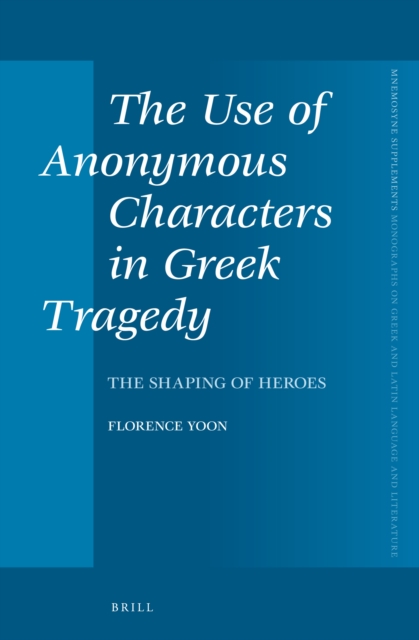
The Use of Anonymous Characters in Greek Tragedy
Anonymous characters appear in almost every extant Greek tragedy, yet they have long been overlooked in critical scholarship. This book argues that the creation and use of anonymous figures is an important tool in the tragedian's transformation of traditional mythological heroes into unique dramatic characters.
eBook

New African Writing and the Question of Audience
Postcolonial novels that tend to become popularly acclaimed in Western Europe and North America share a number of features: they are predominantly written by women; they are presented from the perspectives of culturally innocent or marginal protagonists; they thematize the emotional consequences of familial or public upheavals; and they are not too long but, if they are, they compensate by being thematically, formally, or linguistically unadventurous. This is the primary context of reception of much contemporary African writing, and it is not surprising that new works of fiction by African writers feed into this typology. The novel remains about the most inclusive of literary forms, but a certain kind of novel has become so dominant today as to be viewed as the gold standard, especially when this is measured by popular or critical success. This paper discusses these features in relation to three issues: the structure of the prose form, especially the novel; the external factors of economics and symbolic capital; and the politics of postcolonial stories. The paper argues that the process of cultural politics through which symbolic capital is reproduced in postcolonial stories is a function of what writers perceive to be the market of their works. By reading against the grain of Allah Is Not Obliged (Ahmadou Kourouma) and Purple Hibiscus (Chimamanda Ngozi Adichie), the paper suggests that contemporary African writing remains fraught with a paradox, the productive foreignness of a sensibility that is estranged from its own interests.
Journal Article
Towards an Architecture of Mythos: Lucian Blaga and Utopian Pessimism
This article explores the concept of mythos in Lucian Blaga's philosophy and its potential for constructing a metaphysics that embraces mystery and transcends the limitations of pure reason. It begins by establishing the foundation of mythos in the Buddhist concept of \"Maya\" and the two truths doctrine, highlighting the illusory nature of perceived reality and the limitations of human knowledge. It then delves into Blaga's philosophy, where \"mystery\" is a central category, and the Great Anonymous represents the ultimate, unknowable source of existence. By integrating Blaga's ideas with notions of cognitive biases and Jacobo Grinberg-Zylberbaum's synergic theory, the article argues for a \"metaphysics of mythos.\" This metaphysics recognizes the limitations of human reason and proposes an approach to understanding a reality that incorporates mythical and poetic thinking, opening new avenues for philosophical inquiry beyond the confines of traditional, logic-centered metaphysics. The article concludes by suggesting that artists, as creators of mythos, play a vital role in shaping this new metaphysics and expanding the boundaries of human understanding.
Journal Article
Human Rights, Child-Soldier Narratives, and the Problem of Form
This essay speaks to recent debates in the literature of human rights by focusing on the figure of the African child soldier. I argue that the child-soldier figure represents a kind of limit-case for human rights discourse. Reading memoirs by former child-soldiers and memoir-style novels by the writers Ahmadou Kourouma, Uzodinma Iweala, Emmanuel Dongala, and Chris Abani, I contend that these works mobilize sentiment, Bildung, and the picaresque in their effort to negotiate and contest both the \"““politics of life\"”” of humanitarian intervention and the necropolitical formations that produce child soldiers.
Journal Article

Literary translation during the Chinese Cultural Revolution
This article provides a historical and reflective account of the remarkable perseverance and tenacity of Chinese translators during the turmoil of the Cultural Revolution in Chinese history. It first dispels the misunderstandings and misconceptions associated with the myth that the country was beset by a cultural wilderness, which shaped the impression that no translation activities were widely known. But this is far from a complete picture. Contrary to popular belief, the Chinese leader of the time, Mao Zedong, attached great importance to translation. At the beginning of the mass movement, there were hardly any translations into Chinese, but translation into English and some other languages was not stopped even in the most turbulent period. In this paradoxical scenario, some limited translations into Chinese were allowed, closely supervised by the authorities, and their circulation was strictly internal. Translators were anonymized and deprived of the right to decide for themselves what or with whom they wanted to translate since these were invariably translations in subterranean collaboration. This peculiar form of collective translation will be examined in more detail here. It should be noted, however, that the Chinese translators were not merely subservient. Some respected translators, whom the authorities did not trust with this form of collective translation, did not bow to political pressure and stole the Promethean fire by resorting to “private” (underground) translations, without the intention or hope that the translated texts would see the light of day.
Journal Article

Trzy typy zagadek w historii polskiego przekładu literackiego
The aim of the paper is to present three types of riddles appearing in the history of Polish literary translation, as well as suggestions for methods of solving them. The first type involves the attribution of the authorship of an anonymous translation; here I will use the example of my own attempts to identify the author of an eighteenth-century translation of Voltaire’s philosophical story La Princesse de Babylone. The second type involves the explanation for the fact that the Polish translation appeared very soon after the publication of the original, under conditions of a long publishing process and limited possibilities for the international circulation of texts in the People’s Republic of Poland; the case of Beckett’s drama Fin de partie is discussed here. Thirdly, I try to find out how some texts which, in theory, should not be admitted to the People’s Republic of Poland literary field, were smuggled into it by engaged agents under favourable historical circumstances.
Journal Article