
Catalogue Search | MBRL


Are you sure you want to remove the book from the shelf?

{{itemTitle}}
13
result(s) for
"anti-Vietnam War movement"
Sort by:

The movement and the Middle East : how the Arab-Israeli conflict divided the American left
The Arab-Israeli conflict constituted a serious problem for the American Left in the 1960s: pro-Palestinian activists hailed the Palestinian struggle against Israel as part of a fundamental restructuring of the global imperialist order, while pro-Israeli leftists held a less revolutionary worldview that understood Israel as a paragon of democratic socialist virtue. This intra-left debate was in part doctrinal, in part generational. But further woven into this split were sometimes agonizing questions of identity. Jews were disproportionately well-represented in the Movement, and their personal and communal lives could deeply affect their stances vis-à-vis the Middle East. The Movement and the Middle East offers the first assessment of the controversial and ultimately debilitating role of the Arab-Israeli conflict among left-wing activists during a turbulent period of American history. Michael R. Fischbach draws on a deep well of original sources—from personal interviews to declassified FBI and CIA documents—to present a story of the left-wing responses to the question of Palestine and Israel. He shows how, as the 1970s wore on, the cleavages emerging within the American Left widened, weakening the Movement and leaving a lasting impact that still affects progressive American politics today.
eBook

Understanding antiwar activism as a gendering activity: a look at the U.S.'s anti-Vietnam War movement
Research into the gendered nature of war experiences has provided rich ways of understanding how gender constructs society and the nation. Scholarship on peace activism and gender has deepened our knowledge of women's roles within warring societies and the ways women have understood themselves as promoters of peace. While much of this research asks how antiwar activities and war are predicated upon dominant gender ideals and focuses in particular on women's experiences, this article aims to explore how some wartime events, specifically antiwar activism, constitutes or reconstitutes gender. Focusing on the United States' anti-Vietnam War history, I examine how activists cemented, challenged and made anew notions of femininity and masculinity within and through this antiwar arena. I argue that both women and men activists created opportunities within the anti-Vietnam War movement to reconceptualise links between war and gender. Though feminist scholars have elucidated the splits that occurred amongst these women activists, this article seeks to situate these divisions within contested understandings of femininity, as well as to extend scholarly exploration into competing notions of antiwar masculinities. [PUBLICATION ABSTRACT]
Journal Article

Peace in Vietnam! Beheiren: Transnational Activism and GI Movement in Postwar Japan 1965-1974
Beheiren (Betonamu ni heiwa wo shimin rengō [Citizen’s Committee for Peace in Vietnam]) was launched by a handful of postwar intellectuals in Tokyo when the United States started bombing North Vietnam in February 1965. The widespread presence of US bases throughout Japan allowed American soldiers to be transported and carry out missions from Japan and (then) American occupied-Okinawa to fight Vietnamese people. Japan was a launching pad for America’s war in Southeast Asia. Hundreds of loosely formed Beheiren groups emerged on campuses, in towns and cities across Japan. The emergence of American deserters in the late 1960s transformed Beheiren into a transnational underground operation that sheltered American deserters and moved them out to Sweden and France in cooperation with the former Soviet Union and Resistance groups in Europe. By 1970, while getting the deserters out of Japan became harder because of the increased involvement of US intelligence agents, GI uprisings occurred in every major US base worldwide. American activists started coming to Japan and occupied Okinawa to connect with Beheiren to get GIs out of the military system. Protesting America’s war during the Cold War under the contradiction and dilemma involving Japan’s Peace Constitution and the US-Japan Security Treaty, the central issue of the Beheiren movement was fundamentally transnational. All the people, including deserters, antiwar GIs, young Japanese and American activists, ordinary citizens of Japan who sheltered American deserters in their homes, were thrown into transnational activism through their globalized experiences. This study attempted to paint a holistic picture of Beheiren. The theoretical concepts used in this study includes the political process model, nonviolent direct action, especially in the form of civil disobedience, a generational model of continuity and change, and rooted cosmopolitans. Through archives, qualitative content analysis, participant observation, and interviews with the remaining key activists of Beheiren, this study found that, for the past half century, former Beheiren activists have been quietly continuing grassroots transnational activism to this day. They maintain ‘loose’ civic networks and skepticism toward “power”. These elements stem from keen observation and the experiences of the key actors growing up in the age of Imperial Japan. They remained firm in their belief that the future would support the rights of the individual to refuse to kill and be killed in the name of any state.
Dissertation

New Left, Old Left, and Michael Harrington
The Shachtmanites who took over the Socialist Party in the late 1950s had a vision of a realigned Democratic Party that put trade unions at the center, supported the civil rights movement, and drove out the party’s Dixiecrat flank. They said the Democratic Party was becoming a labor party in disguise. Meanwhile the leaders of Students for a Democratic Society called for a New Left, lumping together communists and anticommunist socialists as the Old Left. The left broke apart in the 1960s over the exotic turmoil of the antiwar, wave two feminist, Black Power, and Third World revolutionary movements. Two new Socialist organizations arose in response: the Democratic Socialist Organizing Committee and the New American Movement. In 1982 they merged to form Democratic Socialists of America (DSA).
Book Chapter

Not a Happy Time
Moses had gambled—and lost. Within the next year, he would lose everything dear to him. Above all, his consensus-based organizational leadership approach faltered through the heavy toll of Freedom Summer and Atlantic City.
A new phase was beginning in the national and local movements, and in his life. “The Movement never really recuperated from that summer,” Moses acknowledged, “and the price [of] freeing Mississippi was the destabilization of SNCC.” As a more and more hierarchical SNCC embraced black nationalism, and as he and SNCC found themselves increasingly at odds with what the grassroots leadership they had encouraged in Mississippi
Book Chapter

Vietnam and Israel (1965–1967)
HESCHEL WAS THE MOST VISIBLE TRADITIONAL JEW IN THE ANTI–VIETNAM WAR movement. Like thousands of Americans he opposed U.S. military support for the corrupt Saigon regime, but his dissent had no institutional backing. He was not associated with Reform Judaism, whose leaders were in the vanguard of social action, civil rights, and the antiwar movement. Orthodox rabbis, closer to his observance, either rejected political protest or upheld the government’s prosecution of the war. A majority of JTS faculty dissociated themselves from Heschel’s involvement. Although some detractors (and friendly conservatives) considered him naive politically, he kept himself well informed of
Book Chapter

Embattled Ecumenism
The Vietnam War and its polarizing era challenged, splintered, and changed The National Council of the Churches of Christ in the U.S.A. (NCC), which was motivated by its ecumenical Christian vision to oppose that war and unify people. The NCC's efforts on the war exposed its strengths and imploded its weaknesses in ways instructive for religious institutions that bring their faith into politics. Embattled Ecumenism explores the ecumenical vision, anti-Vietnam War efforts, and legacy of the NCC. Gill's monumental study serves as a window into the mainline Protestant manner of engaging political issues at a unique time of national crisis and religious transformation. In vibrant prose, Gill illuminates an ecumenical institution, vision, and movement that has been largely misrepresented by the religious right, dismissed by the secular left, misunderstood by laity, and ignored by scholars outside of ecumenical circles. At a time when the majority of scholarly work is committed to looking at the religious right, Gill's groundbreaking study of the Protestant Left is a welcome addition. Embattled Ecumenism will appeal to scholars of U.S. religion, politics, and culture, as well as historians of evangelicalism and general readers interested in U.S. history and religion.
eBook

Peace and Freedom
Two great social causes held center stage in American politics in the 1960s: the civil rights movement and the antiwar groundswell in the face of a deepening American military commitment in Vietnam. InPeace and Freedom, Simon Hall explores two linked themes: the civil rights movement's response to the war in Vietnam on the one hand and, on the other, the relationship between the black groups that opposed the war and the mainstream peace movement. Based on comprehensive archival research, the book weaves together local and national stories to offer an illuminating and judicious chronicle of these movements, demonstrating how their increasingly radicalized components both found common cause and provoked mutual antipathies.Peace and Freedomshows how and why the civil rights movement responded to the war in differing ways-explaining black militants' hostility toward the war while also providing a sympathetic treatment of those organizations and leaders reluctant to take a stand. And, while Black Power, counterculturalism, and left-wing factionalism all made interracial coalition-building more difficult, the book argues that it was the peace movement's reluctance to link the struggle to end the war with the fight against racism at home that ultimately prevented the two movements from cooperating more fully. Considering the historical relationship between the civil rights movement and foreign policy, Hall also offers an in-depth look at the history of black America's links with the American left and with pacifism. With its keen insights into one of the most controversial decades in American history,Peace and Freedomrecaptures the immediacy and importance of the time.
eBook

Building Sanctuary
This book brings to light the activities and influence of the anti-draft groups that sprang up to build support for American Vietnam war resisters in Canada.
eBook
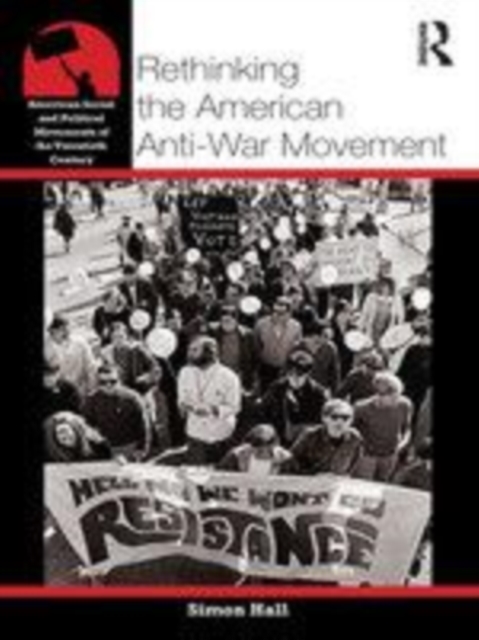
Rethinking the American Anti-War Movement
Between 1965 and 1973, hundreds of thousands of ordinary Americans participated in one of the most remarkable and significant people's movements in American history. Through marches, rallies, draft resistance, teach-ins, civil disobedience, and non-violent demonstrations at both the national and local levels, Americans vehemently protested the country's involvement in the Vietnam War.
Rethinking the American Anti-War Movement provides a short, accessible overview of this important social and political movement, highlighting key events and key figures, the movement's strengths and weaknesses, how it intersected with other social and political movements of the time, and its lasting effect on the country. The book is perfect for anyone wanting to obtain an introduction to the Anti-War movement of the twentieth century.
eBook