
Catalogue Search | MBRL


Are you sure you want to remove the book from the shelf?

{{itemTitle}}
433
result(s) for
"antisemitismus"
Sort by:


RADIO AND THE RISE OF THE NAZIS IN PREWAR GERMANY
How do the media affect public support for democratic institutions in a fragile democracy? What role do they play in a dictatorial regime? We study these questions in the context of Germany of the 1920s and 1930s. During the democratic period, when the Weimar government introduced progovernment political news, the growth of Nazi popularity slowed down in areas with access to radio. This effect was reversed during the campaign for the last competitive election as a result of the pro-Nazi radio broadcast following Hitler’s appointment as chancellor. During the consolidation of dictatorship, radio propaganda helped the Nazis enroll new party members. After the Nazis established their rule, radio propaganda incited anti-Semitic acts and denunciations of Jews to authorities by ordinary citizens. The effect of anti-Semitic propaganda varied depending on the listeners’ predispositions toward the message. Nazi radio was most effective in places where anti-Semitism was historically high and had a negative effect in places with historically low anti-Semitism.
Journal Article

Religion, Division of Labor, and Conflict
We study the role of economic incentives in shaping the coexistence of Jews, Catholics, and Protestants, using novel data from Germany for 1,000+ cities. The Catholic usury ban and higher literacy rates gave Jews a specific advantage in the moneylending sector. Following the Protestant Reformation (1517), the Jews lost these advantages in regions that became Protestant. We show (i) a change in the geography of anti-Semitism with persecutions of Jews and anti-Jewish publications becoming more common in Protestant areas relative to Catholic areas; (ii) a more pronounced change in cities where Jews had already established themselves as moneylenders. These findings are consistent with the interpretation that, following the Protestant Reformation, Jews living in Protestant regions were exposed to competition with the Christian majority, especially in moneylending, leading to an increase in anti-Semitism.
Journal Article
PERSECUTION PERPETUATED: THE MEDIEVAL ORIGINS OF ANTI-SEMITIC VIOLENCE IN NAZI GERMANY
How persistent are cultural traits? Using data on anti-Semitism in Germany, we find local continuity over 600 years. Jews were often blamed when the Black Death killed at least a third of Europe's population during 1348—50. We use plague-era pogroms as an indicator for medieval antiSemitism. They reliably predict violence against Jews in the 1920s, votes for the Nazi Party, deportations after 1933, attacks on synagogues, and letters to Der Stürmer. We also identify areas where persistence was lower: cities with high levels of trade or immigration. Finally, we show that our results are not driven by political extremism or by different attitudes toward violence.
Journal Article

Es ist einfach traurig, dass es halt noch so ein, zwei Menschen davon gibt“. Schüler:innen-Vorstellungen von Antisemitismus und Implikationen für die politische Bildung
Nach einem Überblick über aktuelle Befunde aus der empirischen Forschung zu Antisemitismus und Bildung erfolgt die Darstellung von Forschungsergebnissen zu Schüler:innenvorstellungen von Antisemitismus. Auf dieser Grundlage werden abschließend Handlungsempfehlungen für die politische Bildung herausgearbeitet.
Journal Article
Perversion of Faith
With political disinformation rampant and antisemitism on the rise across the world, it is vital for a healthy society to better understand both racism and the propaganda that promotes it. This study highlights the role of the feature film in promoting an ideology that supports the identification of a racial enemy that can lead to political persecution and social violence. The author presents a psychological model as an explanatory framework for understanding the emotional appeal of racist propaganda. Illustrative evidence for the psychological model will be provided primarily through three feature films made by the National Socialist (Nazi) regime in Germany (1933-1945). These films provide evidence of different ways in which film was utilized to aid in the regime's intent to wage war against its perceived enemies.The book addresses address five major questions related to the role of propaganda in the promotion of racist ideology and social violence: 1) how can we understand the emotional basis of the ideology of racism? 2) How are these ideas translated into mass media like films, television, and the internet? 3) What is the emotional appeal of this propaganda to the committed follower and to the average citizen? 4) What is the role of propaganda in moving people from an ideology to social action including violence? 5) What might be antidotes to racist propaganda?The book will be of interest to students and researchers in film studies, history, sociology, and cultural studies, as well as specialist Jewish Studies and Holocaust Studies centers.
eBook
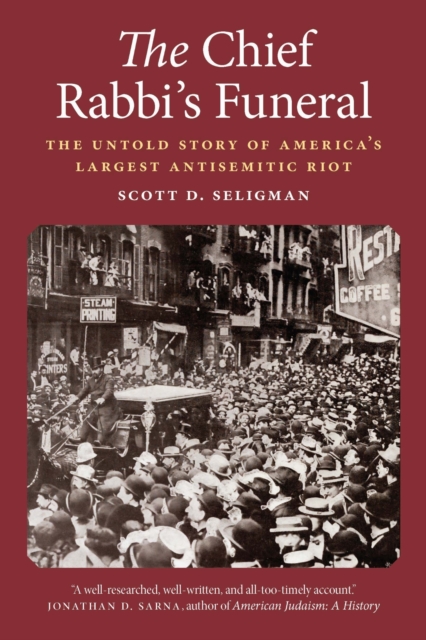
The Chief Rabbi's Funeral: The Untold Story of America's Largest Antisemetic Riot
2024 American Book Fest Award Finalist in U.S. History Gold Medal in History for the 2024 Reader Views Literary Awards Regional: North-East Winner for the 2024 Reader Views Literary Awards On July 30, 1902, tens of thousands of mourners lined the streets of New York's Lower East Side to bid farewell to the city's chief rabbi, the eminent Talmudist Jacob Joseph. All went well until the procession crossed Sheriff Street, where the six-story R. Hoe and Company printing press factory towered over the intersection. Without warning, scraps of steel, iron bolts, and scalding water rained down and injured hundreds of mourners, courtesy of antisemitic factory workers. The police compounded the attack when they arrived on the scene; under orders from the inspector in charge, who made no effort to distinguish aggressors from victims, officers began beating up Jews, injuring dozens. To the Yiddish-language daily Forverts (Forward), the bloody attack on Jews was not unlike those that many Russian Jews remembered bitterly from the old country. But this was America, not Russia, and the Jewish community wasn't going to stand for such treatment. Fed up with being persecuted, New York's Jews, whose numbers and political influence had been growing, set a pattern for the future by deftly pursuing justice for the victims. They forced trials and disciplinary hearings, accelerated retirements and transfers within the corrupt police department, and engineered the resignation of the police commissioner. Scott D. Seligman's The Chief Rabbi's Funeral is the first book-length account of this event and its aftermath.
eBook

Antisemitism as a dark-ego vehicle
According to the recently proposed dark-ego-vehicle principle (DEVP), individuals high in dark-personality traits (e.g., narcissism, psychopathy) tend to be attracted to certain kinds of (political) ideologies if and when these ideologies can be used to satisfy their dark needs. With the present pre-registered longitudinal study, we attempted to falsify the DEVP in the context of antisemitism. In this regard, we predicted positively directed relationships between certain dark-personality traits (i.e., grandiose narcissism, antagonistic narcissism, psychopathy) and antizionist antisemitism. Individuals from several samples from the US and the UK (
N
= 3,981) completed validated psychometric measures of antisemitic attitudes. This data was correlated with several variables which had already been assessed previously: individuals’ dark-personality traits and specific dark-personality-needs indicators (e.g., aggression, virtue signaling). The results showed a failed falsification of the DEVP: The vast majority of the correlations between the examined dark-personality traits and antisemitism were positively directed. This was not only true for antizionist antisemitism but also for the classical Judeophobic antisemitism. The overall pattern of the found relationships was in line with the DEVP and its assumption that individuals high in dark-personality traits, particularly in antagonistic narcissism and psychopathy, may be attracted to antisemitic ideology.
Journal Article

Race Is Everything
'Race Is Everything' looks at ideas of 'racial science' in the nineteenth century and the first half of the twentieth century, and how art was influenced by them. It looks at race in general, but with a particular concentration on attitudes towards and representations of people of African and Jewish descent. David Bindman argues that behind all racial ideas is the belief that outward appearance, and especially skull-shape, can be correlated with inner character and intelligence, and that these could be used to create a seemingly scientific hierarchy of races. This book considers many aspects, including the skull as a racial marker; ancient Egypt as a precedent for Southern slavery; Darwin, race and aesthetics; the 'Mediterranean race'; the visual aspects of eugenics; and the racial politics of Emil Nolde.
eBook

(In)stability in American public attitudes toward Jews: a panel analysis
Polls for the past several decades indicate high regard for Jews in democracies in Western Europe and North American. We however have a limited understanding of the properties underlying those poll responses, for instance whether response bias or nonattitudes account for those results. The nonattitudes perspective suggests that respondents’ survey answers to questions about Jews are not true attitudes. Nonattitudes are weakly held responses to survey questions, and tend to be unstable over time, reflecting random as opposed to systematic change. This paper uses panel data from Voter Study Group surveys to test for individual-level stability in attitudes toward Jews by non-Jews in the United States in the 2010s to assess whether such attitudes are true or nonattitudes. Results suggest considerable instability especially when compared to attitudes toward Muslims, Democrats, and Republicans, suggesting a high degree of nonattitudes in non-Jews attitudes toward Jews. The conclusion offers reasons that might account for this instability in attitudes toward Jews and implications for the continuation of positive regard for Jews in western democracies.
Journal Article