
Catalogue Search | MBRL


Are you sure you want to remove the book from the shelf?

{{itemTitle}}
5,164
result(s) for
"anxiety history"
Sort by:


Associations between green/blue spaces and mental health across 18 countries
Living near, recreating in, and feeling psychologically connected to, the natural world are all associated with better mental health, but many exposure-related questions remain. Using data from an 18-country survey (
n
= 16,307) we explored associations between multiple measures of mental health (positive well-being, mental distress, depression/anxiety medication use) and: (a) exposures (residential/recreational visits) to different natural settings (green/inland-blue/coastal-blue spaces); and (b) nature connectedness, across season and country. People who lived in greener/coastal neighbourhoods reported higher positive well-being, but this association largely disappeared when recreational visits were controlled for. Frequency of recreational visits to green, inland-blue, and coastal-blue spaces in the last 4 weeks were all positively associated with positive well-being and negatively associated with mental distress. Associations with green space visits were relatively consistent across seasons and countries but associations with blue space visits showed greater heterogeneity. Nature connectedness was also positively associated with positive well-being and negatively associated with mental distress and was, along with green space visits, associated with a lower likelihood of using medication for depression. By contrast inland-blue space visits were associated with a greater likelihood of using anxiety medication. Results highlight the benefits of multi-exposure, multi-response, multi-country studies in exploring complexity in nature-health associations.
Journal Article

A brief history of mathematical thought
Emblazoned on many advertisements for the wildly popular game of Sudoku are the reassuring words, \"no mathematical knowledge required.\" Anxiety about math plagues many of us, and school memories can still summon intense loathing. In A Brief History of Mathematical Thought, Luke Heaton shows that much of what many think-and fear-about mathematics is misplaced, and to overcome our insecurities we need to understand its history. To help, he offers a lively guide into and through the world of mathematics and mathematicians, one in which patterns and arguments are traced through logic in a language grounded in concrete experience. Heaton reveals how Greek and Roman mathematicians like Pythagoras, Euclid, and Archimedes helped shaped the early logic of mathematics; how the Fibonacci sequence, the rise of algebra, and the invention of calculus are connected; how clocks, coordinates, and logical padlocks work mathematically; and how, in the twentieth century, Alan Turing's revolutionary work on the concept of computation laid the groundwork for the modern world. A Brief History of Mathematical Thought situates mathematics as part of, and essential to, lived experience. Understanding it requires not abstract thought or numbing memorization but an historical imagination and a view to its origins. -- Provided by publisher.
Book

Anxiety : a short history
Fears, phobias, neuroses, and anxiety disorders from ancient times to the present.
More people today report feeling anxious than ever before—even while living in relatively safe and prosperous modern societies. Almost one in five people experiences an anxiety disorder each year, and more than a quarter of the population admits to an anxiety condition at some point in their lives. Here Allan V. Horwitz, a sociologist of mental illness and mental health, narrates how this condition has been experienced, understood, and treated through the ages—from Hippocrates, through Freud, to today.
Anxiety is rooted in an ancient part of the brain, and our ability to be anxious is inherited from species far more ancient than humans. Anxiety is often adaptive: it enables us to respond to threats. But when normal fear yields to what psychiatry categorizes as anxiety disorders, it becomes maladaptive. As Horwitz explores the history and multiple identities of anxiety—melancholia, nerves, neuroses, phobias, and so on—it becomes clear that every age has had its own anxieties and that culture plays a role in shaping how anxiety is expressed.
eBook

A body made of glass : a cultural history of hypochondria
\"Part cultural history, part literary criticism, and part memoir, A Body Made of Glass is a definitive biography of hypochondria. Caroline Crampton's life was upended at the age of seventeen, when she was diagnosed with Hodgkin's lymphoma, a relatively rare blood cancer. After years of invasive treatment, she was finally given the all clear. But being cured of the cancer didn't mean she now felt well. Instead, the fear lingered, and she found herself always on the alert, braced for signs that the illness had reemerged. Now, in A Body Made of Glass, Crampton has drawn from her own experiences with health anxiety to write a revelatory exploration of hypochondria-a condition that, though often suffered silently, is widespread and rising. She deftly weaves together history, memoir, and literary criticism to make sense of this invisible and undercovered sickness. From the earliest medical case of Hippocrates to the literary accounts of sufferers like Virginia Woolf and Marcel Proust to the modern perils of internet self-diagnosis, Crampton unspools this topic to reveal the far-reaching impact of health anxiety on our physical, mental, and emotional health. At its heart, Crampton explains, hypochondria is a yearning for knowledge. It is a never-ending attempt to replace the edgeless terror of uncertainty with the comforting solidity of a definitive explanation. Through intimate personal stories and compelling cultural perspective, A Body Made of Glass brings this uniquely ephemeral condition into much-needed focus for the first time\"-- Provided by publisher.
Book
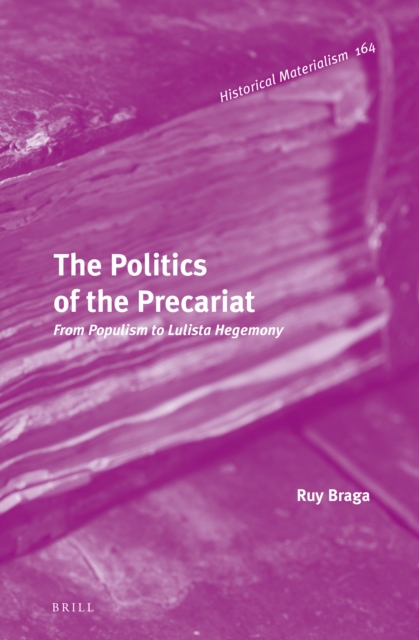
The Politics of the Precariat
Making use of the theoretical tools of Marxist critical sociology, Ruy Braga proposes an innovative reading of the social history of Brazil - from Fordist populism to the Lulista hegemony - using the 'politics of the Precariat' as an analytical vector.
eBook


Berlin Electropolis
Berlin Electropolisties the German discourse on nervousness in the late nineteenth and early twentieth centuries to Berlin's transformation into a capital of the second industrial revolution. Focusing on three key groups-railway personnel, soldiers, and telephone operators-Andreas Killen traces the emergence in the 1880s and then later decline of the belief that modernity caused nervous illness. During this period, Killen explains, Berlin became arguably the most advanced metropolis in Europe. A host of changes, many associated with breakthroughs in technologies of transportation, communication, and leisure, combined to radically alter the shape and tempo of everyday life in Berlin. The resulting consciousness of accelerated social change and the shocks and afflictions that accompanied it found their consummate expression in the discourse about nervousness. Wonderfully researched and clearly written, this book offers a wealth of new insights into the nature of the modern metropolis, the psychological aftermath of World War I, and the operations of the German welfare state. Killen also explores cultural attitudes toward electricity, the evolution of psychiatric thought and practice, and the status of women workers in Germany's rapidly industrializing economy. Ultimately, he argues that the backlash against the welfare state that occurred during the late Weimar Republic brought about the final decoupling of modernity and nervous illness.
eBook

The politics of anxiety in nineteenth-century American literature
\"For much of the nineteenth century, the nervous system was a medical mystery, inspiring scientific studies and exciting great public interest. Because of this widespread fascination, the nerves came to explain the means by which mind and body related to each other. By the 1830s, the nervous system helped Americans express the consequences on the body, and for society, of major historical changes. Literary writers, including Nathaniel Hawthorne and Harriet Beecher Stowe, used the nerves as a metaphor to re-imagine the role of the self amidst political, social and religious tumults, including debates about slavery and the revivals of the Second Great Awakening. Representing the 'romance' of the nervous system and its cultural impact thoughtfully and, at times, critically, the fictional experiments of this century helped construct and explore a neurological vision of the body and mind. Murison explains the impact of neurological medicine on nineteenth-century literature and culture\"-- Provided by publisher.
Book

Goethe's Anxieties, Depressive Episodes and (Self-)Therapeutic Strategies: A Contribution to Method Integration in Psychotherapy
Background: In psychiatry and psychotherapy, abstract scientific principles need to be exemplified by narrative case reports to gain practical precision. Goethe was one of the most creative writers, productive scientists, and effective statesmen that ever lived. His descriptions of feelings, emotions, and mental states related to anxieties, depressive episodes, dysthymia, and creativity are unique in their phenomenological precision and richness. His life and work can thus serve as an excellent example enhancing our understanding of the relationship between anxiety, depression and creativity. Furthermore, he described (self-)therapeutic strategies that reinforce and refine modern views. Methods: Goethe's self-assessments in his works and letters, and the descriptions by others are analyzed under the perspective of current psychiatric classification. His therapeutic techniques and recommendations are compared with cognitive-behavioral, psychodynamic, and existential psychotherapy to amplify modern concepts of psychotherapy. Results: From a scientific perspective, several distinctive depressive episodes can be diagnosed in Goethe's life. They were characterized by extended depressive moods, lack of drive, and loss of interest and self-esteem combined with social retreat. Goethe displayed diffuse and phobic anxieties as well as dysthymia. His (self-)therapeutic strategies were: (a) the systematic use of helping alliances, (b) behavioral techniques, (c) cognitive reflection on meanings and beliefs, (d) psychodynamic and psychoanalytic remembering, repeating, and working through, and (e) existential striving for self-actualization, social commitment, meaning, and creativity. Conclusions: In Goethe's life, creative incubation, illumination, and elaboration appear to have been associated with psychic instability and dysthymia, sometimes with depressive episodes in a clinical sense. On the one hand, his creative work was triggered by anxieties, dysthymia, and depressive moods. On the other hand, his creativity helped him to cope with psychic disorders and suicidal tendencies. Furthermore, Goethe described psychotherapeutic strategies that resemble modern techniques. He integrated relational, behavioral, cognitive, psychodynamic, and existential techniques and attitudes. These modern psychotherapeutic approaches can be exemplified and enhanced by reflecting upon the (self-)therapeutic efforts of one of the most creative persons that have ever lived. Hermeneutics as the art of communication and understanding derived from Goethe's (self-)therapy and creative works can serve as a meta-theoretical framework for the integration of different psychotherapeutic approaches.
Journal Article