
Catalogue Search | MBRL


Are you sure you want to remove the book from the shelf?

{{itemTitle}}
84,252
result(s) for
"artificial intelligence applications"
Sort by:

Artificial Intelligence : Latest Advances, New Paradigms and Novel Applications
\"Artificial Intelligence (AI) is widely known as a knowledge field that aims to make computers, robots, or products that mimic the way humans think. In the current scientific community, AI is an intensively studied area composed of multiple branches. Historically, machine learning and optimization are two of the most studied fronts thanks to the development of novel and challenging research topics such as transfer optimization, swarm robotics, and drift detection and adaptation to evolving conditions in real-time. This book collects radically new theoretical insights, reporting recent developments and evincing innovative applications regarding AI methods in all fields of knowledge. It also presents works focused on new paradigms and novel branches of AI science\"-- Page 4 of cover.
BOOK
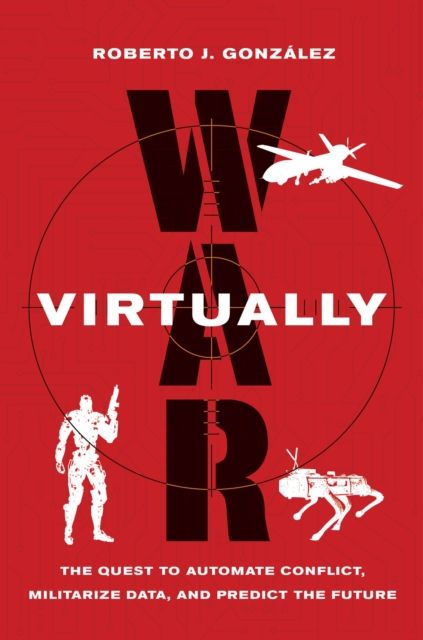
War Virtually
A critical look at how the US military is weaponizing
technology and data for new kinds of warfare-and why we must
resist. War Virtually is the story of how
scientists, programmers, and engineers are racing to develop
data-driven technologies for fighting virtual wars, both at home
and abroad. In this landmark book, Roberto J. González gives us a
lucid and gripping account of what lies behind the autonomous
weapons, robotic systems, predictive modeling software, advanced
surveillance programs, and psyops techniques that are transforming
the nature of military conflict. González, a cultural
anthropologist, takes a critical approach to the techno-utopian
view of these advancements and their dubious promise of a less
deadly and more efficient warfare. With clear, accessible prose,
this book exposes the high-tech underpinnings of contemporary
military operations-and the cultural assumptions they're built on.
Chapters cover automated battlefield robotics; social scientists'
involvement in experimental defense research; the blurred line
between political consulting and propaganda in the internet era;
and the military's use of big data to craft new counterinsurgency
methods based on predicting conflict. González also lays bare the
processes by which the Pentagon and US intelligence agencies have
quietly joined forces with Big Tech, raising an alarming prospect:
that someday Google, Amazon, and other Silicon Valley firms might
merge with some of the world's biggest defense contractors. War
Virtually takes an unflinching look at an algorithmic
future-where new military technologies threaten democratic
governance and human survival.
eBook


Artificial Intelligence and Global Security
Artificial Intelligence and Global Security: Future Trends, Threats and Considerations brings a much-needed perspective on the impact of the integration of Artificial Intelligence (AI) technologies in military affairs. Experts forecast that AI will shape future military operations in ways that will revolutionize warfare.
eBook

Artificial intelligence of health-enabled spaces
\"Artificial Intelligence of Health-Enabled Spaces (AIoH) has made revolutionary advances in clinical studies that we know so far. Among these advances, intelligent and medical services are gaining lots of interest. Nowadays, AI-powered technologies are not only used in saving lives, but also in our daily life activities in diagnosing, controlling, and even tracking of COVID-19 patients. The AI-powered solutions are expected to communicate with cellular networks smoothly in the next generation networks (5G/6G and beyond) for more effective/critical medical applications. This will open the door for another interesting research areas. This book focuses on the development and analysis of Artificial Intelligence (AI) models applications across multi-disciplines. AI based deep learning models, fuzzy and hybrid intelligent systems, and intrinsic explainable model are also being presented in this book. Some of the fields considered in this smart health-oriented book includes AI applications in Electrical Engineering, Biomedical Engineering, Environmental Engineering, Computer Engineering, Education, Cyber Security, Chemistry, Pharmacy, Molecular Biology, and Tourism. This book is dedicated to addressing the major challenges in fighting diseases and psychological issues using AI. Challenges vary from cost and complexity to availability and accuracy. The aim of this book is hence to focus on both the design and implementation aspects of the AI-based approaches in proposed health-related solutions. Targeted readers are from varying disciplines who are interested in implementing the smart planet/environments vision via intelligent enabling technologies\"-- Provided by publisher.
Book

Artificial Neural Networks in Biological and Environmental Analysis
Based on our knowledge of the functioning human brain, ANNs (artificial neural networks) serve as a modern paradigm for computing. Drawing on the author's substantial experience, this book provides a comprehensive introduction and practical guide to the development, optimization, and application of ANNs in modern environmental and biological analysis. Presenting basic principles together with simulated biological and environmental data sets and real applications in the field, this volume helps scientists use the power of the ANN model to explain physical concepts and to demonstrate complex natural processes.
eBook

Surviving and thriving in the age of AI : a handbook for digital leaders
The world is experiencing a rapid rise in the use of artificial intelligence, sparking fierce debate about its impact on both business and society. This book cuts through the noise and acts as a guide on how to survive and thrive in the age of AI. By providing an accessible collection of short, practical insights, it offers you a framework for understanding the issues and implications of AI for individuals and organizations in this time of significant digital disruption. - Page 4 cover
BOOK

AI-Enabled Analytics for Business
We are entering the era of digital transformation where human and artificial intelligence (AI) work hand in hand to achieve data driven performance.Today, more than ever, businesses are expected to possess the talent, tools, processes, and capabilities to enable their organizations to implement and utilize continuous analysis of past business.
eBook

Applied intelligence for industry 4.0
\"We are in the era of Fourth Industrial Revolution where AI plays vital roles in human development by enabling extraordinary technological advances and making a fundamental change to the way we live, work and relate to one another\"-- Provided by publisher.
Book

Computational healthcare: Present and future perspectives (Review)
Artificial intelligence (AI) has been developed through repeated new discoveries since around 1960. The use of AI is now becoming widespread within society and our daily lives. AI is also being introduced into healthcare, such as medicine and drug development; however, it is currently biased towards specific domains. The present review traces the history of the development of various AI-based applications in healthcare and compares AI-based healthcare with conventional healthcare to show the future prospects for this type of care. Knowledge of the past and present development of AI-based applications would be useful for the future utilization of novel AI approaches in healthcare.
Journal Article