
Catalogue Search | MBRL


Are you sure you want to remove the book from the shelf?

{{itemTitle}}
2,299
result(s) for
"automatic production"
Sort by:

The Future of Work
Looking for ways to handle the transition to a digital economy
Robots, artificial intelligence, and driverless cars are no longer things of the distant future. They are with us today and will become increasingly common in coming years, along with virtual reality and digital personal assistants.
As these tools advance deeper into everyday use, they raise the question-how will they transform society, the economy, and politics? If companies need fewer workers due to automation and robotics, what happens to those who once held those jobs and don't have the skills for new jobs? And since many social benefits are delivered through jobs, how are people outside the workforce for a lengthy period of time going to earn a living and get health care and social benefits?
Looking past today's headlines, political scientist and cultural observer Darrell M. West argues that society needs to rethink the concept of jobs, reconfigure the social contract, move toward a system of lifetime learning, and develop a new kind of politics that can deal with economic dislocations. With the U.S. governance system in shambles because of political polarization and hyper-partisanship, dealing creatively with the transition to a fully digital economy will vex political leaders and complicate the adoption of remedies that could ease the transition pain. It is imperative that we make major adjustments in how we think about work and the social contract in order to prevent society from spiraling out of control.
This book presents a number of proposals to help people deal with the transition from an industrial to a digital economy. We must broaden the concept of employment to include volunteering and parenting and pay greater attention to the opportunities for leisure time. New forms of identity will be possible when the \"job\" no longer defines people's sense of personal meaning, and they engage in a broader range of activities. Workers will need help throughout their lifetimes to acquire new skills and develop new job capabilities. Political reforms will be necessary to reduce polarization and restore civility so there can be open and healthy debate about where responsibility lies for economic well-being.
This book is an important contribution to a discussion about tomorrow-one that needs to take place today.
eBook

Mechanical Design and Improvement of Computer Automatic Production Line
The mechanical design amelioration of automatic production line can intelligently adjust the production rhythm of the production line on demand, control the rhythm of production scheduling according to the production process requirements, and establish a modular design mode, so it has important research value. Based on this, this paper first analyses the mechanical design principle of the automatic production line, then studies the computer control system of the automatic production line, and finally gives the amelioration measures of the mechanical design of the automatic production line.
Journal Article
The Future of IoT with Automation in Engineering and Modern Technology
The purpose of this book is to serve as a forum in which academics and researchers from all over the globe may come together to communicate, promote, and debate numerous new challenges and advancements in many fields related to engineering applications and the internet of things (IoT). One of the key benefits of automation offered by IoT is a large reduction in operational expenditures. It is one of the most significant advantages in terms of productivity and efficiency. Information is shared between different types of hardware in order to make it possible to automate processes and eliminate the need for human interaction. Industrial automation needs to be able to self-organize, self-configure, and expand to vast scales, all while consuming very little power, being inexpensive, and being based on a worldwide standard. This book presents the Internet of Things for fleet management, which helps in geolocation, performance analysis, telemetry control, fuel savings, pollution reduction, and vehicle driving. This book is a collection of ideas that looks at how things are connected to the Internet and how it might help people stay connected.
eBook
Devices and Systems for Laboratory Automation
Devices and Systems for Laboratory Automation Structured Overview on the Available Systems and Devices for Laboratory Automation Choosing the right systems and devices for the automation in any given laboratory is an essential part for the process to succeed.
eBook
Closing the Robotics Market Gap Through the Robotics for Inspection and Maintenance Network
This book offers a clear guide on achieving success within an EU-funded project, and highlights the tools required to close the gap between robotics innovation and the markets of inspection and maintenance. The book includes project management perspectives, network building, a catalogue of Digital Innovation Hubs, services and technologies offered to the innovation initiatives, sustainability plans, cybersecurity schemes and an extensive market analysis that could support any endeavor in the field.It also highlights a wide range of features supported by the 50 robotics innovations and describes the Cascade funding mechanism in detail. This book will be of interest to those wishing to learn the basics of the Robotics for Inspection and Maintenance (RIMA) Network, technology innovators, researchers, and those involved in start-ups, scaleups, and small and medium-sized enterprises (SMEs).
eBook
Learn Ansible
Ansible has grown from a small, open source orchestration tool to a full-blown orchestration and configuration management tool owned by Red Hat. Its powerful core modules cover a wide range of infrastructures, including on-premises systems and public clouds, operating systems, devices, and services - meaning it can be used to manage pretty much your entire end-to-end environment. Trends and surveys say that Ansible is the first choice of tool among system administrators as it is so easy to use. This end-to-end, practical guide will take you on a learning curve from beginner to pro. You'll start by installing and configuring the Ansible to perform various automation tasks. Then, we'll dive deep into the various facets of infrastructure, such as cloud, compute and network infrastructure along with security. By the end of this book, you'll have an end-to-end understanding of Ansible and how you can apply it to your own environments.
eBook

Robots, Artificial Intelligence, and Service Automation in Travel, Tourism and Hospitality
Using a combination of theoretical discussion and real-world case studies, this book focuses on current and future use of RAISA technologies in the tourism economy, including examples from the hotel, restaurant, travel agency, museum, and events industries.
eBook

Springer handbook of robotics
The second edition of this handbook provides a state-of-the-art overview on the various aspects in the rapidly developing field of robotics. Reaching for the human frontier, robotics is vigorously engaged in the growing challenges of new emerging domains.
eBook

Automatic system for intelligent support of continuous cast billet production control processes
The development of an automatic system for the intelligent support of continuous cast billet production control processes is described. The motivation for the development of the system is that it should improve the efficiency of production facilities and minimize the possibility of producing inferior and unacceptable quality products. A theoretical analysis of the information relating to the quality control of the processes and the finished products is presented, enabling the identification of the sources of information, methods of information acquisition, and techniques for processing it to ensure improved product quality. The development of mathematical support is described for a program analyzer that automatically and reliably identifies the defects and quality of the continuously cast billets. The application of graphic information acquisition and processing techniques concerning the quality of the metal products is also presented. The development of mathematical and software support is described for the set point adjustment module operating in the automatic system for the intelligent support of the multistage continuous cast billet production control facility. This module makes use of adaptive fuzzy trees with dynamic structures to provide scientifically grounded analysis of factors causing billet defects. The introduction of the developed systems, including practical issues, into the operation of a production facility is explained. The study identifies the general lack of automatic systems that encompass and control the whole production chain on the basis of product quality. Typical savings resulting from quality improvements in a continuous cast billet production facility can approach a million rubles.
Journal Article
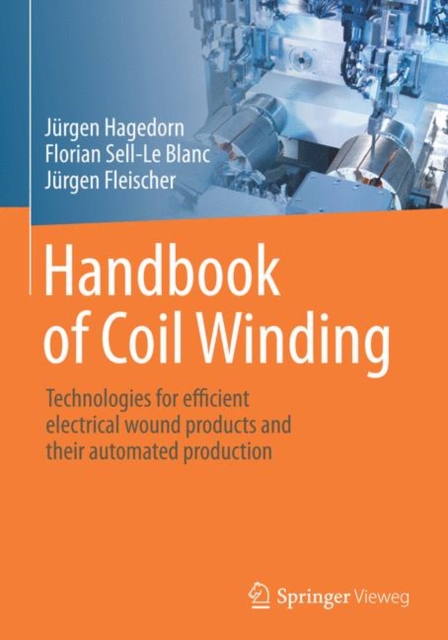
Handbook of coil winding : technologies for efficient electrical wound products and their automated production
This book presents the current coil winding methods, their associated technologies and the associated automation techniques.From the introduction as a forming joining process, over the physical properties of coils, the semifinished products (wire, coil body, insulation) are introduced.
eBook