
Catalogue Search | MBRL


Are you sure you want to remove the book from the shelf?

{{itemTitle}}
7,230
result(s) for
"bauman"
Sort by:


Zygmunt Bauman and the Theory of Culture
One of the most influential intellectuals of the twentieth and twenty-first centuries, sociologist and philosopher Zygmunt Bauman (1925–2017) made reflection on culture a fundamental part of his academic work. He published a substantial number of papers on the topic, and many of his concepts would go on to significantly influence the social sciences and humanities.
Bauman began his theoretical studies on culture when working at the University of Warsaw and continued them all his life. Inspired by the many intellectual currents he encountered over his more than six decades of work, Bauman wrote on culture in the contexts of such issues as Marxism and socialism, modernity and the Holocaust, postmodernity and liquid modernity, and contemporary nostalgia. In Zygmunt Bauman and the Theory of Culture Dariusz Brzezi?ski uses the evolution of Bauman's theory of culture as a prism through which to offer a comparative analysis, putting Bauman's work in conversation with the writings of other contemporary intellectuals.
In this first comprehensive and critical assessment of Bauman's lifelong work on culture, Brzezi?ski includes Bauman's Polish-language papers and books, as well as his works discovered only posthumously, presenting them to an international audience.
eBook


Liquid Consumption
This article introduces a new dimension of consumption as liquid or solid. Liquid consumption is defined as ephemeral, access based, and dematerialized, while solid consumption is defined as enduring, ownership based, and material. Liquid and solid consumption are conceptualized as existing on a spectrum, with four conditions leading to consumption being liquid, solid, or a combination of the two: relevance to the self, the nature of social relationships, accessibility to mobility networks, and type of precarity experienced. Liquid consumption is needed to explain behavior within digital contexts, in access-based consumption, and in conditions of global mobility. It highlights a consumption orientation around values of flexibility, adaptability, fluidity, lightness, detachment, and speed. Implications of liquid consumption are discussed for the domains of attachment and appropriation; the importance of use value; materialism; brand relationships and communities; identity; prosumption and the prosumer; and big data, quantification of the self, and surveillance. Lastly, managing the challenges of liquid consumption and its effect on consumer welfare are explored.
Journal Article
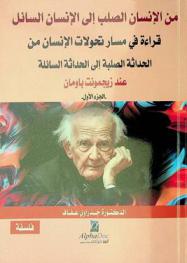
من الإنسان الصلب إلى الإنسان السائل : قراءة في مسار تحولات الإنسان من الحداثة الصلبة إلى الحداثة السائلة عند زيجمونت باومان
هذا الكتاب قراءة في مسار تحولات الإنسان من الحداثة الصلبة إلى الحداثة السائلة عند زيجمونت باومان\" يأتي في سياق رصد جوانب من سيرة عالم الاجتماع البولندي زيجمونت باومان، التي كان لها أثر قوي في تكوين المسار النقدي لديه وبناء مشروعه المتكامل سلسلة السيولة فضلا عن كونها دافع قوى في عادة قراءته لمشروع منظومة الحداثة الغربية، وبيان حركتها ومسيرتها وتحولاتها الكبرى أين نقلت الإنسان من نموذج الصلابة الذي كان مهيمن على الحداثة في مراحلها الأولى إلى نموذج السيولة باعتباره أصدق تعبيرا عن الصورة الراهنة التي لا تحتفظ بلقطة ثابتة، نتيجة التغير الدائم والسريع. وبالتالي يأتي نحت \"زيجمونت \"باومان\" لمصطلح \"الحداثة الصلبة\" و\"الحداثة السائلة\" دلالة على قدرته الفائقة على إبداع المفاهيم بلغة \"جيل\" دلوز\".
Book

Zygmunt Bauman
This timely book provides the definitive concise introduction to the phenomenon of Zygmunt Bauman. After introducing the man, his major influences and his special way of 'thinking sociologically', author Blackshaw traces the development of Bauman's project by identifying and explaining the major shifts of emphasis in his work - the break with Marxism and the postmodern 'turn', and the subsequent refocusing on 'liquid' modernity - as well as offering a clear and accessible guide to the key conceptual hinges which move the reader on.
This book, the only concise introduction to Bauman's work on the market, goes on to explain the importance of the full range of persistent themes concerning Bauman, dealing specifically with individualization, freedom, identity, community, social control, consumption and waste, building a penetrating understanding of why these issues matter for this Key Sociologist.
Bauman's ideas have impacted beyond sociology into criminology, political theory, cultural studies, leisure studies and so forth, and have also now penetrated outside the walls of the academy into social policy, welfare reform, social work and politics. Making use of pedagogical features such as boxed sections, chapter summaries, an annotated bibliography and links to further reading, this well-written text assumes no prior familiarity with Bauman's work and will appeal to anyone in any of these fields wishing to get acquainted with the ideas of one of the world's most wide-ranging thinkers.
eBook

Late modernity, individualization and socialism : an associational critique of neoliberalism
Around the world, the aftershocks of an economic crisis brought on by neoliberal economics and aided by the austerity measures of governments continue to be felt. Yet, we are told that there is simply no alternative; that our current form of capitalism is here to stay.
Book

Fears in the Light of Zygmunt Bauman’s Liquid Post-Modernity
Main task of the paper is to recall sociologist and philosopher – Zygmunt Bauman’s observations and concepts on the fears, anxieties, and uncertainties that appear in the modern world. Main focus was directed to Europe as Bauman was particularly concerned about its future and its role in the global society. The paper is illustrated using current examples from political, social, and economic life to confirm and/or negate Bauman’s concepts. We ask: are fears stable or changeable? Are they stronger or weaker? Are they constant, coming to an end, or are they replaced by new ones? Additionally, we confront Bauman’s concepts with the ideas of other sociologists who applied the interpretative perspective.
We define fear following Bauman’s various proposals, and we distinguish many kinds of fears, giving examples from Western societies and socio-economic realities during the time of globalization. We refer to a few relevant sociological concepts to understand Bauman’s view better, e.g. the strategy of detour or the term of generalized other. In conclusions, we state that most fears remain the same (especially ontological ones). However, in the 21st century, we can observe the emergence of new ones (also artificial ones).
Journal Article


The Emerald Guide to Zygmunt Bauman
This book is the first introductory guide to the work of Zygmunt Bauman, designed specifically for students and those new to his work. It provides a firm foundation for the independent reading of Bauman and for exploring the many interpretations of his influential ideas.
eBook