
Catalogue Search | MBRL


Are you sure you want to remove the book from the shelf?

{{itemTitle}}
23
result(s) for
"biji"
Sort by:

Golden-Silk Smoke
From the long-stemmed pipe to snuff, the water pipe, hand-rolled cigarettes, and finally, manufactured cigarettes, the history of tobacco in China is the fascinating story of a commodity that became a hallmark of modern mass consumerism. Carol Benedict follows the spread of Chinese tobacco use from the sixteenth century, when it was introduced to China from the New World, through the development of commercialized tobacco cultivation, and to the present day. Along the way, she analyzes the factors that have shaped China’s highly gendered tobacco cultures, and shows how they have evolved within a broad, comparative world-historical framework. Drawing from a wealth of historical sources—gazetteers, literati jottings (biji), Chinese materia medica, Qing poetry, modern short stories, late Qing and early Republican newspapers, travel memoirs, social surveys, advertisements, and more—Golden-Silk Smoke not only uncovers the long and dynamic history of tobacco in China but also sheds new light on global histories of fashion and consumption.
eBook

Real Life in China at the Height of Empire
Toward the end of the eighteenth century Ji Xiaolan, widely regarded as the most eminent scholar and foremost wit of his age, published five collections of anecdotes and discourses centring on the interaction between the mundane and spirit worlds, but also including purely earthly life stories and happenings. Some items represent Ji’s own thought and experiences, but the majority were supplied by others, Ji acting only as recorder. Settings range socially from the milieux of peasants, servants and merchants to those of governors and ministers, and geographically extend to the far reaches of the Qing empire. Contents may dwell on comedy or tragedy, cruelty or kindness, corruption or integrity, erudition or ignorance, credulity or scepticism; several items borrow ghost stories to satirize men and manners; some straightforwardly examine current beliefs and practices. Taken together, this miscellany presents a picture of the contemporary world unmatched in its scope and variety of perspectives, and in this way comes nearer to depicting “real life\" than novels or institutional histories.
eBook

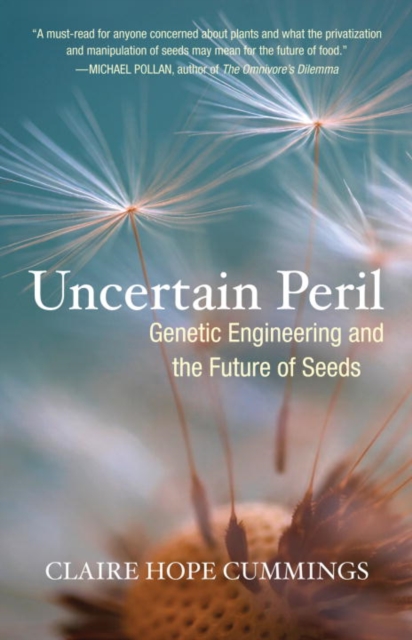
Uncertain peril
Life on earth is facing unprecedented challenges from global warming, war, and mass extinctions. The plight of seeds is a less visible but no less fundamental threat to our survival. Seeds are at the heart of the planet's life-support systems. Their power to regenerate and adapt are essential to maintaining our food supply and our ability to cope with a changing climate. In Uncertain Peril, environmental journalist Claire Hope Cummings exposes the stories behind the rise of industrial agriculture and plant biotechnology, the fall of public interest science, and the folly of patenting seeds. She examines how farming communities are coping with declining water, soil, and fossil fuels, as well as with new commercial technologies. Will genetically engineered and \"terminator\" seeds lead to certain promise, as some have hoped, or are we embarking on a path of uncertain peril? Will the \"doomsday vault\" under construction in the Arctic, designed to store millions of seeds, save the genetic diversity of the world's agriculture? To answer these questions and others, Cummings takes readers from the Fertile Crescent in Iraq to the island of Kaua'i in Hawai'i; from Oaxaca, Mexico, to the Mekong Delta in Vietnam. She examines the plight of farmers who have planted transgenic seeds and scientists who have been persecuted for revealing the dangers of modified genes. At each turn, Cummings looks deeply into the relationship between people and plants. She examines the possibilities for both scarcity and abundance and tells the stories of local communities that are producing food and fuel sustainably and providing for the future. The choices we make about how we feed ourselves now will determine whether or not seeds will continue as a generous source of sustenance and remain the common heritage of all humanity. It comes down to this: whoever controls the future of seeds controls the future of life on earth. Uncertain Peril is a powerful reminder that what's at stake right now is nothing less than the nature of the future.
eBook
UK's Prince Charles to visit India 26 March, promote charitable causes
While a visit to the Taj Mahal in Agra is yet not on the itinerary of the royal couple; according to sources, the couple will stay at the Taj Mahal Hotel after their arrival in New Delhi on Sunday [26 March]. According to sources, the British royals will reach Punjab on 27 March. Prince Charles and [Camilla] will enjoy the hospitality of the erstwhile Patiala royal family headed by Punjab chief minister Amarinder Singh. The royal couple will pay a visit to the Anandpur Sahib gurdwara [Sikh temple], closely linked with the religious traditions and history of the Sikhs.
Newsletter

Hospitals find ways to keep elderly sharp while they heal ; Older patients sometimes lose their grip on reality in hospitals. The solutions can be surprisingly simple
\"It's a hard thing for families to understand that patients do acquire delirium in the hospital,\" said Biji Varghese, a nurse at Fairview Southdale. \"In their mind they're thinking 'there's something wrong with my loved one.'-\" Many jump to the conclusion that the patient must have Alzheimer's disease. But true dementia is a slow, progressive illness, says Joan Karnas, director of nursing practice at Fairview Southdale. The delirium, by contrast, is completely sudden, and reversible. Although delirium usually fades in a matter of days, it makes patients harder to care for, says Varghese, who oversees a medical unit at Fairview Southdale. Typically, they have to be hospitalized longer and may need nursing help after they leave.
Newspaper Article
Indian daily interviews home minister on Mumbai, Obama visit, internal security
Union [Federal] Home Minister P. Chidambaram concedes in this interview with [Sanjay Basak] and [Namrata Biji Ahuja] that the home and defence ministries have \"different points of view\" on modifying the Armed Forces Special Powers Act. He also indicates that his statements on Telangana in December 2009 were made after approval from the highest level within the United Progressive Alliance. On Kashmir, Mr Chidambaram says that one of the reasons for people's anger could be deficiencies in administration. A. I don't know where you got that impression. It is a bit of a stand-off. I can't say that we are \"winning\" in this conflict with the Communist Party of India-Maoist (CPI-Maoist) but I can say we are not \"losing\". It is a bit of a stand-off. In some areas the state government with the aid of security forces has been able to restore the civil administration. But in some other areas the CPI (Maoist) continue to have the upper hand. But this is a long drawn out struggle. So, one has to be patient. A. There is if they are willing to abjure violence and come for talks. We can certainly address the \"underlying causes\" which, according to them, have given rise to the CPI (Maoist) movement. But there is no political solution to the demand that the parliamentary system of government must be overthrown and power must be seized through an armed liberation struggle. The only political answer we can give to that kind of a demand is a flat \"no\".
Newsletter

Unholier Than Thou; In less than 100 days after being returned to power with a clear two-third majority, the LDF Government under V.S. Achuthanandan sees its public ratings take a solid beating
On education policy too, the LDF Government has failed to make much progress. While in Opposition, the LDF had effectively used Rajani [Rajani Anand] as an effective metaphor to prove the UDF government's education policies as pro-rich. In 2004 the LDF's agitation against the then government's education policy received a huge fillip when 20-year-old Anand, a Dalit student in a self-financing engineering college, committed suicide after banks rejected her application for an education loan. The UDF government's opening up of higher education sector and the consequent mushrooming of self-financing colleges with sky-high fees were blamed to have made education out of bounds for the poor. To prove a point, Anand chose to end her life jumping from the multi-storey building which housed the state directorate for entrance examination. The issue rocked the UDF government and was to an extent responsible for its huge electoral rout. The LDF Government's proverbial last straw was the recent revelation of a sexual harassment case involving P.J. Joseph, state public works minister. The 64-year-old minister, who is the chairman of the Kerala Congress(J), was accused of having misbehaved with a woman passenger travelling in a Kingfisher flight from Chennai to Kochi. According to the woman's husband, the minister who was in the seat behind the woman had tried to sexually assault her when the flight was taking off. Joseph has called the allegations a political conspiracy to malign him but has admitted that his fingers might have touched the woman's body unintentionally. The incident has landed Achuthanandan in an awkward position as it was he who had led the LDF's long and vigorous agitation against the alleged sex scandals of some ministers in the UDF government. It may be recalled that P.K. Kunhalikutty, industry minister and Muslim League strongman, had to quit the cabinet after he was alleged to have had a role in a sex scandal. P.J. Kurian, a Congress MP and a former Union minister also was in the dock after a minor girl had alleged that he was among the many who had sexually tortured her. The case is pending in court. \"The LDF in general and Achuthanandan in particular had campaigned for five years against the sexual atrocities against women. Now what do they have to say when women are being harassed by their own ministers,\" asks Shanimol Usman, president of the women's unit of the state Congress. Cases like these have not only overshadowed the limited achievements of the LDF Government, but also landed it in an image crisis prematurely ending its honeymoon.
Magazine Article