
Catalogue Search | MBRL


Are you sure you want to remove the book from the shelf?

{{itemTitle}}
77,110
result(s) for
"black lives matter movement"
Sort by:

Making all Black lives matter : reimagining freedom in the twenty-first century
\"In the wake of the murder of unarmed teenager Trayvon Martin in 2012 and the exoneration of his killer, three black women activists launched a hashtag and social-media platform, Black Lives Matter, which would become the rubric for a larger movement. To many, especially those in the media, Black Lives Matter appeared to burst onto the national political landscape out of thin air. But as Barbara Ransby shows in Making All Black Lives Matter, the movement has roots in prison abolition, anti-police violence, black youth movements, and radical mobilizations across the country dating back at least a decade. Ransby interviewed more than a dozen of the movement's principal organizers and activists, and she provides a detailed review of its extensive coverage in mainstream and social media. Making All Black Lives Matter offers one of the first overviews of Black Lives Matter and explores the challenges and possible future for this growing and influential movement\"--Provided by publisher.
Book
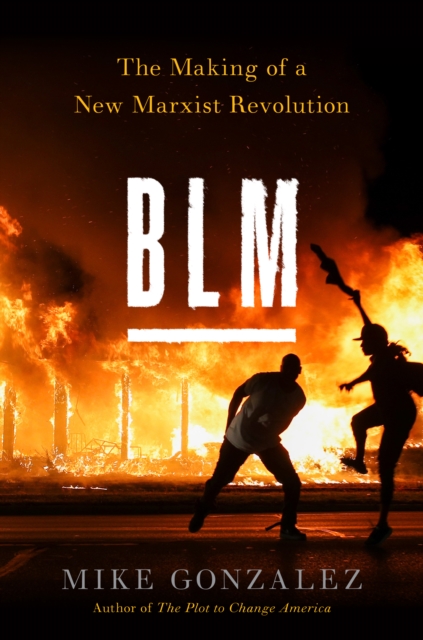
BLM
The George Floyd riots that have precipitated great changes throughout American society were not spontaneous events. Americans did not suddenly rise up in righteous anger, take to the streets, and demand not just that police departments be defunded but that all the structures, institutions, and systems of the United States—all supposedly racist—be overhauled. The 12,000 or so demonstrations and 633 related riots that followed Floyd's death took organizational muscle. The movement's grip on institutions from the classroom to the ballpark required ideological commitment. That muscle and commitment were provided by the various Black Lives Matter organizations. This book examines who the BLM leaders are, delving into their backgrounds and exposing their agendas—something the media has so far refused to do. These people are shown to be avowed Marxists who say they want to dismantle our way of life. Along with their fellow activists, they make savvy use of social media to spread their message and organize marches, sit-ins, statue tumblings, and riots. In 2020 they seized upon the video showing George Floyd's suffering as a pretext to unleash a nationwide insurgency. Certainly, no person of good will could object to the proposition that \"black lives matter\" as much as any other human life. But Americans need to understand how their laudable moral concern is being exploited for purposes that a great many of them would not approve.
eBook


Fractured Militancy
Drawing on extensive ethnographic fieldwork and
interviews with activists, Fractured
Militancy tells the story of postapartheid
South Africa from the perspective of Johannesburg's impoverished
urban Black neighborhoods. Nearly three decades after
South Africa's transition from apartheid to democracy, widespread
protests and xenophobic attacks suggest that not all is well in the
once-celebrated \"rainbow nation.\"
Marcel Paret traces rising protests back to the process of
democratization and racial inclusion. This process dangled the
possibility of change but preserved racial inequality and economic
insecurity, prompting residents to use militant protests to express
their deep sense of betrayal and to demand recognition and
community development. Underscoring remarkable parallels to
movements such as Black Lives Matter in the United States, this
account attests to an ongoing struggle for Black liberation in the
wake of formal racial inclusion.
Rather than unified resistance, however, class struggles within
the process of racial inclusion produced a fractured militancy.
Revealing the complicated truth behind the celebrated \"success\" of
South African democratization, Paret uncovers a society divided by
wealth, urban geography, nationality, employment, and political
views. Fractured Militancy warns of the threat that
capitalism and elite class struggles present to social movements
and racial justice everywhere.
eBook


“Why Does Color Have to Matter?”: Color-Blind Racism and Political Polarization Among Jewish Americans
There is an appreciable divergence in views on racism among Jewish Americans based on their political affiliations, with Jewish Democrats being almost four times as likely as Jewish Republicans to perceive substantial discrimination against Black people. Through qualitative interviews with 30 Jewish adults across the political spectrum in the Philadelphia area, we analyze narratives surrounding George Floyd’s murder, the Black Lives Matter (BLM) movement, and the ensuing 2020 racial justice protests. The findings reveal pronounced polarization: Politically conservative Jews, predominantly Orthodox, largely opposed the BLM movement, often employing “color-blind racism” to justify their stance. In contrast, politically liberal Jews supported the BLM movement, emphasizing its importance in addressing racial injustice. This study contributes to the literature on Black–Jewish relations by providing insights into the complex relationship between American Jews and race, highlighting the impact of both religious and political polarization within the Jewish community on matters of racial justice.
Journal Article

A good kind of trouble
After attending a powerful protest, Shayla starts wearing an armband to school to support the Black Lives Matter movement, but when the school gives her an ultimatum, she is forced to choose between her education and her identity.
BOOK

The Black Lives Matter Movement, Jewish Allies, and the Long Legacy of Black Anti-Zionism
From the emergence of the Black Lives Matter (BLM) movement, massive numbers of Jews, committed to resuming the Black-Jewish coalition of the civil rights era, became its avid allies. They failed to recognize that this alliance, which foundered and was sundered by the late 1970s, had increasingly been replaced by Blacks' identification with \"their Brown Palestinian siblings,\" which rendered the conflict with Israel in stark racial terms. After the Six Day War, Black militants promoted a narrative that replaced Jews as a fellow oppressed group with Jews as iniquitous Zionists, who had established an illegitimate settler-colonial state that ethnically cleansed and victimized indigenous people of color—a narrative upon which their successors in the BLM movement drew heavily. With the rise of the BLM movement, the Black-Palestinian alliance was solidified—their wide divide on issues of race, gender, and homosexuality overridden by their shared anti-Zionism. In 2016, when the Movement for Black Lives (M4BL), a constituent partner of the BLM umbrella organization, issued a policy platform identifying Israel as \"an apartheid state,\" committing \"genocide against the Palestinian people,\" leading Jewish organizations appeared confounded and dismissed these views as a minority position. Spokespersons of secular and religious Jewish associations condemned what they labeled BLM's \"anti-Israel rhetoric,\" which they insisted was \"totally unrelated\" to the movement's \"social justice work.\" They appeared to be unaware that far from mere \"rhetoric,\" the denigration and delegitimization of the Jewish state had long been at or near the core of the anti-racist ideology propounded by the Black militants revered by BLM leaders and activists. Thus, in 2020, organizations allegedly \"representing over half of Jewish people in America\" published a statement that endorsed the BLM movement \"unequivocally,\" while several of the signatories released additional statements condemning those Jews who had rejected the movement once it posted the policy platform. The Jewish community fractured over the issue of Black antisemitism, but unlike in earlier periods, far more Jews, identifying as \"progressives,\" continued to support a movement whose leaders and activists espoused or tolerated antisemitism, albeit lightly cloaked in anti-Zionist garb.
Journal Article

Our black sons matter : mothers talk about fears, sorrows, and hopes
\"From Trayvon Martin to Tamir Rice, the list of young black men who have suffered racial violence continues to grow. Young black people also deal with ... stereotypes and structural barriers. And yet, young black men are often paradoxically revered as icons of cultural cool. [This book] features contributions from women across the racial spectrum who are raising or have raised black sons--whether biologically their sons or not. The book ... addresses painful trauma, challenges assumptions, and offers insights and hope through the deep bonds between mothers and their children\"--Provided by publisher.
Book

Black Lives Matter protests shift public discourse
We show that Black Lives Matter (BLM) protests shift public discourse toward the movement’s agenda, as captured by social media and news reports. We find that BLM protests dramatically amplify the use of terms associated with the BLM agenda throughout the movement’s history. Longitudinal data show that terms denoting the movement’s theoretically distinctive ideas, such as “systemic racism,” receive more attention during waves of protest. We show that these shocks have notable impact beyond intense, or “viral,” periods of nationwide protest. Together, these findings indicate that BLM has successfully leveraged protest events to engender lasting changes in the ways that Americans discuss racial inequality.
Journal Article