
Catalogue Search | MBRL


Are you sure you want to remove the book from the shelf?

{{itemTitle}}
2,079
result(s) for
"bourgeoisie"
Sort by:



From Brexit to Trump: Anthropology and the rise of nationalist populism
Brexit and Donald Trump's election victory are symptoms of a new nationalist populism in western Europe and the United States. This political and ideological movement has arisen in reaction to reconfigurations of power, wealth, and identity that are endemic to global neoliberalism. In the United States, however, the media's dominant \"blue-collar narrative\" about Trump's victory simplifies the relationship between neoliberalism and nationalist populism by ignoring the role of the petty bourgeoisie and the wealthy in Trump's coalition. An anthropology of Trump requires ethnographies of communities largely shunned by anthropologists as well as reftexivity about the unintended role of universities in producing support for Trump.
Journal Article

Jewgraf ou l’héroïsme liquidé : (Frankfurter Zeitung, 21 décembre 1926)
Il est un « moraliste », il veut montrer que le temps est venu pour les héros de devenir des bourgeois si cela ne doit pas mal finir pour eux. Si la grenade fait le révolutionnaire, le couteau à raser le petit-bourgeois, qu’est donc le « bourgeois » contre lequel on utilise tant de grenades ? N’est-il pas davantage une hideuse création de la nature qu’un dangereux produit de systèmes économiques ? Même si l’on reconnaît que la structure intellectuelle typiquement bourgeoise est une conséquence directe de la forme économique capitaliste, on ne peut cependant pas écarter qu’une disposition naturelle à la « bourgeoisie » est présente a priori. Mais aucune statistique ne révèle si, au lieu des soixante-dix pour cent d’analphabètes, on obtient quatre-vingt-quinze pour ccent de petits-bourgeois, de petits réactionnaires ; si le 600e paysan lit ce qui le rend plus intelligent ou ce qui le rend plus idiot (car on peut devenir idiot par la lecture) ; si le 1000e nouveau professeur est à la hauteur de son poste ; si les trente pour cent d’étudiants universitaires d’origine prolétaire ont suffisamment de connaissances préalables.
Journal Article

State, State Institutions, and Political Power in Brazil
The political conflicts during the Workers’ Party administrations led by Luís Inácio Lula da Silva and Dilma Rousseff have been driven by disputes between two fractions of the country’s bourgeoisie: the internal and the internationalized bourgeoisie. Their ideologies, policies, institutions, and forms of political representation have determined government policies and outcomes. These processes have unfolded within an authoritarian democracy whose structures have not been challenged by the party. The party’s limited power and continuing timidity have produced an aggressive reaction by the internationalized bourgeoisie and the upper middle class, leading to a severe crisis in the administration of President Dilma Rousseff. Durante os dois governos do Partido dos Trabalhadores (PT), chefiados por Luís Inácio Lula da Silva e por Dilma Rousseff, os conflitos políticos têm sido conflagrados por disputas entre duas facções burguesas do país: a burguesia interna e a burguesia internacionalizada. Suas respectivas formas de representações políticas, ideologias, programas, bem como instituições têm determinado políticas governamentais e seus resultados. Esses processos evoluíram em uma democracia autoritária, cujas estruturas não foram contestadas pelo PT. A timidez contínua e o poder limitado do partido têm produzido uma reação agressiva por parte da burguesia internacionalizada e da classe média alta, levando a uma crise severa na administração da Presidente Dilma Rousseff.
Journal Article
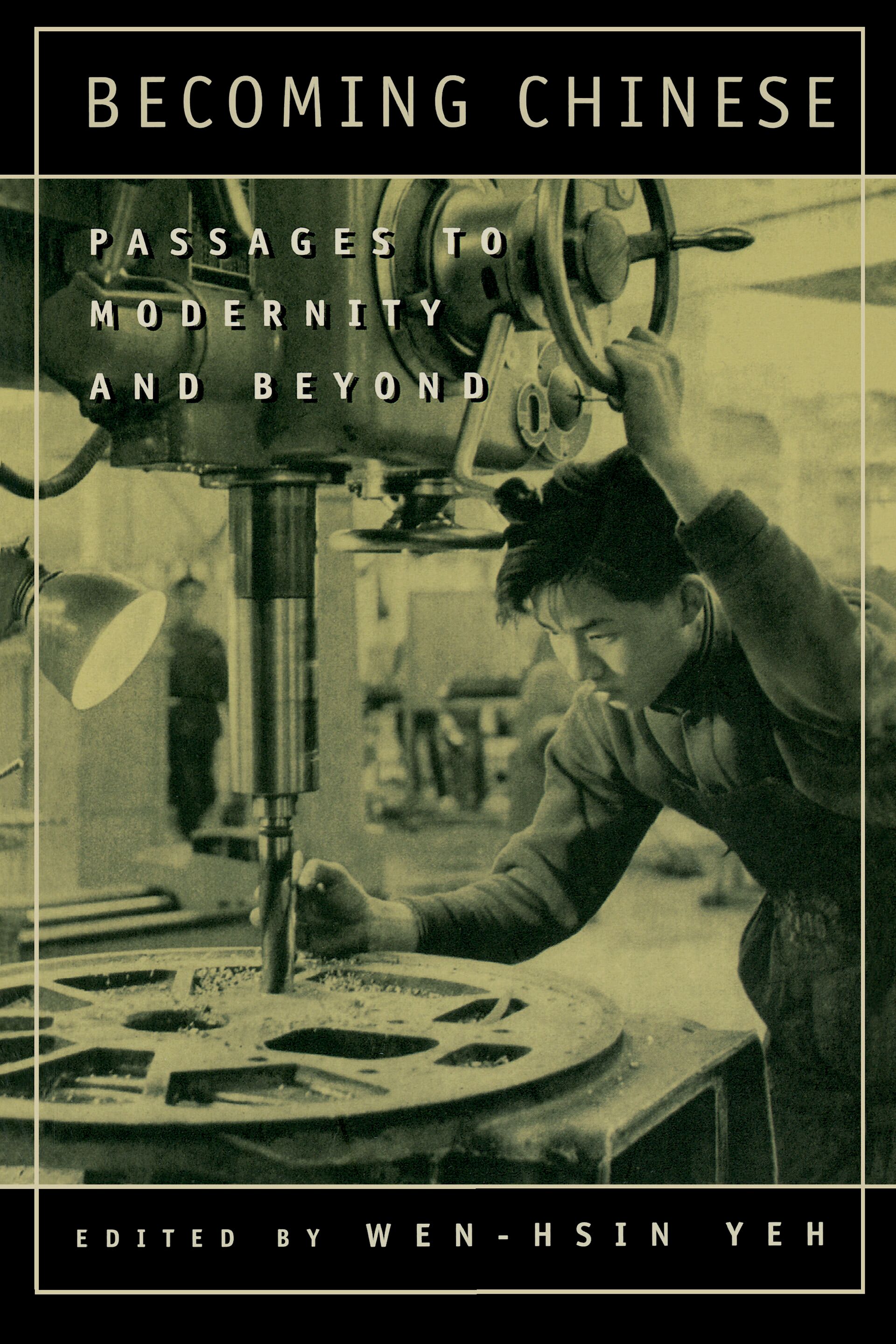
Becoming Chinese
This volume evaluates the dual roles of war and modernity in the
transformation of twentieth-century Chinese identity. The
contributors, all leading researchers, argue that war, no less than
revolution, deserves attention as a major force in the making of
twentieth-century Chinese history. Further, they show that
modernity in material culture and changes in intellectual
consciousness should serve as twin foci of a new wave of scholarly
analysis. Examining in particular the rise of modern Chinese cities
and the making of the Chinese nation-state, the contributors to
this interdisciplinary volume of cultural history provide new ways
of thinking about China's modern transformation up to the 1950s.
Taken together, the essays demonstrate that the combined effect of
a modernizing state and an industrializing economy weakened the
Chinese bourgeoisie and undercut the individual's quest for
autonomy.
Drawing upon new archival sources, these theoretically informed,
thoroughly revisionist essays focus on topics such as
Western-inspired modernity, urban cosmopolitanism, consumer
culture, gender relationships, interchanges between city and
countryside, and the growing impact of the state on the lives of
individuals. The volume makes an important contribution toward a
postsocialist understanding of twentieth-century China.
eBook

Le rêve éveillé contre la normalité destructrice de la grisaille bourgeoise. Ernst Bloch et les utopies concrètes
This article is devoted to Ernst Bloch’s concept of the daydream. First, I will present some fundamental categories of Bloch’s thought, such as the cold and hot currents of Marxism and concrete utopia. In the second part, I will focus on the originality of Bloch’s concept of the daydream, which he constructs from his critique of psychoanalysis. Finally, I’ll outline a contemporary problem that keeps Bloch’s thinking alive and relevant, despite certain limitations: climate crisis and the return of concrete utopias.
Journal Article

Bolsonaro’s Foreign Policy and the Brazilian Bourgeoisie
Abstract This article analyses the Bolsonaro government’s foreign policy and the interests of the Brazilian internal bourgeoisie. The hypothesis is that the internal bourgeoisie supported the 2016 coup d’état and the 2018 election of Jair Bolsonaro but, over the years, they started to exhibit resistance to the government’s political practices and responded to the external pressures related to environmental policy and threats to democracy. The empirical research analysed the position papers of the internal bourgeoisie’s main employer organisations, focusing on the following agendas: i) the Mercosur-EU agreement; ii) entry into the OECD; iii) reformulation of Mercosur’s Common External Tariff (CET); and iv) environmental policy. The study concludes that there were conflicts within the internal bourgeoisie throughout the Bolsonaro administration and, in the end, there was a change in their interests that, alongside other elements, can explain Jair Bolsonaro’s 2022 electoral defeat.
Journal Article

Burguesía petrolera y redistribuciones estatales: el caso de Argentina durante el gobierno de Macri (2015-2019)
La relación entre hidrocarburos y acumulación por desposesión es muy antigua en Argentina y siempre se ha desarrollado en un marco signado por redistribuciones estatales. Este artículo describe y analiza las políticas ejecutadas por el gobierno de M. Macri (201 5-201 9) para apuntalar y reforzar la rentabilidad de la burguesía petrolera, utilizando para ello bibliografía académica, estadísticas oficiales e informes de organizaciones ambientalistas. El estudio se basa en cuatro categorías de análisis: colonización de organismos reguladores estatales; privilegios comerciales, fiscales y monetarios; concesión y extranjerización de áreas hidrocarburíferas; y socialización del riesgo empresario. Se concluye que la política hidrocarburífera de Macri fue un híbrido entre neoliberalismo y (neo)desarrollismo signado por conflictos de intereses entre Estado y capital, la imposición de la disciplina de mercado a los consumidores y la producción política de rentabilidad para petroleras locales y extranjeras, generando pobres resultados en materia de autoabastecimiento y soberanía energética.
Journal Article

Apuntes sobre la relación Estado-burguesía. El debate Miliband-Poulantzas y la crisis argentina de 1998-2001
Objective/Context: To advance in the conceptualization of the State-bourgeoisie relationship, the paper returns to a classic debate in the Marxist tradition on the capitalist State. Methodology: In methodological terms, we carry out a critical analysis of the works of Ralph Miliband and Nicos Poulantzas —especially on the distinction of class power and State power, relative autonomy and State intervention in the economy— and we revisit the criticism of John Holloway. With this, we seek to understand the relationship between State and bourgeoisie, to explain the economic and political crisis of the forms of the capital relationship in Argentina, in 1998-2001. Conclusions: We conclude that there is a crisis of a specific form of State intervention in the economy, based on the expansion of market discipline, and, with it, both State power and capital power erodes. Originality: The article analyzes the Miliband-Poulantzas debate and, based on this, builds an explanation of the Argentinean crisis.
Journal Article