
Catalogue Search | MBRL


Are you sure you want to remove the book from the shelf?

{{itemTitle}}
11
result(s) for
"buprestid"
Sort by:
The Emerald ash borer Agrilus planipennis Fairmaire (Coleoptera: Buprestidae) invaded Belarus
The emerald ash borer, Agrilus planipennis Fairmaire, 1888 (Coleoptera: Buprestidae), is a harmful East Asian insect pest damaging ash trees Fraxinus spp. Over the past three decades, it has invaded European part of Russia and Ukraine, causing widespread mortality of ash trees in both urban and natural ecosystems. Here, we report first occurrence of this devastating pest in Belarus, specifically in the city of Gomel. During reconnaissance survey performed in the late June 2025, a total of 46 ash trees, including 39 Fraxinus pennsylvanica and 7 F. excelsior trees, displayed characteristic symptoms of infestation: canopy dieback, epicormic sprouting, and distinct D-shaped exit holes in the bark. A single larva of the IV instar was found within a typical gallery beneath the bark, and 13 adult beetles mating and feeding on the foliage of both ash species were recorded. Given the proximity of infested regions in neighboring countries – specifically Bryansk (243 km away from Gomel) and Smolensk (270 km) in Russia, as well as Kiev (220 km) in Ukraine – it is suspected that the buprestid was accidentally introduced from some of these localities rather than expanding its range by itself. Urgent research is required to delineate the extent of its spread within Belarus. Moreover, decisive actions must be taken promptly to suppress current infestation foci and prevent further distribution of this highly aggressive alien pest.
Journal Article

The Hazel Stem Borer, Agrilus pseudocoryli (Coleoptera: Buprestidae), as a Pest of Hybrid Hazelnuts
Nuts from hybrid hazels (Corylus americana Walter × Corylus avellana L.) are a burgeoning, novel industry for the Great Lakes region of the United States. As such, scant information exists about the pest complex, although stem-boring beetles in the genus Agrilus Curtis (Coleoptera: Buprestidae) have been noted by growers as potential pests. Here, we report results of a comprehensive survey of 186 plants in a hybrid hazel planting consisting of nine cultivars in southeastern Minnesota affected by stem borers. Sixteen percent of the hybrid hazel plants exhibited between 25 and 100% buprestid associated dieback. Morphological and molecular identification of the adult and larval buprestids colonizing hybrid hazel plants revealed that the hazel stem borer, Agrilus pseudocoryli Fisher, was the only species present. Adult A. pseudocoryli were observed on plants between 8 June and 13 July 2021. Plants with higher damage ratings from the hazel stem borer were more likely to exhibit signs of eastern filbert blight (Anisogramma anomala Peck), a fungal pathogen virulent to C. avellana. Some hazel cultivars were more susceptible to damage from stem borers than others.Taken together, our findings suggest that the hazel stem borer has the potential to impact hybrid hazelnut yield.We speculate that a regional drought may have promoted increased populations of the hazel stem borer, as native Agrilus species are often secondary pests that become problematic when environmental stresses decrease host resistance. More research is needed to elucidate interactions between hazels, buprestid pests, and environmental conditions to predict impacts on crop yields.
Journal Article

Malice at the Gates of Eden: current and future distribution of Agrilus mali threatening wild and domestic apples
The apple buprestid, Agrilus mali Matsumura, that was widespread in north-eastern China, was accidently introduced to the wild apple forest ecosystem in mountainous areas of Xinjiang, China. This invasive beetle feeds on domesticated apples and many species of Malus and presents a serious threat to ancestral apple germplasm sources and apple production worldwide. Estimating the potential area at risk of colonization by A. mali is crucial for instigating appropriate preventative management strategies, especially under global warming. We developed a CLIMEX model of A. mali to project this pest's potential distribution under current and future climatic scenarios in 2100 using CSIRO-Mk 3.0 GCM running the SRES A1B emissions scenario. Under current climate, A. mali could potentially invade neighbouring central Asia and eventually the mid-latitude temperate zone, and some subtropical areas and Pampas Steppe in the Southern Hemisphere. This potential distribution encompasses wild apples species, the ancestral germplasm for domesticated apples. With global warming, the potential distribution shifts to higher latitudes, with the potential range expanding slightly, though the overall suitability could decline in both hemispheres. In 2100, the length of the growing season of this pest in the mid-latitude temperature zone could increase by 1–2 weeks, with higher growth rates in most sites compared with current climate in mid-latitudes, at least in China. Our work highlights the need for strategies to prevent the spread of this pest, managing the threats to wild apples in Tian Shan Mountain forests in Central Asia, and commercial apple production globally. We discuss practical management tactics to reduce the spread of this pest and mitigate its impacts.
Journal Article

Buprestid Beetles of Togo: Ecological, Sociocultural, and Nutritional Impacts of a High Quality Food Source
In the face of increasing pressure on agriculture and the effects of climate change, as well as the increasing popularity of Western foods, the enhancement of local food resources stands out as an essential strategy to strengthen food security and to slow down the erosion of traditions. Buprestid beetles are customarily consumed by some people in Togo, but these beetles remain poorly documented. This study explores the nutritional value of Buprestids consumed in Ecological Zone I of Togo. In total 630 individuals representing 7 ethnic groups from 14 localities, with 45 respondents in each, were interviewed. Buprestids were collected in the surveyed areas for identification, and specimens of Sternocera interrupta (Olivier, 1790) were specifically selected for biochemical analyses. Ash, amino and fatty acids, vitamins and fibre contents were determined using AOAC and AFNOR methods. Mineral content was determined by spectrophotometry; fatty acid composition by gas chromatography and amino acid composition by Biochrom 30+ analyzer. The results show that three species of Buprestids are still consumed in Togo, but that this practice is becoming increasingly rare among younger people. The decline can be attributed to a combination of ecological, sociocultural, and economic factors. The analysis of S. interrupta revealed the following composition (dry weight): 58.02 ± 0.18% protein, 6.63 ± 0.28% lipid, and 12.81 ± 0.49% fibre. From a micronutritional standpoint, the species is rich in vitamins and minerals, highlighting the need to conserve Buprestids for their nutritional value and role in food security amidst ecological transition, as well as their contribution to biodiversity.
Journal Article

Specificity and Sensitivity of a Rapid LAMP Assay for Early Detection of Emerald Ash Borer (Agrilus planipennis) in Europe
Buprestids are an emerging threat to broadleaf forests across the world. Species such as emerald ash borer (EAB, Agrilus planipennis) seriously threaten ash (Fraxinus spp.) in North America and Europe. As it continues spreading west from European Russia, native European ash populations will suffer dramatic losses. Due to their cryptic lifestyle of the egg and larval stages on developing bark and vascular tissue, buprestids and other wood borers can be difficult to detect. Early detection tools are vital to implement fast eradication measures, and prevent the establishment of invasive species populations. Detection methods using polymerase chain reaction (PCR) assays to target specific taxa can be extremely timely to obtain results especially since samples need to be transported to the laboratory first. However, loop-mediated isothermal amplification (LAMP) eDNA assays are highly specific and sensitive providing results within 30 min after sample extraction. In this study, we investigated the specificity and sensitivity of an EAB LAMP assay as an early detection tool in Europe. The assay was specific to EAB when tested against 12 European Agrilus spp., five buprestids, two Scolytinae, and five cerambycids (n = 24). The LAMP assay sensitivity amplified DNA from a concentration as low as 0.02 pg/µL. These results demonstrate that the LAMP assay is a highly specific, sensitive tool that can be used to detect and monitor EAB in European forests and urban settings.
Journal Article

Infestation patterns of a major wood boring pest, Psiloptera fastuosa (Buprestidae: Coleoptera) in Tasar, Terminalia arjuna (Myrtales: Combretaceae) plantation
Tasar silk is a significant cash crop in the tropics. In Tasar culture, arjuna (Terminalia arjuna) (Combretaceae) are often planted on farms because the Tasar worm largely consumes their leaves, Antheraea paphia (Lepidoptera: Saturniidae). The wood-boring Psiloptera fastuosa (Coleoptera: Buprestidae) causes severe threats to Tasar plantations during their mating season (September equinox to December solstice). After hatching, the coleopteran grubs puncture and penetrate the arjuna stem, mature into pupae inside, pass into adults, and exit through emergence holes, causing severe damage to younger plants. Though such infestations are highly fatal, no precautions have been proposed to protect the arjuna plantations. Therefore, sustainable Tasar plantation management is highly challenging because of limited bio-ecological information and the infestation pattern of the pest. This study investigates the origins and implications of P. fastuosa infestations in T. arjuna plantations. Our study focuses on seasonal changes in P. fastuosa assaults on its primary host and infestation frequency in an Indian agroecosystem. Second, we examined whether host plant age and size affected the P. fastuosa invasion. The occurrence and distribution of emergence holes for adult beetles on the arjuna bark and the intensity of wood galleries on the stem aid in assessing the beetle infestation. It was observed that 4 to 8-year-old arjuna plants wilted more frequently than younger (< 4 years) and older (> 8 years) plants. Since most infestations occur on the main trunks up to the middle of the plant's height during autumn, insecticidal treatments can be performed around the middle of the main trunks of 4–8-year-old arjuna plants during fall. The findings of this study will benefit the management and propagation of arjuna plants for tropical Tasar silk production.
Journal Article
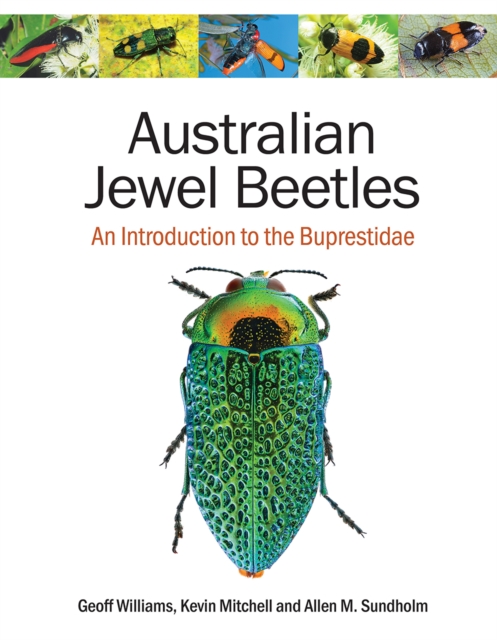
Australian Jewel Beetles
Australian Jewel Beetles: An Introduction to the Buprestidae is a comprehensive overview of Australia's buprestid fauna. It presents taxonomic, ecological and biogeographic information for all Australian genera, and their association with the world's Buprestidae more widely. It explores plant-evolution dependencies, as well as threats and conservation for this diverse fauna.The authors bring together their extensive experience and understanding of the wealth of Australia's largely endemic species, supported by spectacular images and discussion of photographic techniques.Australian Jewel Beetles will be valued by professional biologists and ecologists, as well as entomologists and naturalists in Australia and abroad.
eBook
Assessment and Distribution of Damages Caused by the Trunk-Boring Insects Coraebus undatus (Fabricius) (Coleoptera: Buprestidae) and Reticulitermes grassei Clément (Blattodea: Rhinotermitidae) in Mediterranean Restored Cork-Oak Forests
This work assesses damage caused by Coraebus undatus (Fabricius) (Coleoptera: Buprestidae) and Reticulitermes grassei Clément (Blattodea: Rhinotermitidae) in managed cork oak forests from the southern Iberian Peninsula. Lesions were diagnosed and quantified in relation to the following features: height and orientation in the trunk, diameter at breast height, solar exposure, understory presence and orography. The distribution patterns of lesions in the study area across 12 plots and in the trunk of the trees were also analyzed. The study was performed in “Sa de Hornachuelos” Natural Park (Córdoba, Spain) and the research area encompassed 12 environmentally-restored sampling plots. Data were recorded from 2007 to 2014, with yearly sampling from late June to mid-September, corresponding to the cork extraction period, since lesions caused by these insects are well distinguishable promptly after bark removal. The results reveal that C. undatus has low population levels and a non-uniform distribution pattern in the study area as well as in the trunk of the tree. It shows preference for medium height but not by any trunk orientation. R. grassei also shows low infestation levels and a preference to affect the trunk’s base. Comparatively, C. undatus showed higher infestation levels than R. grassei. The location of damage was also different, since galleries made by C. undatus predominated at intermediate trunk heights while those of R. grassei were more frequent at lower heights. Our results further showed a low co-occurrence of both species in the same tree trunks, which could be explained in terms of overlapping in the distribution areas of both species. These results provide background information that will enable natural resources managers to detect changes and trends of these species and inform future management decisions.
Journal Article
Semiochemical and Communication Ecology of the Emerald Ash Borer, Agrilus planipennis (Coleoptera: Buprestidae)
Knowledge of buprestid chemical ecology is sparse but the appearance of the invasive pest Agrilus planipennis Fairmaire in North America has provided the impetus to study in detail the semiochemistry and ecology of this important buprestid. The macrocyclic lactone (3Z)-12-dodecenolide [(3Z)-lactone] is identified as a key antennally-active compound that is produced by females and attracts males. Though a weak trap attractant alone, when combined with the host kairomone (3Z)-hexenol and the important visual cue of a green canopy trap, significant increases in male trap capture occur, thus defining (3Z)-lactone as both a sex pheromone of A. planipennis as well as the first and only known buprestid pheromone. The non-natural stereoisomer (3E)-12-dodecenolide and the saturated analog, 12-dodecanolide also exhibit mimetic activities towards male A. planipennis, suggesting a notable plasticity in this pheromonal structural motif. Efficient synthetic routes to these compounds have been developed. A series of fluoro-12-dodecanolides has also been synthesized containing CF2 groups as a strategy to bias the conformational space accessed by these macrolides and to assess if the analogs may act as mimetics for 12-dodecanolide pheromones associated in A. planipennis. These compounds also afford a unique opportunity to study the binding affinities of lactone surrogates with A. planipennis chemosensory proteins and olfactory receptors. Some progress has also been made in identifying the genes involved in the reception, processing and degradation of volatiles in this invasive insect. It is now evident that the behavior and ecology of A. planipennis involves a complex pattern of sensory modalities, including visual, tactile, olfactory and potentially acoustic components. Earlier reviews focused on studies of attractive host volatiles in development of a trapping system for early detection and visual and contact phenomena in A. planipennis mate finding. This review will update the semiochemistry and chemical ecology of A. planipennis and discuss studies on chemistry and behavior that have identified female-produced pheromone components and host kairomones.
Journal Article

Prey carriage varies with prey size in Cerceris fumipennis (Hymenoptera, Crabronidae)
Exploitation of the hunting behavior of the solitary wasp Cerceris fumipennis is proving to be a useful method for detecting pest Buprestidae as well as for documenting buprestid diversity in eastern North America. Here we review prey carriage mechanisms in the species, and conclude that variation in prey carriage is correlated with the spectacular size range of their buprestid prey (4.9-22.3 mm length). Small prey items, including Agrilus species, are transported with the aid of a specialized morphological structure on the fifth metasomal sternite (\"buprestid clamp\"), resulting in a distinct curved posture during flight. Analysis of prey items from Cerceris fumipennis in North Carolina in 2014 indicates that 30% of collected Agrilus spp. were not paralyzed prior to wasp arrival at the nest, and suggests that the buprestid clamp may function to prevent the escape of active small prey. Recognition that the curved flight posture of a female approaching her nest is a signal that she may be carrying a beetle in the genus Agrilus can improve efficiency of biosurveillance for pest Buprestidae.
Journal Article