
Catalogue Search | MBRL


Are you sure you want to remove the book from the shelf?

{{itemTitle}}
34
result(s) for
"chefferie"
Sort by:

Geochemical sourcing of volcanic materials imported into Teti’aroa Atoll shows multiple long-distance interactions in the Windward Society Islands, French Polynesia
Teti’aroa, located 28 nautical miles (52 km) north of Tahiti, lies at the periphery of the Windward Society islands. At the end of the eighteenth century, this atoll was presumably controlled by the chiefdom of Porionu’u, which included the districts of Pare and Arue on the north coast of Tahiti. This situation is confirmed by a number of ethnohistorical accounts and oral traditions describing an intense traffic of basic resources between the atoll and Tahiti island as well as the specific function of Teti’aroa for Tahitian social elites visiting the atoll for ceremonial or recreational purposes. However, the prehistory of the atoll remains largely unknown and the time-depth of dominance by Tahitian elites on the atoll is unclear. In this paper, we investigate potential inter-island relationships between Teti’aroa and other islands in the archipelago and beyond. We present geochemical analyses (energy dispersive X-ray fluorescence and inductively coupled plasma-atomic emission spectrometry) of stone tools and elements of ceremonial architecture (marae), which were necessarily imported given the complete subsidence of the volcanic substratum of the island. Our results confirm the regional origin of a majority of artefacts, but also indicate several later long-distance relationships maintained by Tahitian chiefs.
L’atoll de Teti’aroa, situé à 28 miles nautiques (52 km) au nord de l’île de Tahiti, se trouve àlapériphérie des Iles du Vent dans l’archipel de la Société. A la fin du 18ème siècle, cet atoll était intégré au territoire de la chefferie de Porionu’u qui dominait les districts Pare et d’Arue sur la côte nord de Tahiti. Cette situation est confirmée par de nombreux témoignages ethno-historiques et traditions orales décrivant l’intense échange de ressources et de biens entre l’atoll et l’île de Tahiti, ainsi que le rôle de Teti’aroa pour les élites tahitiennes qui y séjournaient pour des durées plus ou moins courtes, dans le cadre de cérémonies particulières ou pour se retirer lors de périodes de conflits.
Dans cet article, nous traitons des relations interinsulaires qui impliquait Teti’aroa et d’autres îles de l’archipel et au-delà. Nous présentons les analyses des compositions chimiques (ED-XRF et ICP-AES) d’un ensemble d’outils en pierre et éléments d’architecture cérémonielle (marae), qui furent nécessairement transportés depuis une île haute, puisque le substrat volcanique de l’île est enfoui par subsidence. Nos résultats conferment l’origine régionale de la plupart des artefacts, et indiquent également plusieurs connexions àtrès longue distance maintenues par les chefferies tahitiennes à une époque relativement récente.
Journal Article

How Chiefs Became Kings
In How Chiefs Became Kings, Patrick Vinton Kirch addresses a central problem in anthropological archaeology: the emergence of \"archaic states\" whose distinctive feature was divine kingship. Kirch takes as his focus the Hawaiian archipelago, commonly regarded as the archetype of a complex chiefdom. Integrating anthropology, linguistics, archaeology, traditional history, and theory, and drawing on significant contributions from his own four decades of research, Kirch argues that Hawaiian polities had become states before the time of Captain Cook's voyage (1778-1779). The status of most archaic states is inferred from the archaeological record. But Kirch shows that because Hawai`i's kingdoms were established relatively recently, they could be observed and recorded by Cook and other European voyagers. Substantive and provocative, this book makes a major contribution to the literature of precontact Hawai`i and illuminates Hawai`i's importance in the global theory and literature about divine kingship, archaic states, and sociopolitical evolution.
eBook

The Chattahoochee chiefdoms
An overview and model of complex society in the prehistoric Southeast. Along the banks of the lower Chattahoochee River, the remains of ancient settlements are abundant, including archaeological sites produced by Native Americans between 900 and 350 years ago, and marked by the presence of large earthen mounds. Like similar monuments elsewhere in the Southeastern United States, the lower Chatta-hoochee River mounds have long attracted the attention of travelers, antiquarians, and archaeologists. As objects from the mounds were unearthed, occasionally illustrated and discussed in print, attention became focused on the aesthetic qualities of the artifacts, the origins of the remains, and the possible relationship to the Creek Indians. Beginning in the 20th century, new concerns emerged as the developing science of archaeology was introduced to the region. As many of the sites became threatened or destroyed by reservoir construction, trained archaeologists initiated extensive excavations of the mounds. Although classification of artifacts and sites into a chronological progression of cultures was the main objective of this effort, a second concern, sometimes more latent than manifest, was the reconstruction of a past way of life. Archaeologists hoped to achieve a better understanding of the sociopolitical organization of the peoples who built the mounds and of how those organizations changed through time. Contemporary archaeologists, while in agreement on many aspects of the ancient cultures, debate the causes, forms, and degrees of sociopolitical complexity in the ancient Southeast. Do the mounds mark the capitals of political territories? If so, what was the scale and scope of these ancient “provinces”? What manner of society constructed the mound settlements? What was the sociopolitical organization of these long-dead populations? How can archaeologists answer such queries with the mute and sometimes ordinary materials with which they work: pottery, stone tools, organic residues, and the strata of remnant settlements, buildings, and mounds?
eBook

The Ecology of Power
In 1884 a community of Brazilians was \"discovered\" by the Western world. The Ecology of Power examines these indigenous people from the Upper Xingu region, a group who even today are one of the strongest examples of long-term cultural continuity. Drawing upon written and oral history, ethnography, and archaeology, Heckenberger addresses the difficult issues facing anthropologists today as they \"uncover\" the muted voices of indigenous peoples and provides a fascinating portrait of a unique community of people who have in a way become living cultural artifacts.
Michael Heckenberger is Assistant Professor in the Department of Anthropology at the University of Florida--Gainesville. He has recieved numerous research grants and is principal investigator in the Southern Amazon Ethno-archaeological Project. He is co-author of the forthcoming Archaeology of the Amazon (Cambridge University Press).
eBook

Les conflits de proximité et la crise de la démocratie au Niger : de la famille à la classe politique
Aujourd’hui, au Niger, la politique des partis et de la démocratie, caractérisée par des affontements incessants entre politiciens, avec de fréquents changements de camp, est rejetée par la population. Ces conflits de proximité sont nommés par un terme emprunté aux conflits familiaux, qui s’applique aux relations de jalousie entre demi-frères, à savoir les baab-izey. La famille est un espace autant de rivalités que de solidarité, contrairement aux stéréotypes sur la famille africaine. Ces rivalités alimentées par la polygamie deviennent publiques dans les querelles d’héritage ou de chefferie. Le microcosme politique nigérien est confronté à des rivalités internes semblables où les camarades d’aujourd’hui deviennent demain des ennemis. Autre similarité, les conflits de proximité familiaux comme les conflits de proximité politiques sont avivés par les spécialistes de l’occulte qui rendent toujours les proches responsables des problèmes.
Journal Article

Struggle and Hope
Struggle and Hope is an absorbing memoir by a distinguished citizen of 'Phalo’s Land', in which the memoirist Mda Mda, traces the fractious events of Transkeien history over the period from roughly the late eighteen-hundreds to the present – that is, through the momentous epochs of colonialism, apartheid and liberal-democracy.
eBook

Modernising Traditions and Traditionalising Modernity in Africa
Chieftaincy in Africa has displayed remarkable dynamics and adaptability to new socio-economic and political developments, without becoming totally transformed in the process. Almost everywhere on the continent, chiefdoms and chiefs have become active agents in the quest for ethnic, cultural symbols as a way of maximising opportunities at the centre of bureaucratic and state power, and at the home village where control over land and labour often require both financial and symbolic capital. Chieftaincy remains central to ongoing efforts at developing democracy and accountability in line with the expectations of Africans as individual 'citizens' and also as 'subjects' of various cultural communities. This book uses Cameroon and Botswana as case studies, to argue that the rigidity and prescriptiveness of modernist partial theories have left a major gap in scholarship on chiefs and chieftaincy in Africa. It stresses that studies of domesticated agency in Africa are sorely needed to capture the creative ongoing processes and to avoid overemphasising structures and essentialist perceptions on chieftaincy and the cultural communities that claim and are claimed by it.
eBook
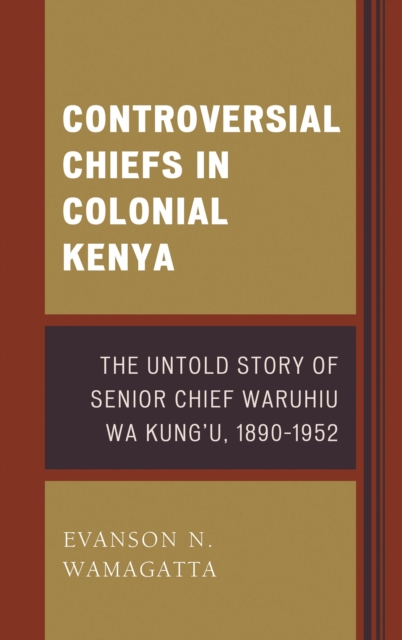
Controversial chiefs in colonial Kenya
Senior Chief Waruhiu wa Kung'u is one of colonial Kenya's most controversial chiefs.His name has gone down in history as a traitor who was assassinated because he sold his country to the British colonizers.This book is the untold story of the controversial life of Senior Chief Waruhiu who served the colonial government for thirty years.
eBook
Les derniers fils de chefs de canton au Sénégal : « Nous étions des sujets, nous sommes devenus des compléments d’objet direct »
Cet article restitue des entretiens menés avec des fils de chefs de cantons, devenus adultes dans les années 1950, en les croisant avec des archives coloniales. Il tente de faire voir leurs parcours en reconstituant leurs « carrières » pour poser la question des socialisations à la fonction de chef en tant que métier et en tant que statut social. En faisant cela, il montre comment différents dispositifs coloniaux ont en partie modelé les usages de l’hérédité politique au Sénégal. D’autre part, ce travail pose la question des incidences biographiques de l’indépendance pour les anciens intermédiaires du pouvoir colonial, et de la reconversion de leurs dispositions au commandement dans les États indépendants.
Journal Article

Le “roi-prêtre” n’existe (peut-être) pas
La figure anthropologique du roi-prêtre peine à s’accorder avec la réalité de l’institution de la chefferie Grassfields. Plus exactement, nous observons un motif dont l’histoire nous ramène à l’apparition d’une forme particulière, la « religion », et à la présence d’un prophète officiant : le missionnaire. L’analyse proposée revient sur les circonstances coloniales dans lesquelles le concept de « religion » fut introduit, un prisme qui permet de penser le déjà-là et de produire à plusieurs voix un récit biblique des origines de la royauté. L’objet de la religion dont il est question se révèle dans le cadre d’une cohabitation avec les missions, dans les enjeux politiques et rituels que génère la propagation de la doctrine et de la liturgie chrétiennes, amenant le souverain à endosser des habits religieux à même d’investir les lieux-symboles du christianisme. Cet article dévoile un pan méconnu du devenir de la royauté Grassfields durant la période coloniale, où le corps-fétiche du roi se fétichise à nouveaux frais.
Journal Article