
Catalogue Search | MBRL


Are you sure you want to remove the book from the shelf?

{{itemTitle}}
13,624
result(s) for
"children of migrants"
Sort by:


Migrant Youth, Transnational Families, and the State
Each year, more than half a million migrant children journey from countries around the globe and enter the United States with no lawful immigration status; many of them have no parent or legal guardian to provide care and custody. Yet little is known about their experiences in a nation that may simultaneously shelter children while initiating proceedings to deport them, nor about their safety or well-being if repatriated. Migrant Youth, Transnational Families, and the State examines the draconian immigration policies that detain unaccompanied migrant children and draws on U.S. historical, political, legal, and institutional practices to contextualize the lives of children and youth as they move through federal detention facilities, immigration and family courts, federal foster care programs, and their communities across the United States and Central America.Through interviews with children and their families, attorneys, social workers, policy-makers, law enforcement, and diplomats, anthropologist Lauren Heidbrink foregrounds the voices of migrant children and youth who must navigate the legal and emotional terrain of U.S. immigration policy. Cast as victims by humanitarian organizations and delinquents by law enforcement, these unauthorized minors challenge Western constructions of child dependence and family structure. Heidbrink illuminates the enduring effects of immigration enforcement on its young charges, their families, and the state, ultimately questioning whose interests drive decisions about the care and custody of migrant youth.
eBook


Ethnicity in Schools: Perceptions of Migrant Children from Central Asia in the Multicultural Environment of Russian Cities
This article analyzes phenomenon of “migrant schools” and “migrant classes” in schools that began to emerge in the 2010s in Siberian cities of Tomsk and Irkutsk. The study is based on 120 interviews with migrants and 36 express-interviews with parents of children from both local families and those that have migrated from Central Asia, as well as case studies of four schools in these two cities identified as “migrant” by local residents. Despite the ethnic diversity of these Siberian cities where most families themselves descend from migrants from other regions, the local population singles out new migrants from the countries of Central Asia as “others” in the urban space. While school administrations, teachers, and parents reproduce the narratives of tolerance and ethnic diversity, school segregation persists in these cities, manifested, among other things, in the emergence of “migrant” schools and “migrant classes” in schools. This study presents this segregation as an outcome of strategies pursued by school administrators and parents of both local and migrant children. In particular, creation of “migrant” classes in some schools is the school administrators’ response to the lack of adaptation programs for migrant children. I conclude that rather than assisting the socialization of migrant children, such schools reproduce their isolation from other pupils, limiting their ability to succeed in the future.
Journal Article


Divided by borders
Since 2000, approximately 440,000 Mexicans have migrated to the United States every year. Tens of thousands have left children behind in Mexico to do so. For these parents, migration is a sacrifice. What do parents expect to accomplish by dividing their families across borders? How do families manage when they are living apart? More importantly, do parents' relocations yield the intended results? Probing the experiences of migrant parents, children in Mexico, and their caregivers, Joanna Dreby offers an up-close and personal account of the lives of families divided by borders. What she finds is that the difficulties endured by transnational families make it nearly impossible for parents' sacrifices to result in the benefits they expect. Yet, paradoxically, these hardships reinforce family members' commitments to each other. A story both of adversity and the intensity of family ties, Divided by Borders is an engaging and insightful investigation of the ways Mexican families struggle and ultimately persevere in a global economy.
eBook

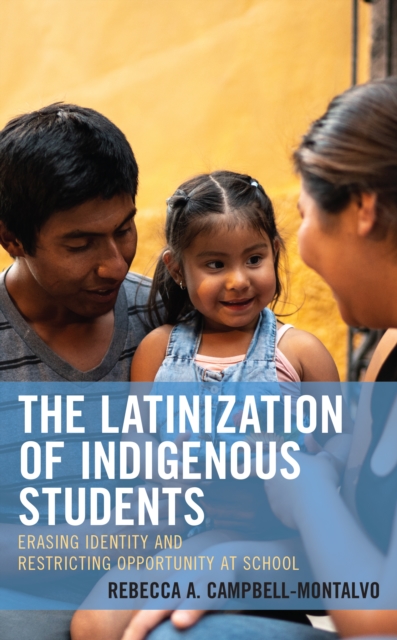
The Latinization of Indigenous Students
Based upon research in rural central Florida, The Latinization of Indigenous Students examines how schools perceive and process demographic information, including how those perceptions may erase Indigeneity and impact resource access. Based on multiyear fieldwork, Campbell-Montalvo argues that languages and racial identities of Indigenous Latinx students and families may be re-formed by schools, erasing Indigeneity. However, programs such as the federally funded Migrant Education Program can foster equitable access by encouraging pedagogies that position teachers as cultural insiders or learners. Anchored by pertinent anthropological theories, this work advances our ability to name and explain pedagogical phenomena and their role in rectifying or reproducing colonialism among marginalized and minoritized groups.
eBook

Economic Pressure and Loneliness in Migrant Children in China: The Mediating Roles of Parent–Child Communication and Parental Warmth
The purpose of the current study was to examine the mediating roles of parent–child communication and parental warmth in the relationship between economic pressure and loneliness in a sample of migrant children in China. A total of 437 participants were selected from two public schools for migrant children in Zhejiang Province, China. All participants were asked to complete four measures, including the Perceived Economic Strain Scale, the Parent–Child Communication Questionnaire, the Parental Warmth Scale, and the Children’s Loneliness Scale. The results showed that economic pressure was positively and directly related to loneliness. Furthermore, parent–child communication and parental warmth partially mediated the relationship between economic pressure and loneliness in migrant children. Thus, parent–child communication and parental warmth play important roles in reducing the negative effect of economic pressure on loneliness in migrant children.
Journal Article

Children and Television: Vicarious Socialisation Experiences
This article contributes to the understanding of socialisation of children of Filipino immigrants in South Australia by examining their experiences and engagement with media, particularly television. Thirty children, aged 8–12 years, who participated in the study were mainly accessed through social networks. Children’s names, which reflect Anglicised or Spanish influence to Filipinos, were changed to maintain ethical considerations. A qualitative methodological framework grounded the children’s perspectives in symbolic interactionism. The study particularly focused on symbolic interaction concepts of the self (selves) and influence of others, forming perspectives, roles, attitudes of others and coping, as well as how socialisation experiences of children facilitated children’s perspectives on media. These concepts are significant in understanding how children made sense of television content. This discussion on children’s media socialisation is organised into two sections according to children’s engagement with television and parental control of television watching. The children in this article have been exposed to both television content in the Philippines and Australia. Whilst the article focuses on a small cohort of primary school children, the theory and methodology could be applied to children of other cultures and as such may generate comparative results.
Journal Article