
Catalogue Search | MBRL


Are you sure you want to remove the book from the shelf?

{{itemTitle}}
2,016
result(s) for
"classical ethics"
Sort by:

Aristotle's Ethics and Moral Responsibility
\"Aristotle's Ethics develops a complex theory of the qualities which make for a good human being and for several decades there has been intense discussion about whether Aristotle's theory of voluntariness, outlined in the Ethics, actually delineates what modern thinkers would recognize as a theory of moral responsibility. Javier Echeñique presents a novel account of Aristotle's discussion of voluntariness in the Ethics, arguing - against the interpretation by Arthur Adkins and that inspired by Peter Strawson - that he developed an original and compelling theory of moral responsibility and that this theory has contributed in important ways to our understanding of coercion, ignorance and violence. His study will be valuable for a wide range of readers interested in Aristotle and in ancient ethics more broadly\"-- Provided by publisher.
BOOK

The core of the ethics in some Middle-Platonists
One of the main lines of research that emerged within the framework of studies on ancient philosophy consists of outlining the main proposals of its most representative authors. At least in part, the philosophers so-called today Middle-Platonists are studied from this perspective. Thus, the article proposes a schematization of the Middle-Platonist ethics starting from the metaphysical-anthropological approaches common to the main representatives of these philosophers. By analysing the concepts of God, Idea and man, the article seeks to highlight which are the main ethical theses of the Middle-Platonists, namely, the subjection of sensitivity to reason, the importance of moral virtue and human directionality in relation to the ultimate end.
Journal Article

How to say no : an ancient guide to the art of cynicism
\"Among the schools of philosophy in the Greco-Roman world, there was Stoicism, Epicureanism, Platonism, and Skepticism to name the most prominent and influential. There was however another \"school\" and that was known as Cynicism. The Cynics were not scholars or writers. Like a Jesus, or a Socrates, or a Buddha, they were oralists whose memorable utterances and actions were transmitted to posterity by admirers (and detractors). It is doubtful whether we can even justly call them philosophers, as they did not organize themselves into a school or possess a set of systematic doctrines. Their mode of life was a philosophy of doing. The Cynics were, to put it in contemporary terms, lifestylists and performance artists. The most famous Cynic, Diogenes of Sinope, threw out his bowl, as one less thing he needed, when he saw a young boy drinking with his hands. He also comically, when Alexander the Great asked what he could do for him, replied \"Get out of my sun\" making clear the young conqueror had nothing to offer him. And yet the Cynics, as Mark Usher aims to show in this collection, did purvey some core values that distinguished them in their own time and recommends them to ours. Indeed, they speak with some urgency to our current predicaments involving climate change, socio-economic uncertainty, and psychic malaise. Their \"less is more\" approach to living anticipates our contemporary fashion for decluttering, minimalism, and simpler more natural ways of living. Like ancient Thoreaus, their disentanglement of our needs from our wants provides an object lesson in prioritizing truly human goods. The Cynics also exemplified the idea that subsistence lifestyles are sustainable lifestyles, and the principle behind their lived example gives the lie to the modern article of faith that economic development and growth are synonymous with quality of life. Finally, their embrace of cosmopolitanism-the Cynics coined the word-flies in the face of the resurgent nativism that threatens the stability of nations, including our own. The Cynics championed their positions on the grounds that each of them accorded with a state of affairs found in Nature. Their appeal to the example of non-human agents, animals in particular, is highly instructive as it validates the intrinsic worth of the non-human world more broadly, foreshadowing thereby a central tenet of modern environmental philosophy. Taken as a whole, this volume will aim to recover the Cynic ways of thinking and living and refurbish them and make them relevant for our modern, beleaguered world\"-- Provided by publisher.
Book

On Duties
Benjamin Patrick Newton's translation of Cicero'sOn Dutiesis the most complete edition of a text that has been considered a source of moral authority throughout classical, medieval, and modern times. Marcus Tullius Cicero was a preeminent Roman statesman, orator, and philosopher who introduced philosophy into Rome, and through Rome, into Christendom and the modern world.On Dutieswas championed by important thinkers including Thomas Aquinas, Montesquieu, and Voltaire, and it was one of the earliest books printed on the Gutenberg press.
The true significance ofOn Dutieslies in its examination of several fundamental problems of political philosophy, the most important being the possible conflict between the honorable and the useful. The honorable encompasses the virtues of human beings, which include justice and concern for the common good. The useful refers to the needs of living beings, which includes certain necessities and concern for private good. Only by understanding the possible conflict between these two sides of human nature, Cicero declares, may we understand our duties to our community and to ourselves. This new edition ofOn Dutiesaims to provide readers who cannot read Latin but wish to study the book with a literal yet elegant translation. It features an introduction, outline, footnotes, interpretative essay, glossary, and indexes, making Cicero's thought accessible to a general audience.
Benjamin Patrick Newton's translation of Cicero'sOn Dutiesis the most complete edition of a text that has been considered a source of moral authority throughout classical, medieval, and modern times. Marcus Tullius Cicero was a preeminent Roman statesman, orator, and philosopher who introduced philosophy into Rome, and through Rome, into Christendom and the modern world.On Dutieswas championed by important thinkers including Thomas Aquinas, Montesquieu, and Voltaire, and it was one of the earliest books printed on the Gutenberg press.The true significance ofOn Dutieslies in its examination of several fundamental problems of political philosophy, the most important being the possible conflict between the honorable and the useful. The honorable encompasses the virtues of human beings, which include justice and concern for the common good. The useful refers to the needs of living beings, which includes certain necessities and concern for private good. Only by understanding the possible conflict between these two sides of human nature, Cicero declares, may we understand our duties to our community and to ourselves. This new edition ofOn Dutiesaims to provide readers who cannot read Latin but wish to study the book with a literal yet elegant translation. It features an introduction, outline, footnotes, interpretative essay, glossary, and indexes, making Cicero's thought accessible to a general audience.
eBook

Antropología filosófica y ética aristotélico-escolástica en Francisco Hernández
En este trabajo, el autor busca recuperar las tesis antropológico-morales de Francisco Hernández, representante de lo que puede llamarse “aristotelismo novohispano”. En sus doctrinas se aprecia la asimilación y amalgama entre el aristotelismo escolástico y el neoplatonismo cristiano, que caracteriza buena parte de la producción medieval que, a través de la época renacentista, recibe el aristotelismo salmantino del siglo XV y que pasa al pensamiento novohispano del siglo XVI. In this work, the author seeks to recover the anthropological-moral theses of Francisco Hernández, representative of what can be called “Aristotelianism of New Spain”. In its doctrines we can see the assimilation and amalgamation between scholastic Aristotelianism and Christian Neoplatonism, which characterizes a good part of the medieval production that, through the Renaissance era, receives the Salamancan Aristotelianism of the 15th century and which passes to the New Spain thought of the 16th century.
Journal Article
El núcleo de la ética de algunos platónicos medios
Una de las principales líneas de investigación surgida en el marco de los estudios sobre la filosofía antigua consiste en esquematizar las propuestas principales de sus autores más representativos. Los filósofos que hoy en día se denominan platónicos medios son estudiados, al menos en parte, precisamente desde tal perspectiva. Así pues, el artículo propone una esquematización de la ética medioplatónica partiendo de los planteamientos metafísico-antropológico comunes a los principales representantes de esta amplia corriente de pensamiento. Retomando los conceptos de Dios, las Ideas y el hombre, el artículo busca poner de relieve cuáles son las principales tesis éticas de los platónicos medios, a saber, la sujeción de la sensibilidad a la razón, la importancia de la virtud moral y la direccionalidad humana en relación al fin último.
Journal Article

Christian Theology: Ethics
This chapter contains sections titled:
Teleological Ethics
Deontological Ethics
Agent‐centered (Virtue) Ethics
Life “in Christ”
References
Book Chapter

Tradition and Invention: Bacon's Aphorisms and the Essays
This chapter contains section titled:
Bacon's Reinvention of the Aphorism in his Science
The New Science and the Essays: Ethos, Logos, and Pathos
Book Chapter
Anger, mercy, revenge
Lucius Annaeus Seneca (4 BCE–65 CE) was a Roman Stoic philosopher, dramatist, statesman, and adviser to the emperor Nero, all during the Silver Age of Latin literature. The Complete Works of Lucius Annaeus Seneca is a fresh and compelling series of new English-language translations of his works in eight accessible volumes. Edited by world-renowned classicists Elizabeth Asmis, Shadi Bartsch, and Martha C. Nussbaum, this engaging collection restores Seneca—whose works have been highly praised by modern authors from Desiderius Erasmus to Ralph Waldo Emerson—to his rightful place among the classical writers most widely studied in the humanities. Anger, Mercy, Revenge comprises three key writings: the moral essays On Anger and On Clemency—which were penned as advice for the then young emperor, Nero—and the Apocolocyntosis, a brilliant satire lampooning the end of the reign of Claudius. Friend and tutor, as well as philosopher, Seneca welcomed the age of Nero in tones alternately serious, poetic, and comic—making Anger, Mercy, Revenge a work just as complicated, astute, and ambitious as its author.
eBook
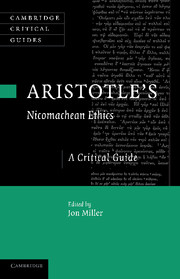
Aristotle's Nicomachean Ethics
Aristotle's Nicomachean Ethics is one of the most important ethical treatises ever written, and has had a profound influence on the subsequent development of ethics and moral psychology. This collection of essays, written by both senior and younger scholars in the field, presents a thorough and close examination of the work. The essays address a broad range of issues including the compositional integrity of the Ethics, the nature of desire, the value of emotions, happiness and the virtues. The result is a volume which will challenge and advance the scholarship on the Ethics, establishing new ways of viewing and appreciating the work for all scholars of Aristotle.
eBook