
Catalogue Search | MBRL


Are you sure you want to remove the book from the shelf?

{{itemTitle}}
92
result(s) for
"colonial education reform"
Sort by:

Reconstructing Race in French Africa and Liberated Europe
As a student in the mid-1940s in French schools in Senegal, Marie Louise Potin Gueye had a wildly diverse set of classroom experiences. The daughter of métis parents from royal Serer lineages, Potin Gueye was born into the small francophone elite in Saint Louis and was part of an even smaller subset of African girls pursuing formal education in the middle decades of the twentieth century.¹ In a 2010 interview with the French leftist magazine Libération, Potin Gueye, then seventy-eight, recalled how during the war, she and her classmates were forced to pay homage to Pétain at the start of
Book Chapter

Introduction
This introductory chapter provides an overview of the interconnectedness of the histories of African decolonization and European integration. World War II was a turning point for education in French Africa and for the colonial administration's stance toward African youth. As the end of the war drew near, the dismal state of education in France's African colonies became a point of international embarrassment and anxiety for French leaders. Determined to restore France's global image and stave off international oversight in the education space, French colonial officials committed themselves to the expansion of African education at Charles de Gaulle's landmark Brazzaville Conference on colonial reform in early 1944. The chapter explains that the book explores how colonial education reforms and public and private programs to promote solidarity between French and African youth collided with transnational efforts to make young people in Western Europe feel more European after World War II. The book connects the vision of Europe that coalesced in postwar campaigns for European unity to crucial decisions about how much France should invest in the promotion of African youth and what African education should entail.
Book Chapter

Inhabiting 'childhood' : children, labour and schooling in postcolonial India
Through a rich ethnography of street and working children in Calcutta, India, this book offers the first sustained enquiry into postcolonial childhoods, arguing that the lingering effects of colonialism are central to comprehending why these children struggle to inhabit the transition from labour to schooling.
eBook

Decolonizing the History Curriculum in Malaysia and Singapore
Decolonizing the History Curriculum in Malaysia and Singapore is a unique study in the history of education because it examines decolonization in terms of how it changed the subject of history in the school curriculum of two colonized countries - Malaysia and Singapore. Blackburn and Wu's book analyzes the transition of the subject of history from colonial education to postcolonial education, from the history syllabus upholding the colonial order to the period after independence when the history syllabus became a tool for nation-building. Malaysia and Singapore are excellent case studies of this process because they once shared a common imperial curriculum in the English language schools that was gradually 'decolonized' to form the basis of the early history syllabuses of the new nation-states (they were briefly one nation-state in the early to mid-1960s). The colonial English language history syllabus was 'decolonized' into a national curriculum that was translated for the Chinese, Malay, and Tamil schools of Malaysia and Singapore. By analyzing the causes and consequences of the dramatic changes made to the teaching of history in the schools of Malaya and Singapore as Britain ended her empire in Southeast Asia, Blackburn and Wu offer fascinating insights into educational reform, the effects of decolonization on curricula, and the history of Malaysian and Singaporean education.
eBook

The economic rationale for the provision of technical/vocational education (TVE) in colonial Ghana: Implications for practice
The paper examines the economic rationale for the provision of technical and vocational education (TVE) in the Colonial Ghana. It highlights some key lessons drawn from the study, particularly in term of the Ghanaian contemporary search for a more pragmatic policy formulation for TVE. Data were retrieved from primary sources in the form of archival materials and some secondary sources, as well some interview sessions with two personalities who were actively involved in the provision of TVE during the period. Chronological and thematic analysis of the data was utilised. The study revealed that the missionary bodies and the colonial administration promoted TVE largely because of economic reasons. It further argues that this level of vigour could unfortunately not keep pace with the developmental needs of the country due mainly to factors such as negative perception towards TVE, the failure of successive governments to provide the requisite infrastructure and equipment for the steady promotion of TVE, lack of entrepreneurial training for graduates of the TVE institutions and virtual non-existence of local industries to absorb these graduates.
Journal Article

Higher education development in Korea
The features of Korean higher education development are related to sociocultural tradition (Confucian tradition), the model university ideas, and economic development in Korea. The modern university ideas adopted in Korean are based on the German model which was established by the Japanese colonial government and drawing on the US university model after the World War II. However, the modern university ideas are intertwined with socio-cultural factors and have been embedded in current Korean universities. As well as the western ideas and the Confucian tradition, the growth of Korean higher education has relied upon the rapid growth of the Korean economy. Education development is well aligned with economic development in Korea thanks to government policy initiatives. This framework can be applied in the analysis of higher education development in other countries. Higher education development cannot be solely explained by individual cultural, historical or economic factor. These three factors are interlinked and influence the development of Korean higher education.
Journal Article

Rethinking bilingual education in postcolonial contexts
Taking an ethnographic study of the purpose and value of bilingual education in Mozambique as a starting point, this book calls for critical adaptations when theories of bilingual education, based on practices in the North, are applied to the countries of the global South.
eBook

The capacity to share : a study of Cuba's international cooperation in educational development
01
02
The Capacity to Share is a discussion of Cuba's international policies in education. It shows how Cuba shares its educational resources with other countries by helping them with scholarships; school and university teaching; and the development of adult literacy programs and of educational planning. The postcolonial critique underlying the book explores Cuba's role in relation to how the disengagement from colonial legacies in education is taking place in many countries. This kind of critique is useful in discussing the alternatives that become possible with disentanglement from the constraints of colonial histories.
31
02
The first comprehensive study of Cuba's international role in improving education
13
02
Rosemary Preston is director of the International Centre for Continuing Education (INCED) at the University of Warwick. Anne Hickling-Hudson is an associate professor of International and Cross-cultural Education in Australia at the Queensland University of Technology's School of Cultural and Language Studies, Faculty of Education. Jorge Corona Gonzalez teaches Political Economy at the University of Havana. A former president of the Pedagogical Institute for Latin America and the Caribbean, he is currently special advisor on International Collaboration in Cuba's Ministry of Education, and a member of the UNESCO Chair in Educational Sciences.
19
02
It is the first comprehensive analysis of Cuba's international role in improving education and will appeal to readers curious about Cuba The first comprehensive analysis of the development potential of 'South-South' collaboration in education thus opens up a new space in the field of development education It helps academics, students and policy-makers to challenge preconceptions about educational aid, showing up the limitations of the traditional approach compared to the radically different approaches pioneered by Cuba Provides a basis for comparing the experiences of overseas students in other countries at a time when the global student market is increasing Avaluable addition to postcolonial analysis of the efforts of decolonising countries to tackle cooperatively the vast problems of the aftermath of colonialism, particularly in Education
04
02
PART I: THE GLOBAL EDUCATIONAL CRISIS, INTERNATIONAL AID, AND SOUTH-SOUTH COLLABORATION: THE ROLE OF CUBA Global Educational Underdevelopment and the Role of Aid; A.Hickling-Hudson, J.Corona Gonzalez & S.Lehr The Solidarity Approach: South-South Cooperation and Cuba's International Role in Health & Education; A.Hickling-Hudson, J.Corona Gonzalez & S.Lehr; with M.Majoli Cuba's Education System: a Foundation for 'the Capacity to Share'; E.Martín Sabina, J.Corona Gonzalez & A.Hickling-Hudson PART II: STUDYING IN CUBA; RETURNING HOME TO WORK International Students in Cuban Universities and Colleges; F.Martinez Perez The Children of the Isle of Youth: How Ghanaian Students Learned to Cope with 'Anything in Life'; S.Lehr Studying in Cuba; Returning Home to Work. The Experience of Graduates from the English-speaking Caribbean; A.Hickling-Hudson Destinations of Africans After Study in Cuba: the Namibian Experience; R.Preston PART III: CUBAN EDUCATORS OVERSEAS The Cuban Internationalist Mission in Education. The Example of Angola 1976-1991; C.Hatzky Educational Administration and University Management: Cuban Collaboration in Latin America; B.Trista Perez Cubans Teaching Overseas; A.Hickling-Hudson Cuba's Contribution to Adult Literacy, Popular Education and Peace-building in Timor-Leste; B.Boughton
02
02
This discussion of Cuba's international policies in education shows how Cuba shares its educational resources with other countries. The postcolonial critique underlying the book explores Cuba's role in relation to how the disengagement from colonial legacies in education is taking place in many countries.
eBook

‘Cheek by jowl’: education as a bridge between Muslims and the British in colonial India
Muslims’ education in British India is treated in the literature as something encompassing resistance, reaction, and hence emancipation from putatively exploitative British policies. This article focuses on the patterns of Muslims’ emergent knowledge traditions in British India in response to the British government's involvement in the educational matters of the Indian subcontinent. Data findings reveal that Indian Muslims’ responses to the growing trend towards ‘modern’ education in the Indian subcontinent evolved gradually through discursive interactions leading to divergent reformist tendencies in favour of or against adopting Western education. The British government's decision to make ‘special’ arrangements for Muslims’ educational uplift had left legacies of mutual admiration, fear, and sometimes resentment between Muslims and the British government in the subcontinent. Amid ambivalent relations between the British and Muslims, it was not difficult to find apt illustrations of what Francis Robinson calls a ‘cheek by jowl’ relationship.
Journal Article
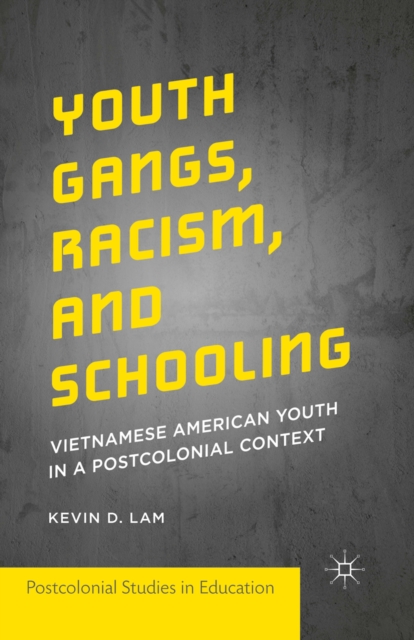
Youth Gangs, Racism, and Schooling
Youth Gangs, Racism, and Schooling examines the formation of Vietnamese American youth gangs in Southern California. Lam addresses the particularities of racism, violence, and schooling in an era of anti-youth legislation and frames gang members as post-colonial subjects, offering an alternative analysis toward humanization and decolonization.
eBook