
Catalogue Search | MBRL


Are you sure you want to remove the book from the shelf?

{{itemTitle}}
2,879
result(s) for
"comic studies"
Sort by:


Christianity and Comics
The Bible has inspired Western art and literature for centuries, so it is no surprise that Christian iconography, characters, and stories have also appeared in many comic books. Yet the sheer stylistic range of these comics is stunning. They include books from Christian publishers, as well as underground comix with religious themes and a vast array of DC, Marvel, and Dark Horse titles, from Hellboy to Preacher. Christianity and Comics presents an 80-year history of the various ways that the comics industry has drawn from biblical source material. It explores how some publishers specifically targeted Christian audiences with titles like Catholic Comics, books featuring heroic versions of Oral Roberts and Billy Graham, and special religious-themed editions of Archie. But it also considers how popular mainstream comics like Daredevil, The Sandman, Ghost Rider, and Batman are infused with Christian themes and imagery. Comics scholar Blair Davis pays special attention to how the medium's unique use of panels, word balloons, captions, and serialized storytelling have provided vehicles for telling familiar biblical tales in new ways. Spanning the Golden Age of comics to the present day, this book charts how comics have both reflected and influenced Americans' changing attitudes towards religion.
eBook

Unaccompanied : stories of brave teenagers seeking asylum
\"This book tells the true stories of five brave teens fleeing their home countries of Guatemala, El Salvador, Honduras, and Guinea, on their own, traveling through unknown and unfriendly places, and ultimately crossing into the US to find refuge and seek asylum. Based on extensive interviews with teen refugees, lawyers, caseworkers, and activists, Tracy White shines a light on five individual kids from among the tens of thousands of unaccompanied minors who enter the US each year. In stark black and white illustrations, she helps us understand why some young people would literally risk their lives to seek safety in the US. Each one of them has been backed into a corner where emigration to the US seems like their only hope.\"--Amazon.
Book

Hero Me Not
First introduced in the pages of X-Men , Storm is
probably the most recognized Black female superhero. She is also
one of the most powerful characters in the Marvel Universe, with
abilities that allow her to control the weather itself. Yet that
power is almost always deployed in the service of White characters,
and Storm is rarely treated as an authority figure. Hero Me
Not offers an in-depth look at this fascinating yet often
frustrating character through all her manifestations in comics,
animation, and films. Chesya Burke examines the coding of Storm as
racially \"exotic,\" an African woman who nonetheless has bright
white hair and blue eyes and was portrayed onscreen by biracial
actresses Halle Berry and Alexandra Shipp. She shows how Storm,
created by White writers and artists, was an amalgam of various
Black stereotypes, from the Mammy and the Jezebel to the Magical
Negro, resulting in a new stereotype she terms the Negro Spiritual
Woman. With chapters focusing on the history, transmedia
representation, and racial politics of Storm, Burke offers a very
personal account of what it means to be a Black female comics fan
searching popular culture for positive images of powerful women who
look like you.
eBook

Out on the wire : the storytelling secrets of the new masters of radio
\"Go behind the scenes of seven of today's most popular narrative radio shows and podcasts, including This American Life and RadioLab, in graphic narrative. Every week, millions of devoted fans tune in to or download This American Life, The Moth, Radiolab, Planet Money, Snap Judgment, Serial, Invisibilia and other narrative radio shows. Using personal stories to breathe life into complex ideas and issues, these beloved programs help us to understand ourselves and our world a little bit better. Each has a distinct style, but every one delivers stories that are brilliantly told and produced. Out on the Wire offers an unexpected window into this new kind of storytelling--one that literally illustrates the making of a purely auditory medium. With the help of This American Life's Ira Glass, Jessica Abel, a cartoonist and devotee of narrative radio, uncovers just how radio producers construct narrative, spilling some juicy insider details. Jad Abumrad of RadioLab talks about chasing moments of awe with scientists, while Planet Money's Robert Smith lets us in on his slightly goofy strategy for putting interviewees at ease. And Abel reveals how mad--really mad--Ira Glass becomes when he receives edits from his colleagues. Informative and engaging, Out on the Wire demonstrates that narrative radio and podcasts are creating some of the most exciting and innovative storytelling available today\"-- Provided by publisher.
Book

Rebuilding Story Worlds
A collaboration between Belgian artist Francois Schuiten and French writer Benoit Peeters, The Obscure Cities is one of the few comics series to achieve massive popularity while remaining highly experimental in form and content. Set in a parallel world, full of architecturally distinctive city-states, The Obscure Cities also represents one of the most impressive pieces of world-building in any form of literature.Rebuilding Story Worlds offers the first full-length study of this seminal series, exploring both the artistic traditions from which it emerges and the innovative ways it plays with genre, gender, and urban space. Comics scholar Jan Baetens examines how Schuiten's work as an architectural designer informs the series' concerns with the preservation of historic buildings. He also includes an original interview with Peeters, which reveals how poststructuralist critical theory influenced their construction of a rhizomatic fictional world, one which has made space for fan contributions through the Alta Plana website.Synthesizing cutting-edge approaches from both literary and visual studies, Rebuilding Story Worlds will give readers a new appreciation for both the aesthetic ingenuity of The Obscure Cities and its nuanced conception of politics.
eBook

Superwomen : gender, power, and representation
\"Explores the production, representation, and reception of prominent female superheroes in mainstream superhero comics, television shows, and films\"-- Provided by publisher.
Book
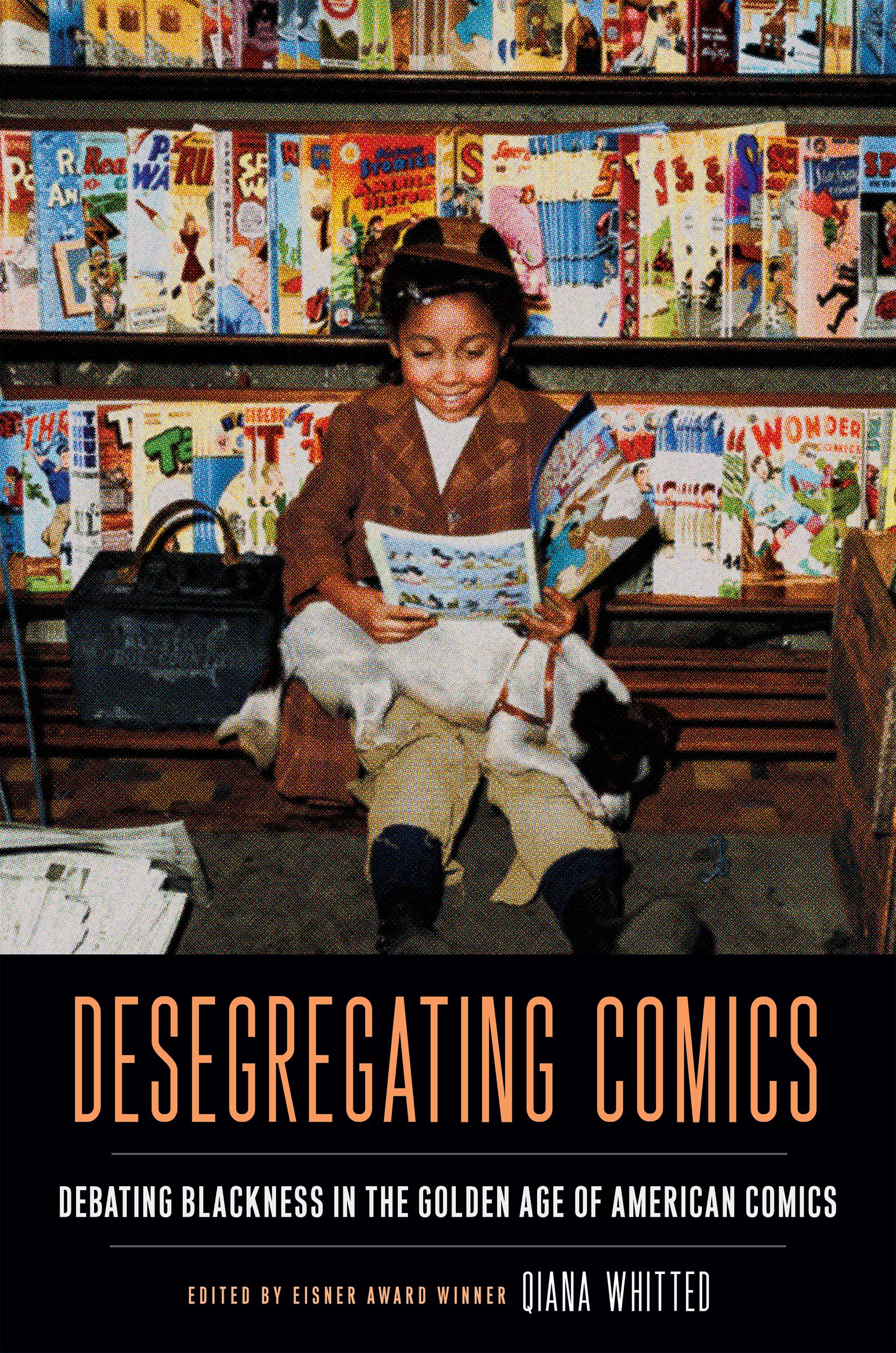
Desegregating Comics
Some comics fans view the industry's Golden Age (1930s-1950s) as a
challenging time when it comes to representations of race, an era
when the few Black characters appeared as brutal savages, devious
witch doctors, or unintelligible minstrels. Yet the true portrait
is more complex and reveals that even as caricatures predominated,
some Golden Age comics creators offered more progressive and
nuanced depictions of Black people. Desegregating Comics
assembles a team of leading scholars to explore how debates about
the representation of Blackness shaped both the production and
reception of Golden Age comics. Some essays showcase rare titles
like Negro Romance and consider the formal innovations
introduced by Black comics creators like Matt Baker and Alvin
Hollingsworth, while others examine the treatment of race in the
work of such canonical cartoonists as George Herriman and Will
Eisner. The collection also investigates how Black fans read and
loved comics, but implored publishers to stop including hurtful
stereotypes. As this book shows, Golden Age comics artists,
writers, editors, distributors, and readers engaged in heated
negotiations over how Blackness should be portrayed, and the
outcomes of those debates continue to shape popular culture today.
eBook

Strange fruit : uncelebrated narratives from Black history
A collection of stories from African American history that exemplifies success in the face of great adversity. This graphic anthology offers historical and cultural commentary on nine uncelebrated heroes whose stories are not often found in history books. Among the stories included are: Henry 'Box' Brown, who escaped from slavery by mailing himself to Philadelphia; Alexander Crummel and the Noyes Academy, the first integrated school in America, established in the 1830s; Marshall 'Major' Taylor, a.k.a. the Black Cyclone, the first Black champion in any sport; and Bass Reeves, the most successful lawman in the Old West. Written and illustrated by Joel Christian Gill, the diverse art beautifully captures the spirit of each remarkable individual and opens a window into an important part of American history.
Book

Litcomix
Critical studies of the graphic novel have often employed
methodologies taken from film theory and art criticism. Yet, as
graphic novels from Maus to Watchmen have
entered the literary canon, perhaps the time has come to
develop theories for interpreting and evaluating graphic novels
that are drawn from classic models of literary theory and
criticism. Using the methodology of Georg Lukács and his detailed
defense of literary realism as a socially embedded practice,
Litcomix tackles difficult questions about reading graphic
novels as literature. What critical standards should we use to
measure the quality of a graphic novel? How does the genre
contribute to our understanding of ourselves and the world? What
qualities distinguish it from other forms of literature?
LitComix hones its theoretical approach through case
studies taken from across the diverse world of comics, from
Yoshihiro Tatsumi's groundbreaking manga to the Hernandez Brothers'
influential alt-comix. Whether looking at graphic novel adaptations
of Proust or considering how Jack Kirby's use of intertextuality
makes him the Balzac of comics, this study offers fresh
perspectives on how we might appreciate graphic novels as
literature.
eBook